Inizio Registrati Login

Elenco album Ultimi arrivi Ultimi commenti Più viste Più votate Preferiti Cerca

Inizio > THE LUNAR EXPLORER ARCHIVES > The Universe in Super Definition
Ritorna alla pagina delle miniature FILE 129/157 Torna all'inizio Guarda foto precedente Guarda foto successiva Salta alla fine
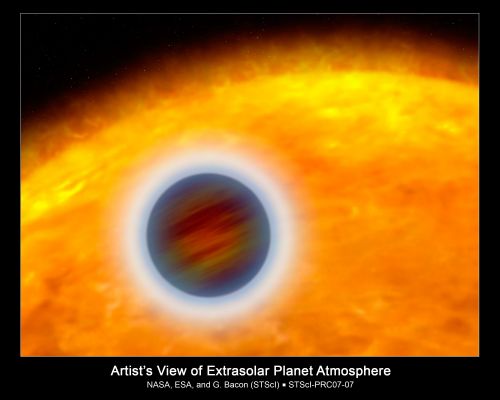
Extra-Solar Planet HD-209458b (1)
The powerful vision of NASA's HST has allowed astronomers to study for the first time the layer-cake structure of the atmosphere of a planet orbiting another star. HST discovered a dense upper layer of hot Hydrogen gas where the super-hot planet's atmosphere is bleeding off into space. 
The planet, designated HD 209458b, is unlike any world in our Solar System. It orbits so close to its star and gets so hot that its gas is streaming into space, making the planet appear to have a comet-like tail. This new research reveals the layer in the planet's upper atmosphere where the gas becomes so heated it escapes, like steam rising from a boiler.

"The layer we studied is actually a transition zone where the temperature skyrockets from about 1340 deg. Fahrenheit (1000 Kelvin) to about 25.540 degrees (15.000 Kelvin), which is hotter than the Sun " said Gilda Ballester of the University of Arizona in Tucson, leader of the research team. 
"With this detection we see the details of how a planet loses its atmosphere." 

The findings by Ballester, David K. Sing of the University of Arizona and the Institut d'Astrophysique de Paris, and Floyd Herbert of the University of Arizona will appear Feb. 1 in a letter to the journal Nature.

The Hubble data show how intense ultraviolet radiation from the host star heats the gas in the upper atmosphere, inflating the atmosphere like a balloon. The gas is so hot that it moves very fast and escapes the planet's gravitational pull at a rate of 10,000 tons a second, more than three times the rate of water flowing over Niagara Falls. The planet, however, will not wither away any time soon. Astronomers estimate its lifetime is more than 5 billion years. 

The scorched planet is a big puffy version of Jupiter. In fact, it is called a "hot Jupiter," a large gaseous planet orbiting very close to its parent star. Jupiter might even look like HD 209458b if it were close to the Sun, Ballester said. 

The planet completes an orbit around its star every 3.5 days. It orbits 4.7 million miles from its host, 20 times closer than the Earth is to the Sun. By comparison, Mercury, the closest planet to our Sun, is 10 times farther away from the Sun than HD 209458b is from its star. Unlike HD 209458b, Mercury is a small ball of iron with a rocky crust.

Parole chiave: Artistic Interpretations of the Universe

Extra-Solar Planet HD-209458b (1)

The powerful vision of NASA's HST has allowed astronomers to study for the first time the layer-cake structure of the atmosphere of a planet orbiting another star. HST discovered a dense upper layer of hot Hydrogen gas where the super-hot planet's atmosphere is bleeding off into space.
The planet, designated HD 209458b, is unlike any world in our Solar System. It orbits so close to its star and gets so hot that its gas is streaming into space, making the planet appear to have a comet-like tail. This new research reveals the layer in the planet's upper atmosphere where the gas becomes so heated it escapes, like steam rising from a boiler.

"The layer we studied is actually a transition zone where the temperature skyrockets from about 1340 deg. Fahrenheit (1000 Kelvin) to about 25.540 degrees (15.000 Kelvin), which is hotter than the Sun " said Gilda Ballester of the University of Arizona in Tucson, leader of the research team.
"With this detection we see the details of how a planet loses its atmosphere."

The findings by Ballester, David K. Sing of the University of Arizona and the Institut d'Astrophysique de Paris, and Floyd Herbert of the University of Arizona will appear Feb. 1 in a letter to the journal Nature.

The Hubble data show how intense ultraviolet radiation from the host star heats the gas in the upper atmosphere, inflating the atmosphere like a balloon. The gas is so hot that it moves very fast and escapes the planet's gravitational pull at a rate of 10,000 tons a second, more than three times the rate of water flowing over Niagara Falls. The planet, however, will not wither away any time soon. Astronomers estimate its lifetime is more than 5 billion years.

The scorched planet is a big puffy version of Jupiter. In fact, it is called a "hot Jupiter," a large gaseous planet orbiting very close to its parent star. Jupiter might even look like HD 209458b if it were close to the Sun, Ballester said.

The planet completes an orbit around its star every 3.5 days. It orbits 4.7 million miles from its host, 20 times closer than the Earth is to the Sun. By comparison, Mercury, the closest planet to our Sun, is 10 times farther away from the Sun than HD 209458b is from its star. Unlike HD 209458b, Mercury is a small ball of iron with a rocky crust.

M 42-PIA08655-ed.jpg NGC-2535-PIA09106.jpg HD-209458b-01.jpg HD189733b-PIA09200.jpg Spectrum-PIA09197.jpg
Informazioni sul file
Nome del file:HD-209458b-00.jpg
Nome album:The Universe in Super Definition
Valutazione (9 voti):55555(Mostra dettagli)
Parole chiave:Artistic / Interpretations / of / the / Universe
Copyright:NASA, ESA and G. Bacon (STScI)
Dimensione del file:342 KiB
Data di inserimento:Feb 04, 2007
Dimensioni:3000 x 2400 pixels
Visualizzato:56 volte
URL:https://www.lunexit.it/gallery/displayimage.php?pid=15779
Preferiti:Aggiungi ai preferiti


Powered by Coppermine Photo Gallery