Inizio Registrati Login

Elenco album Ultimi arrivi Ultimi commenti Più viste Più votate Preferiti Cerca

Inizio > THE LUNAR EXPLORER ARCHIVES > The Universe in Super Definition
Ritorna alla pagina delle miniature FILE 48/157 Torna all'inizio Guarda foto precedente Guarda foto successiva Salta alla fine
M 16 - The "Eagle Nebula"
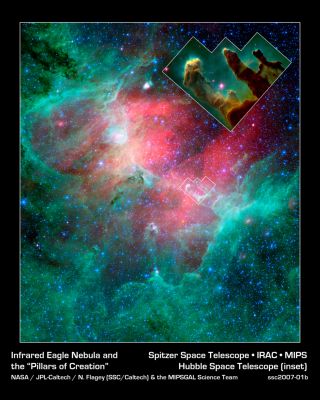
This majestic view taken by NASA's Spitzer Space Telescope tells an untold story of life and death in the Eagle Nebula, an industrious star-making factory located 7000 L.Y. away in the Serpens constellation. The image shows the region's entire network of turbulent clouds and newborn stars in infrared light. 
The color green denotes cooler towers and fields of dust, including the three famous space pillars, dubbed the "Pillars of Creation," which were photographed by NASA's Hubble Space Telescope in 1995 (see inset). 
But it is the color red that speaks of the drama taking place in this region. Red represents hotter dust thought to have been warmed by the explosion of a massive star about 8,000 to 9,000 years ago. Since light from the Eagle nebula takes 7000 years to reach us, this "supernova" explosion would have appeared as an oddly bright star in our skies about 1000 to 2000 years ago. 
According to astronomers' estimations, the explosion's blast wave would have spread outward and toppled the three pillars about 6,000 years ago (which means we wouldn't witness the destruction for another 1,000 years or so). The blast wave would have crumbled the mighty towers, exposing newborn stars that were buried inside, and triggering the birth of new ones. 

The pillars of the Eagle nebula were originally sculpted by radiation and wind from about 20 or so massive stars hidden from view in the upper left portion of the image. The radiation and wind blew dust away, carving out a hollow cavity (center) and leaving only the densest nuggets of dust and gas (tops of pillars) flanked by columns of lighter dust that lie in shadow (base of pillars). This sculpting process led to the creation of a second generation of stars inside the pillars. 

If a star did blow up in this region, it is probably located among the other massive stars in the upper left portion of the image. Its blast wave might have already caused a third generation of stars to spring from the wreckage of the busted pillars. 

This image is a composite of infrared light detected by Spitzer's infrared array camera and multiband imaging photometer. Blue is 4.5-micron light; green is 8-micron light; and red is 24-micron light.

Parole chiave: From Space Images - Spitzer Space Telescope (SST)

M 16 - The "Eagle Nebula"

This majestic view taken by NASA's Spitzer Space Telescope tells an untold story of life and death in the Eagle Nebula, an industrious star-making factory located 7000 L.Y. away in the Serpens constellation. The image shows the region's entire network of turbulent clouds and newborn stars in infrared light.
The color green denotes cooler towers and fields of dust, including the three famous space pillars, dubbed the "Pillars of Creation," which were photographed by NASA's Hubble Space Telescope in 1995 (see inset).
But it is the color red that speaks of the drama taking place in this region. Red represents hotter dust thought to have been warmed by the explosion of a massive star about 8,000 to 9,000 years ago. Since light from the Eagle nebula takes 7000 years to reach us, this "supernova" explosion would have appeared as an oddly bright star in our skies about 1000 to 2000 years ago.
According to astronomers' estimations, the explosion's blast wave would have spread outward and toppled the three pillars about 6,000 years ago (which means we wouldn't witness the destruction for another 1,000 years or so). The blast wave would have crumbled the mighty towers, exposing newborn stars that were buried inside, and triggering the birth of new ones.

The pillars of the Eagle nebula were originally sculpted by radiation and wind from about 20 or so massive stars hidden from view in the upper left portion of the image. The radiation and wind blew dust away, carving out a hollow cavity (center) and leaving only the densest nuggets of dust and gas (tops of pillars) flanked by columns of lighter dust that lie in shadow (base of pillars). This sculpting process led to the creation of a second generation of stars inside the pillars.

If a star did blow up in this region, it is probably located among the other massive stars in the upper left portion of the image. Its blast wave might have already caused a third generation of stars to spring from the wreckage of the busted pillars.

This image is a composite of infrared light detected by Spitzer's infrared array camera and multiband imaging photometer. Blue is 4.5-micron light; green is 8-micron light; and red is 24-micron light.

NGC-0404-PIA11393-1.jpg EpsilonEridani-PIA11375.jpg HR8799b.jpg LonelyPlanet-PIA09118.jpg AlienWorld-PIA09228.jpg
Informazioni sul file
Nome del file:M-016-PIA09107.jpg
Nome album:The Universe in Super Definition
Valutazione (9 voti):55555(Mostra dettagli)
Parole chiave:From / Space / Images / - / Spitzer / Space / Telescope / (SST)
Copyright:NASA/JPL-Caltech/STScI/ Institut d'Astrophysique Spatiale
Dimensione del file:975 KiB
Data di inserimento:Gen 10, 2007
Dimensioni:2400 x 3000 pixels
Visualizzato:59 volte
URL:https://www.lunexit.it/gallery/displayimage.php?pid=15531
Preferiti:Aggiungi ai preferiti


Powered by Coppermine Photo Gallery