Inizio Registrati Login

Elenco album Ultimi arrivi Ultimi commenti Più viste Più votate Preferiti Cerca

Inizio > THE LUNAR EXPLORER ARCHIVES > The Universe in Super Definition
Ritorna alla pagina delle miniature FILE 62/157 Torna all'inizio Guarda foto precedente Guarda foto successiva Salta alla fine
Infrared Orion
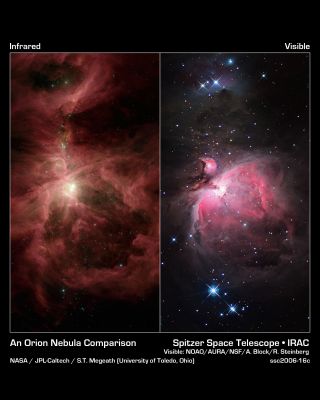
This image composite compares infrared and visible views of the famous Orion nebula and its surrounding cloud, an industrious star-making region located near the hunter constellation's sword. The infrared picture is from NASA's Spitzer Space Telescope, and the visible image is from the National Optical Astronomy Observatory, headquartered in Tucson, Ariz. 

In addition to Orion, two other nebulas can be seen in both pictures. The Orion nebula, or M42, is the largest and takes up the lower half of the images; the small nebula to the upper left of Orion is called M43; and the medium-sized nebula at the top is NGC 1977. Each nebula is marked by a ring of dust that stands out in the infrared view. These rings make up the walls of cavities that are being excavated by radiation and winds from massive stars. The visible view of the nebulas shows gas heated by ultraviolet radiation from the massive stars. 

Above the Orion nebula, where the massive stars have not yet ejected much of the obscuring dust, the visible image appears dark with only a faint glow. In contrast, the infrared view penetrates the dark lanes of dust, revealing bright swirling clouds and numerous developing stars that have shot out jets of gas (green). This is because infrared light can travel through dust, whereas visible light is stopped short by it. 

The infrared image shows light captured by Spitzer's infrared array camera. Light with wavelengths of 8 and 5.8 microns (red and orange) comes mainly from dust that has been heated by starlight. Light of 4.5 microns (green) shows hot gas and dust; and light of 3.6 microns (blue) is from starlight. 


Parole chiave: From Space Images - Spitzer Space Telescopes

Infrared Orion

This image composite compares infrared and visible views of the famous Orion nebula and its surrounding cloud, an industrious star-making region located near the hunter constellation's sword. The infrared picture is from NASA's Spitzer Space Telescope, and the visible image is from the National Optical Astronomy Observatory, headquartered in Tucson, Ariz.

In addition to Orion, two other nebulas can be seen in both pictures. The Orion nebula, or M42, is the largest and takes up the lower half of the images; the small nebula to the upper left of Orion is called M43; and the medium-sized nebula at the top is NGC 1977. Each nebula is marked by a ring of dust that stands out in the infrared view. These rings make up the walls of cavities that are being excavated by radiation and winds from massive stars. The visible view of the nebulas shows gas heated by ultraviolet radiation from the massive stars.

Above the Orion nebula, where the massive stars have not yet ejected much of the obscuring dust, the visible image appears dark with only a faint glow. In contrast, the infrared view penetrates the dark lanes of dust, revealing bright swirling clouds and numerous developing stars that have shot out jets of gas (green). This is because infrared light can travel through dust, whereas visible light is stopped short by it.

The infrared image shows light captured by Spitzer's infrared array camera. Light with wavelengths of 8 and 5.8 microns (red and orange) comes mainly from dust that has been heated by starlight. Light of 4.5 microns (green) shows hot gas and dust; and light of 3.6 microns (blue) is from starlight.

ARP194-HST-2009-18-a-full_jpg.jpg DR22.jpg Life-PIA03538.jpg Upsilon Andromedae-PIA01937.jpg M-016-PIA09109.jpg
Informazioni sul file
Nome del file:M 42-PIA08654-ed.jpg
Nome album:The Universe in Super Definition
Valutazione (4 voti):55555(Mostra dettagli)
Parole chiave:From / Space / Images / - / Spitzer / Space / Telescopes
Copyright:NASA/JPL-Caltech/Univ. of Toledo/NOAO
Dimensione del file:583 KiB
Data di inserimento:Ago 17, 2006
Dimensioni:2400 x 3000 pixels
Visualizzato:57 volte
URL:https://www.lunexit.it/gallery/displayimage.php?pid=14502
Preferiti:Aggiungi ai preferiti


Powered by Coppermine Photo Gallery