Inizio Registrati Login

Elenco album Ultimi arrivi Ultimi commenti Più viste Più votate Preferiti Cerca

Inizio > THE LUNAR EXPLORER ARCHIVES > The Universe in Super Definition
Ritorna alla pagina delle miniature FILE 31/157 Torna all'inizio Guarda foto precedente Guarda foto successiva Salta alla fine
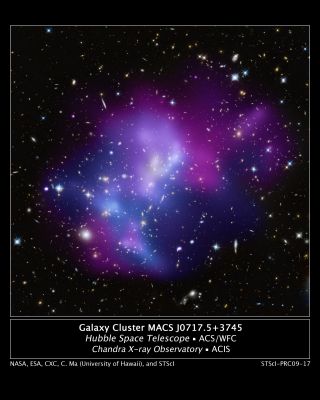
MACS J0717.5+3745 (Galaxy Cluster)
This composite image shows the massive Galaxy Cluster MACS J0717.5+3745 (MACS J0717, for short), where four separate Galaxy Clusters have been involved in a collision — the first time such a phenomenon has been documented. Hot gas is shown in an image from NASA's Chandra X-ray Observatory, and galaxies are shown in an optical image from NASA's Hubble Space Telescope. 
The hot gas is color-coded to show temperature, where the coolest gas is reddish purple, the hottest gas is blue, and the temperatures in between are purple.

The repeated collisions in MACS J0717 are caused by a 13 MLY-long stream of galaxies, gas, and dark matter — known as a "Filament" — pouring into a region already full of matter. A collision between the gas in two or more clusters causes the hot gas to flow down. However, the massive and compact galaxies do not slow down as much as the gas does, and so move ahead of it. Therefore, the speed and direction of each cluster's motion — perpendicular to the line of sight — can be estimated by studying the offset between the average position of the galaxies and the peak in the hot gas.

MACS J0717 is located about 5,4 BLY from Earth. It is one of the most complex Galaxy Clusters ever seen. Other well-known Clusters, like the Bullet Cluster and MACS J0025.4-1222, involve the collision of only two galaxy clusters and show much simpler geometry.
Parole chiave: From Space Images - Hubble and Chandra X-Ray

MACS J0717.5+3745 (Galaxy Cluster)

This composite image shows the massive Galaxy Cluster MACS J0717.5+3745 (MACS J0717, for short), where four separate Galaxy Clusters have been involved in a collision — the first time such a phenomenon has been documented. Hot gas is shown in an image from NASA's Chandra X-ray Observatory, and galaxies are shown in an optical image from NASA's Hubble Space Telescope.
The hot gas is color-coded to show temperature, where the coolest gas is reddish purple, the hottest gas is blue, and the temperatures in between are purple.

The repeated collisions in MACS J0717 are caused by a 13 MLY-long stream of galaxies, gas, and dark matter — known as a "Filament" — pouring into a region already full of matter. A collision between the gas in two or more clusters causes the hot gas to flow down. However, the massive and compact galaxies do not slow down as much as the gas does, and so move ahead of it. Therefore, the speed and direction of each cluster's motion — perpendicular to the line of sight — can be estimated by studying the offset between the average position of the galaxies and the peak in the hot gas.

MACS J0717 is located about 5,4 BLY from Earth. It is one of the most complex Galaxy Clusters ever seen. Other well-known Clusters, like the Bullet Cluster and MACS J0025.4-1222, involve the collision of only two galaxy clusters and show much simpler geometry.

Sharpless308-Goldman.jpg ARP194-HST-2009-18-a-full_jpg.jpg MACS-J0717_5+3745-hs-2009-17-a-print.jpg M-087-HST-2009-03-a-print.jpg HR8799b.jpg
Informazioni sul file
Nome del file:MACS-J0717_5+3745-hs-2009-17-a-print.jpg
Nome album:MareKromium / The Universe in Super Definition
Valutazione (5 voti):55555(Mostra dettagli)
Parole chiave:From / Space / Images / - / Hubble / and / Chandra / X-Ray
Copyright:NASA, ESA, CXC, C. Ma, H. Ebeling, and E. Barrett (University of Hawaii/IfA), et al., and STScI
Dimensione del file:806 KiB
Data di inserimento:Apr 22, 2009
Dimensioni:2400 x 3000 pixels
Visualizzato:57 volte
URL:https://www.lunexit.it/gallery/displayimage.php?pid=24273
Preferiti:Aggiungi ai preferiti


Powered by Coppermine Photo Gallery