Inizio Registrati Login

Elenco album Ultimi arrivi Ultimi commenti Più viste Più votate Preferiti Cerca

Inizio > THE LUNAR EXPLORER ARCHIVES > The Universe in Super Definition
Ritorna alla pagina delle miniature FILE 48/157 Torna all'inizio Guarda foto precedente Guarda foto successiva Salta alla fine
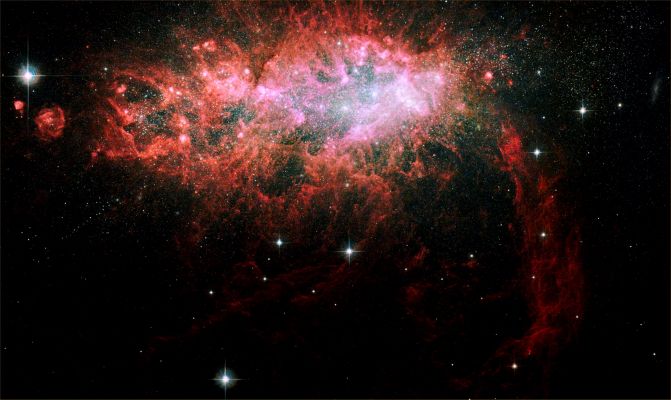
Starburst Galaxy NGC 1569
This image taken by NASA's Hubble Space Telescope showcases the brilliant core of one of the most active galaxies in our local neighborhood. The entire core is 5,000 light-years wide.

The galaxy, called NGC 1569, sparkles with the light from millions of newly formed young stars. NGC 1569 is pumping out stars at a rate that is 100 times faster than the rate observed in our Milky Way Galaxy. This frenzied pace has been almost continuous for the past 100 million years.

The core's centerpiece is a grouping of three giant star clusters, each containing more than a million stars. (Two of the clusters are so close they appear as one grouping.) The clusters reside in a large, central cavity. The gas in the cavity has been blown out by the multitude of massive, young stars that already exploded as supernovae. These explosions also triggered a violent flow of gas and particles that is sculpting giant gaseous structures. The sculpted structure at lower right is about 3,700 light-years long.

Huge bubbles of gas, such as the two at left, appear like floating islands. The largest bubble is about 378 light-years wide and the smallest 119 light-years wide. They are being illuminated by the radiation from the bright, young stars within them. Some of those stars are peaking through their gaseous cocoons.

The biggest and brightest objects surrounding the core are stars scattered throughout our Milky Way Galaxy. In contrast, the thousands of tiny white dots in the image are stars in the halo of NGC 1569. The galaxy is 11 million light-years from Earth.

A new analysis of NGC 1569 shows that it is one and a half times farther from Earth than astronomers previously thought. The extra distance places the galaxy in the middle of a group of about 10 galaxies centered on the spiral galaxy IC 342. Gravitational interactions among the group's galaxies may be compressing gas in NGC 1569 and igniting the star-birthing frenzy.


Parole chiave: From Space Images - Hubble Space Telescope (HST) Images

Starburst Galaxy NGC 1569

This image taken by NASA's Hubble Space Telescope showcases the brilliant core of one of the most active galaxies in our local neighborhood. The entire core is 5,000 light-years wide.

The galaxy, called NGC 1569, sparkles with the light from millions of newly formed young stars. NGC 1569 is pumping out stars at a rate that is 100 times faster than the rate observed in our Milky Way Galaxy. This frenzied pace has been almost continuous for the past 100 million years.

The core's centerpiece is a grouping of three giant star clusters, each containing more than a million stars. (Two of the clusters are so close they appear as one grouping.) The clusters reside in a large, central cavity. The gas in the cavity has been blown out by the multitude of massive, young stars that already exploded as supernovae. These explosions also triggered a violent flow of gas and particles that is sculpting giant gaseous structures. The sculpted structure at lower right is about 3,700 light-years long.

Huge bubbles of gas, such as the two at left, appear like floating islands. The largest bubble is about 378 light-years wide and the smallest 119 light-years wide. They are being illuminated by the radiation from the bright, young stars within them. Some of those stars are peaking through their gaseous cocoons.

The biggest and brightest objects surrounding the core are stars scattered throughout our Milky Way Galaxy. In contrast, the thousands of tiny white dots in the image are stars in the halo of NGC 1569. The galaxy is 11 million light-years from Earth.

A new analysis of NGC 1569 shows that it is one and a half times farther from Earth than astronomers previously thought. The extra distance places the galaxy in the middle of a group of about 10 galaxies centered on the spiral galaxy IC 342. Gravitational interactions among the group's galaxies may be compressing gas in NGC 1569 and igniting the star-birthing frenzy.

Epsilon_Eridani-PIA11376.JPG PIA11417.jpg NGC-1569.jpg ARP-147.jpg EpsilonEridani-PIA11375.jpg
Informazioni sul file
Nome del file:NGC-1569.jpg
Nome album:MareKromium / The Universe in Super Definition
Valutazione (7 voti):55555(Mostra dettagli)
Parole chiave:From / Space / Images / - / Hubble / Space / Telescope / (HST) / Images
Copyright:NASA, ESA, the Hubble Heritage Team (STScI/AURA), and A. Aloisi (STScI/ESA)
Dimensione del file:681 KiB
Data di inserimento:Nov 21, 2008
Dimensioni:2824 x 1681 pixels
Visualizzato:54 volte
URL:https://www.lunexit.it/gallery/displayimage.php?pid=22610
Preferiti:Aggiungi ai preferiti


Powered by Coppermine Photo Gallery