Inizio Registrati Login

Elenco album Ultimi arrivi Ultimi commenti Più viste Più votate Preferiti Cerca

Inizio > THE LUNAR EXPLORER ARCHIVES > The Universe in Super Definition
Ritorna alla pagina delle miniature FILE 50/157 Torna all'inizio Guarda foto precedente Guarda foto successiva Salta alla fine
Epsilon Eridani
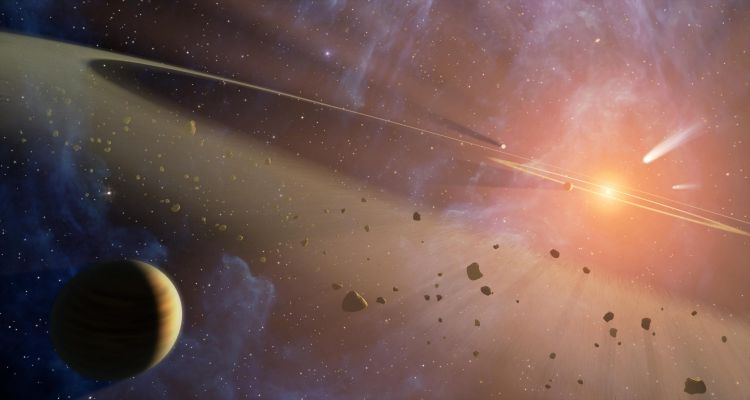
This artist's conception shows the closest known Planetary System to our own, called Epsilon Eridani. Observations from NASA's Spitzer Space Telescope show that the system hosts two Asteroid Belts, in addition to previously identified candidate planets and an outer Comet Ring. 

Epsilon Eridani is located about 10 LY away in the constellation Eridanus. It is visible in the night skies with the naked eye. 

The System's Inner Asteroid Belt appears as the yellowish ring around the star, while the Outer Asteroid Belt is in the foreground. The outermost Comet Ring is too far out to be seen in this view, but comets originating from it are shown in the upper right corner. 

Astronomers think that each of Epsilon Eridani's Asteroid Belts could have a planet orbiting just outside it, shepherding its rocky debris into a ring in the same way that Jupiter helps keep our asteroid belt confined. 
The planet near the inner belt was previously identified in 2000 via the radial velocity, or "star wobble", technique, while the planet near the outer belt was inferred when Spitzer discovered the belt. 

The inner belt orbits at a distance of about 3 AU from its star — or about the same position as the Asteroid Belt in our own Solar System (an astronomical unit is the distance between Earth and the Sun). The second Asteroid Belt lies at about 20 AU from the star, or a position comparable to Uranus in our Solar System. 
The outer Comet Ring orbits from 35 to 90 AU from the star; our Solar System's analogous Kuiper Belt extends from about 30 to 50 AU from the sun.
Parole chiave: Artistic Interpretations of the Universe

Epsilon Eridani

This artist's conception shows the closest known Planetary System to our own, called Epsilon Eridani. Observations from NASA's Spitzer Space Telescope show that the system hosts two Asteroid Belts, in addition to previously identified candidate planets and an outer Comet Ring.

Epsilon Eridani is located about 10 LY away in the constellation Eridanus. It is visible in the night skies with the naked eye.

The System's Inner Asteroid Belt appears as the yellowish ring around the star, while the Outer Asteroid Belt is in the foreground. The outermost Comet Ring is too far out to be seen in this view, but comets originating from it are shown in the upper right corner.

Astronomers think that each of Epsilon Eridani's Asteroid Belts could have a planet orbiting just outside it, shepherding its rocky debris into a ring in the same way that Jupiter helps keep our asteroid belt confined.
The planet near the inner belt was previously identified in 2000 via the radial velocity, or "star wobble", technique, while the planet near the outer belt was inferred when Spitzer discovered the belt.

The inner belt orbits at a distance of about 3 AU from its star — or about the same position as the Asteroid Belt in our own Solar System (an astronomical unit is the distance between Earth and the Sun). The second Asteroid Belt lies at about 20 AU from the star, or a position comparable to Uranus in our Solar System.
The outer Comet Ring orbits from 35 to 90 AU from the star; our Solar System's analogous Kuiper Belt extends from about 30 to 50 AU from the sun.

NGC-1569.jpg ARP-147.jpg EpsilonEridani-PIA11375.jpg NGC-0404-PIA11393-1.jpg NGC-0346-PIA11227.jpg
Informazioni sul file
Nome del file:EpsilonEridani-PIA11375.jpg
Nome album:MareKromium / The Universe in Super Definition
Valutazione (8 voti):55555(Mostra dettagli)
Parole chiave:Artistic / Interpretations / of / the / Universe
Copyright:NASA/JPL-Caltech
Dimensione del file:243 KiB
Data di inserimento:Nov 04, 2008
Dimensioni:3000 x 1600 pixels
Visualizzato:58 volte
URL:https://www.lunexit.it/gallery/displayimage.php?pid=22418
Preferiti:Aggiungi ai preferiti

Commento 1 a 4 di 4
Pagina: 1

Anakin   [Mar 20, 2020 at 01:58 PM]
Se non lo avete fatto, vi invito a guardare questo video

https: // www. youtube.com /watch? time_ continue= 46&v= 0SQFhJ7umFo&feature= emb_logo
walthari   [Mar 24, 2020 at 05:47 PM]
ma che è??? Un'astronave madre?????
Anakin   [Mar 26, 2020 at 07:12 AM]
non si sa, eppure in quel punto c'è qualcosa che avanza. Vorrei sentire il parere di Paolo
MareKromium   [Mar 26, 2020 at 05:49 PM]
L'"Oggetto" è estremamente veloce e NON ruota su se stesso (si nota tenendo a vista tre punti fissi).
Dimensioni indefinibili, ma sagoma apparentemente irregolare. Non credo sia un NEAR (Near Earth Asteroid). Ovviamente non posso dire cosa sia, ma ho trovato il filmato originale. Questo NON é un falso. E' un OVNI, per definizione.
Mia congettura: era relativamente "vicino" alla Sonda (ed infatti ha interferito con il suo segnale). Se non lo fosse stato, allora avrebbe avuto dimensioni equiparabili (o superiori) a quelle di Mercurio, e lo avremmo visto anche da Terra, subendone le conseguenze gravitazionali.

Ma, lo so, la risposta non ci é data. Ottimo Lavoro! paolo

Commento 1 a 4 di 4
Pagina: 1


Powered by Coppermine Photo Gallery