Inizio Registrati Login

Elenco album Ultimi arrivi Ultimi commenti Più viste Più votate Preferiti Cerca

Inizio > THE LUNAR EXPLORER ARCHIVES > The Universe in Super Definition
Ritorna alla pagina delle miniature FILE 59/157 Torna all'inizio Guarda foto precedente Guarda foto successiva Salta alla fine
Baby Boom!
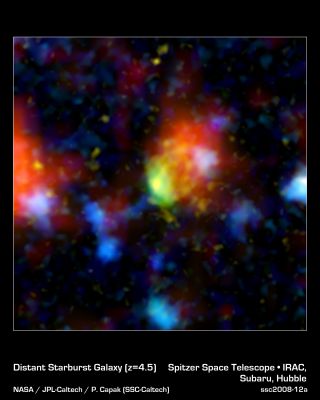
The green and red splotch in this image is the most active star-making galaxy in the very distant universe. Nicknamed "Baby Boom", the galaxy is churning out an average of up to 4000 stars per year, more than 100 times the number produced in our own Milky Way galaxy. It was spotted 12,3 Billion Light-Years away by a suite of telescopes, including NASA's Spitzer Space Telescope. 

Baby Boom is a type of galaxy called a "Starburst". 
Like some other Starbursts, it is thought to be a collection of colliding galaxies. As the galaxies smash together, gas becomes compressed, triggering the birth of stars. In this multi-wavelength portrait, the color red shows where loads of new stars are forming in Baby Boom, and where warm dust heated by the stars is giving off infrared light. 

Green (visible-light wavelengths) denotes gas in the Baby Boom galaxy, while blue (also visible light) shows galaxies in the foreground that are not producing nearly as many stars. Yellow/orange (near-infrared light) indicates starlight from the outer portion of Baby Boom. The red blob to the left is another foreground galaxy that is not producing a lot of stars. 

This composite contains data from NASA's Hubble Space Telescope, Spitzer and Japan's Subaru Telescope in Hawaii.
Parole chiave: From Space and from Earth Images - Hubble, SST and Subaru (mix)

Baby Boom!

The green and red splotch in this image is the most active star-making galaxy in the very distant universe. Nicknamed "Baby Boom", the galaxy is churning out an average of up to 4000 stars per year, more than 100 times the number produced in our own Milky Way galaxy. It was spotted 12,3 Billion Light-Years away by a suite of telescopes, including NASA's Spitzer Space Telescope.

Baby Boom is a type of galaxy called a "Starburst".
Like some other Starbursts, it is thought to be a collection of colliding galaxies. As the galaxies smash together, gas becomes compressed, triggering the birth of stars. In this multi-wavelength portrait, the color red shows where loads of new stars are forming in Baby Boom, and where warm dust heated by the stars is giving off infrared light.

Green (visible-light wavelengths) denotes gas in the Baby Boom galaxy, while blue (also visible light) shows galaxies in the foreground that are not producing nearly as many stars. Yellow/orange (near-infrared light) indicates starlight from the outer portion of Baby Boom. The red blob to the left is another foreground galaxy that is not producing a lot of stars.

This composite contains data from NASA's Hubble Space Telescope, Spitzer and Japan's Subaru Telescope in Hawaii.

W5-PIA11047.jpg M-101-PIA10968.jpg PIA10932.jpg PIA10955.jpg SN-1006-PIA10926.jpg
Informazioni sul file
Nome del file:PIA10932.jpg
Nome album:MareKromium / The Universe in Super Definition
Valutazione (5 voti):55555(Mostra dettagli)
Parole chiave:From / Space / and / from / Earth / Images / - / Hubble, / SST / and / Subaru / (mix)
Copyright:NASA/JPL-Caltech/Subaru/STScI
Dimensione del file:331 KiB
Data di inserimento:Lug 19, 2008
Dimensioni:2400 x 3000 pixels
Visualizzato:56 volte
URL:https://www.lunexit.it/gallery/displayimage.php?pid=21168
Preferiti:Aggiungi ai preferiti


Powered by Coppermine Photo Gallery