Inizio Registrati Login

Elenco album Ultimi arrivi Ultimi commenti Più viste Più votate Preferiti Cerca

Inizio > THE LUNAR EXPLORER ARCHIVES > The Universe in Super Definition
Ritorna alla pagina delle miniature FILE 60/157 Torna all'inizio Guarda foto precedente Guarda foto successiva Salta alla fine
The brightest Stars of the (known) Universe
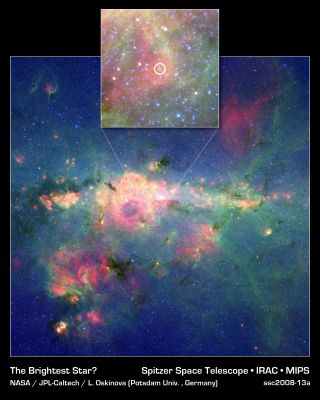
If our galaxy, the Milky Way, were to host its own version of the Olympics, the title for the brightest known star would go to a massive star called Eta Carinae. However, a new runner-up — now the second-brightest star in our galaxy — has been discovered in the galaxy's dusty and frenzied interior. This image from NASA's Spitzer Space Telescope shows the new silver medalist, circled in the inset above, in the central region of our Milky Way. 

Dubbed the 'Peony Nebula' star, this blazing ball of gas shines with the equivalent light of 3,2 million Suns. The reigning champ, Eta Carinae, produces the equivalent of 4,7 million Suns worth of light — though astronomers say these estimates are uncertain, and it's possible that the Peony Nebula star could be even brighter than Eta Carinae. 

If the Peony Star is so bright, why doesn't it stand out more in this view? The answer is dust. This star is located in a very dusty region jam packed with stars. In fact, there could be other super bright stars still hidden deep in the stellar crowd. Spitzer's infrared eyes allowed it to pierce the dust and assess the Peony Nebula star's true brightness. 
Likewise, infrared data from the European Southern Observatory's New Technology Telescope in Chile were integral in calculating the Peony Nebula star's luminosity. 

The Peony Nebula, which surrounds the Peony nebular star, is the reddish cloud of dust in and around the white circle. 

This is a three-color composite showing infrared observations from two Spitzer instruments. Blue represents 3.6-micron light and green shows light of 8 microns, both captured by Spitzer's infrared array camera. Red is 24-micron light detected by Spitzer's multiband imaging photometer.
Parole chiave: From Space Images - Spitzer Space Telescope Images

The brightest Stars of the (known) Universe

If our galaxy, the Milky Way, were to host its own version of the Olympics, the title for the brightest known star would go to a massive star called Eta Carinae. However, a new runner-up — now the second-brightest star in our galaxy — has been discovered in the galaxy's dusty and frenzied interior. This image from NASA's Spitzer Space Telescope shows the new silver medalist, circled in the inset above, in the central region of our Milky Way.

Dubbed the 'Peony Nebula' star, this blazing ball of gas shines with the equivalent light of 3,2 million Suns. The reigning champ, Eta Carinae, produces the equivalent of 4,7 million Suns worth of light — though astronomers say these estimates are uncertain, and it's possible that the Peony Nebula star could be even brighter than Eta Carinae.

If the Peony Star is so bright, why doesn't it stand out more in this view? The answer is dust. This star is located in a very dusty region jam packed with stars. In fact, there could be other super bright stars still hidden deep in the stellar crowd. Spitzer's infrared eyes allowed it to pierce the dust and assess the Peony Nebula star's true brightness.
Likewise, infrared data from the European Southern Observatory's New Technology Telescope in Chile were integral in calculating the Peony Nebula star's luminosity.

The Peony Nebula, which surrounds the Peony nebular star, is the reddish cloud of dust in and around the white circle.

This is a three-color composite showing infrared observations from two Spitzer instruments. Blue represents 3.6-micron light and green shows light of 8 microns, both captured by Spitzer's infrared array camera. Red is 24-micron light detected by Spitzer's multiband imaging photometer.

M-101-PIA10968.jpg PIA10932.jpg PIA10955.jpg SN-1006-PIA10926.jpg The_Missing_Matter.jpg
Informazioni sul file
Nome del file:PIA10955.jpg
Nome album:MareKromium / The Universe in Super Definition
Valutazione (2 voti):55555(Mostra dettagli)
Parole chiave:From / Space / Images / - / Spitzer / Space / Telescope / Images
Copyright:NASA/JPL-Caltech/Potsdam Univ.
Dimensione del file:1341 KiB
Data di inserimento:Lug 19, 2008
Dimensioni:2400 x 3000 pixels
Visualizzato:55 volte
URL:https://www.lunexit.it/gallery/displayimage.php?pid=21167
Preferiti:Aggiungi ai preferiti


Powered by Coppermine Photo Gallery