Inizio Registrati Login

Elenco album Ultimi arrivi Ultimi commenti Più viste Più votate Preferiti Cerca

Inizio > THE LUNAR EXPLORER ARCHIVES > The Universe in Super Definition
Ritorna alla pagina delle miniature FILE 117/157 Torna all'inizio Guarda foto precedente Guarda foto successiva Salta alla fine
Extra-Solar Planet HD-209458b (2)
Although HD 209458b does not have a twin in our Solar System, it has plenty of relatives beyond our Solar System. About 10 to 15% of the more than 200 known extrasolar planets are hot Jupiters. A recent HST survey netted 16 hot Jupiter candidates in the central region of our Milky Way Galaxy, suggesting that there may be billions of these gas-giant star huggers in our galaxy. 

HD 209458b is one of the most intensely studied extrasolar planets because it is one of the few known alien worlds that can be seen passing in front of, or transiting, its star, causing the star to dim slightly. In fact, the gas giant is the first such alien world discovered to transit its star. 
HD 209458b is 150 LY from Earth, in the Constellation of Pegasus.

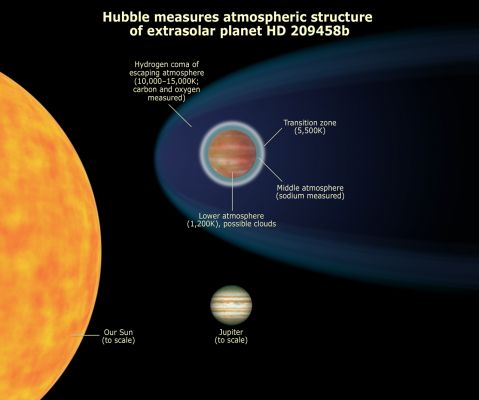
The planet's transits allow astronomers to analyze the structure and chemical makeup of the gas giant's atmosphere by sampling the starlight that passes through it. The effect is similar to finding fingerprints on a window by watching how sunlight filters through the glass.

Previous HST observatoins revealed Oxygen, Carbon and Sodium in the planet's atmosphere, as well as a huge Hydrogen upper atmosphere with a comet-like tail. These landmark studies provided the first detection of the chemical makeup of an extrasolar planet's atmosphere. 
Additional observations by NASA's SST captured the infrared glow from the planet's hot atmosphere. 

The new study by Ballester and her team is based on an analysis of archival observations made in 2003 with HST's Imaging Spectrograph by David Charbonneau of the Harvard-Smithsonian Center for Astrophysics in Cambridge, Mass. Ballester's team analyzed spectra from hot hydrogen atoms in the planet's upper atmosphere, a region not studied by Charbonneau's group.
Parole chiave: Artistic Interpretations of the Universe

Extra-Solar Planet HD-209458b (2)

Although HD 209458b does not have a twin in our Solar System, it has plenty of relatives beyond our Solar System. About 10 to 15% of the more than 200 known extrasolar planets are hot Jupiters. A recent HST survey netted 16 hot Jupiter candidates in the central region of our Milky Way Galaxy, suggesting that there may be billions of these gas-giant star huggers in our galaxy.

HD 209458b is one of the most intensely studied extrasolar planets because it is one of the few known alien worlds that can be seen passing in front of, or transiting, its star, causing the star to dim slightly. In fact, the gas giant is the first such alien world discovered to transit its star.
HD 209458b is 150 LY from Earth, in the Constellation of Pegasus.

The planet's transits allow astronomers to analyze the structure and chemical makeup of the gas giant's atmosphere by sampling the starlight that passes through it. The effect is similar to finding fingerprints on a window by watching how sunlight filters through the glass.

Previous HST observatoins revealed Oxygen, Carbon and Sodium in the planet's atmosphere, as well as a huge Hydrogen upper atmosphere with a comet-like tail. These landmark studies provided the first detection of the chemical makeup of an extrasolar planet's atmosphere.
Additional observations by NASA's SST captured the infrared glow from the planet's hot atmosphere.

The new study by Ballester and her team is based on an analysis of archival observations made in 2003 with HST's Imaging Spectrograph by David Charbonneau of the Harvard-Smithsonian Center for Astrophysics in Cambridge, Mass. Ballester's team analyzed spectra from hot hydrogen atoms in the planet's upper atmosphere, a region not studied by Charbonneau's group.

HD189733b-PIA09200.jpg HD-209458b-00.jpg HD-209458b-01.jpg NGC-2535-PIA09106.jpg NGC-1313.jpg
Informazioni sul file
Nome del file:HD-209458b-01.jpg
Nome album:The Universe in Super Definition
Valutazione (5 voti):55555(Mostra dettagli)
Parole chiave:Artistic / Interpretations / of / the / Universe
Copyright:NASA, ESA and G. Bacon (STScI)
Dimensione del file:419 KiB
Data di inserimento:Feb 04, 2007
Dimensioni:1280 x 1067 pixels
Visualizzato:56 volte
URL:https://www.lunexit.it/gallery/displayimage.php?pid=15778
Preferiti:Aggiungi ai preferiti


Powered by Coppermine Photo Gallery