Inizio Registrati Login

Elenco album Ultimi arrivi Ultimi commenti Più viste Più votate Preferiti Cerca

Inizio > THE LUNAR EXPLORER ARCHIVES > The Universe in Super Definition
Ritorna alla pagina delle miniature FILE 121/157 Torna all'inizio Guarda foto precedente Guarda foto successiva Salta alla fine
The many colors of the Eagle
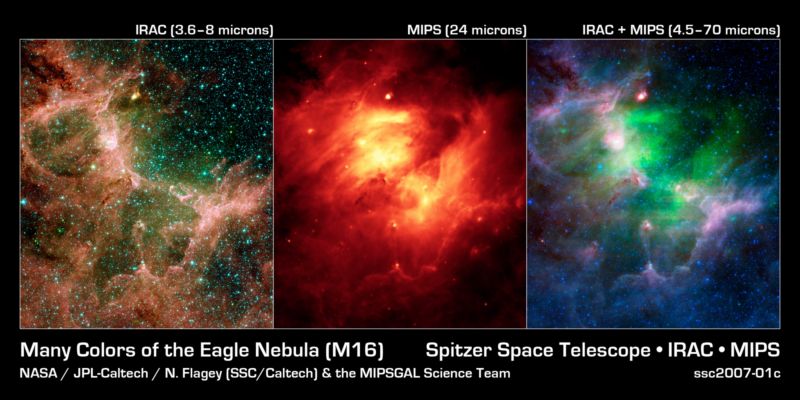
This set of images from NASA's Spitzer Space Telescope shows the Eagle Nebula in different hues of infrared light. Each view tells a different tale. The left picture shows lots of stars and dusty structures with clarity. Dusty molecules found on Earth called polycyclic aromatic hydrocarbons produce most of the red; gas is green and stars are blue. 
The middle view is packed with drama, because it tells astronomers that a star in this region violently erupted, or went supernova, heating surrounding dust (orange). This view also reveals that the hot dust is shell shaped, another indication that a star exploded. 
The final picture highlights the contrast between the hot, supernova-heated dust (green) and the cooler dust making up the region's dusty star-forming clouds and towers (red, blue and purple). 

The left image is a composite of infrared light with the following wavelengths: 3.6 microns (blue); 4.5 microns (green); 5.8 microns (orange); and 8 microns (red). The right image includes longer infrared wavelengths, and is a composite of light of 4.5 to 8.0 microns (blue); 24 microns (green); and 70 microns (red). The middle image is made up solely of 24-micron light. 
Parole chiave: From Space Images - Spitzer Space Telescope (SST)

The many colors of the Eagle

This set of images from NASA's Spitzer Space Telescope shows the Eagle Nebula in different hues of infrared light. Each view tells a different tale. The left picture shows lots of stars and dusty structures with clarity. Dusty molecules found on Earth called polycyclic aromatic hydrocarbons produce most of the red; gas is green and stars are blue.
The middle view is packed with drama, because it tells astronomers that a star in this region violently erupted, or went supernova, heating surrounding dust (orange). This view also reveals that the hot dust is shell shaped, another indication that a star exploded.
The final picture highlights the contrast between the hot, supernova-heated dust (green) and the cooler dust making up the region's dusty star-forming clouds and towers (red, blue and purple).

The left image is a composite of infrared light with the following wavelengths: 3.6 microns (blue); 4.5 microns (green); 5.8 microns (orange); and 8 microns (red). The right image includes longer infrared wavelengths, and is a composite of light of 4.5 to 8.0 microns (blue); 24 microns (green); and 70 microns (red). The middle image is made up solely of 24-micron light.

NGC-1313.jpg M-016-PIA09107.jpg M-016-PIA09108.jpg M-016-PIA09109.jpg Dark_Matter.jpg
Informazioni sul file
Nome del file:M-016-PIA09108.jpg
Nome album:The Universe in Super Definition
Valutazione (8 voti):55555(Mostra dettagli)
Parole chiave:From / Space / Images / - / Spitzer / Space / Telescope / (SST)
Copyright:NASA/JPL-Caltech/ Institut d'Astrophysique Spatiale
Dimensione del file:556 KiB
Data di inserimento:Gen 10, 2007
Dimensioni:3000 x 1500 pixels
Visualizzato:57 volte
URL:https://www.lunexit.it/gallery/displayimage.php?pid=15530
Preferiti:Aggiungi ai preferiti


Powered by Coppermine Photo Gallery