|
|
AS 16-107-17483 - Station 4 Crater (ejecta crater)
|
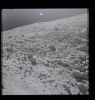
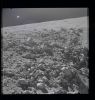
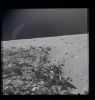
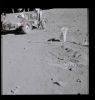
Station 4 crater. Note that there is very little debris on the Western (right) side of the Crater. As John Young recognized in the field, this crater was almost certainly formed by a large piece of highly-shocked ejecta from South Ray Crater which plowed into the side of Stone Mountain at relatively low velocity and came apart.
Hence, this is a Secondary Crater.
Notes (from "Glossary of Geology", 2nd Edition, American Geological Inst., Falls Church (VA) - 1980)
Ejecta — The material thrown out of an impact crater by the shock pressures generated during the impact event. Ejecta generally covers the surface around an impact crater to a distance of at least one crater diameter, with individual streamers of material extending well beyond this distance ("rays"). The ejecta blanket of a crater becomes less visible with increasing age of the crater.
Secondary craters — Craters produced by the impact of debris thrown out by a large impact event. Many secondary craters occur in clusters or lines where groups of ejecta blocks impacted almost simultaneously.
|
|