Inizio Registrati Login

Elenco album Ultimi arrivi Ultimi commenti Più viste Più votate Preferiti Cerca

Inizio > SOLAR SYSTEM > Asteroids and Comets
Ritorna alla pagina delle miniature FILE 240/282 Torna all'inizio Guarda foto precedente Guarda foto successiva Salta alla fine
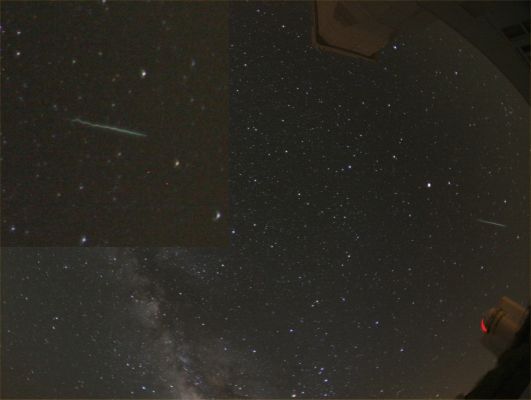
Wiggling Meteor
Dalla Rubrica "NASA - Picture of the Day" del giorno 2 Giugno 2010:"Did this meteor take a twisting path? 
No one is sure. Considered opinions are solicited. 

Meteors, usually sand sized grains that originate in comets, will typically disintegrate as they enter the Earth's atmosphere. A fast moving meteor ionizes molecules in the Earth's atmosphere that subsequently glow when they reacquire electrons. Meteor paths that twist noticeably have been noted before, and even photographed, but attributing such behavior to the motion of the meteor itself and neither the wind-blown meteor train nor the observer remains somewhat controversial. 

The above meteor, imaged two weeks ago streaking over the Teide Observatory in Tenerife, Canary Islands, appears to swagger as much as several minutes of arc, which the experienced astrophotographer did not think could be attributed to drifting of the resulting train or motion of the camera mount. 
If truly an indication of a twisted meteor path, an underlying reason could be the pictured meteor was markedly non-spherical in shape, non-uniform in composition, or electrically charged. Non-uniform meteors, for example, may evaporate more on one side than another, causing a rotating meteor to wobble. 

Understanding meteors is important partly because meteors are candidates to have seeded Earth with prebiotic molecules that allowed for the development of life". 
Parole chiave: From Earth Images - Professional Pictures

Wiggling Meteor

Dalla Rubrica "NASA - Picture of the Day" del giorno 2 Giugno 2010:"Did this meteor take a twisting path?
No one is sure. Considered opinions are solicited.

Meteors, usually sand sized grains that originate in comets, will typically disintegrate as they enter the Earth's atmosphere. A fast moving meteor ionizes molecules in the Earth's atmosphere that subsequently glow when they reacquire electrons. Meteor paths that twist noticeably have been noted before, and even photographed, but attributing such behavior to the motion of the meteor itself and neither the wind-blown meteor train nor the observer remains somewhat controversial.

The above meteor, imaged two weeks ago streaking over the Teide Observatory in Tenerife, Canary Islands, appears to swagger as much as several minutes of arc, which the experienced astrophotographer did not think could be attributed to drifting of the resulting train or motion of the camera mount.
If truly an indication of a twisted meteor path, an underlying reason could be the pictured meteor was markedly non-spherical in shape, non-uniform in composition, or electrically charged. Non-uniform meteors, for example, may evaporate more on one side than another, causing a rotating meteor to wobble.

Understanding meteors is important partly because meteors are candidates to have seeded Earth with prebiotic molecules that allowed for the development of life".

McNaught-13.jpg McNaught-9.jpg Meteor-Wiggle.jpg Orcus-GIF.gif P-2010-A2-HST.jpg
Informazioni sul file
Nome del file:Meteor-Wiggle.jpg
Nome album:MareKromium / Asteroids and Comets
Valutazione (3 voti):55555(Mostra dettagli)
Parole chiave:From / Earth / Images / - / Professional / Pictures
Copyright:Juergen Rendtel (AIP Potsdam), IMO
Dimensione del file:692 KiB
Data di inserimento:Giu 02, 2010
Dimensioni:2801 x 2109 pixels
Visualizzato:74 volte
URL:https://www.lunexit.it/gallery/displayimage.php?pid=26872
Preferiti:Aggiungi ai preferiti


Powered by Coppermine Photo Gallery