Inizio Registrati Login

Elenco album Ultimi arrivi Ultimi commenti Più viste Più votate Preferiti Cerca

Inizio > SOLAR SYSTEM > Asteroids and Comets
Ritorna alla pagina delle miniature FILE 242/282 Torna all'inizio Guarda foto precedente Guarda foto successiva Salta alla fine
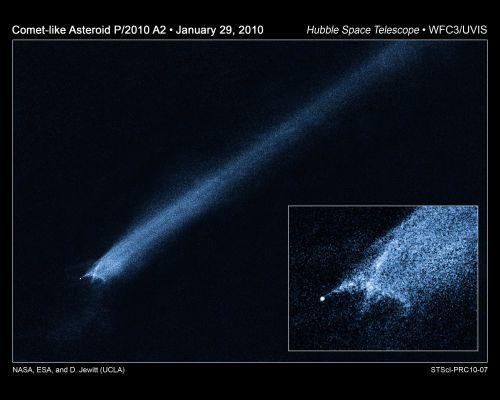
P/2010-A2: Extremely unusually-looking Asteroid
First discovered on ground based LINEAR images on January 6, 2010, the object appeared unusual enough to investigate further with the Hubble Space Telescope last week. 
Pictured above, what Hubble saw indicates that P/2010 A2 is unlike any object ever seen before. 

At first glance, the object appears to have the tail of a comet. Close inspection, however, shows an about 140-meter Nucleus offset from the tail center, very unusual structure near the Nucleus, and no discernable gas in the Tail. Knowing that the object orbits in the Asteroid Belt between Mars and Jupiter, a preliminary hypothesis that appears to explain all of the known clues is that P/2010 A2 is the debris left over from a recent collision between two small asteroids. 

If true, the collision likely occurred at over 15.000 Km-per-hour (five times the speed of a rifle bullet) and liberated energy in excess of a nuclear bomb. Pressure from Sunlight would then spread out the debris into a trailing tail. 

Future study of P/2010 A2 may better indicate the nature of the progenitor collision and may help humanity better understand the early years of our Solar System, when many similar collisions occurred. 
Parole chiave: From Space Images - Hubble Space Telescope (HST)

P/2010-A2: Extremely unusually-looking Asteroid

First discovered on ground based LINEAR images on January 6, 2010, the object appeared unusual enough to investigate further with the Hubble Space Telescope last week.
Pictured above, what Hubble saw indicates that P/2010 A2 is unlike any object ever seen before.

At first glance, the object appears to have the tail of a comet. Close inspection, however, shows an about 140-meter Nucleus offset from the tail center, very unusual structure near the Nucleus, and no discernable gas in the Tail. Knowing that the object orbits in the Asteroid Belt between Mars and Jupiter, a preliminary hypothesis that appears to explain all of the known clues is that P/2010 A2 is the debris left over from a recent collision between two small asteroids.

If true, the collision likely occurred at over 15.000 Km-per-hour (five times the speed of a rifle bullet) and liberated energy in excess of a nuclear bomb. Pressure from Sunlight would then spread out the debris into a trailing tail.

Future study of P/2010 A2 may better indicate the nature of the progenitor collision and may help humanity better understand the early years of our Solar System, when many similar collisions occurred.

Meteor-Wiggle.jpg Orcus-GIF.gif P-2010-A2-HST.jpg Planet_9-a.jpg Planet_9-b.jpg
Informazioni sul file
Nome del file:P-2010-A2-HST.jpg
Nome album:MareKromium / Asteroids and Comets
Valutazione (5 voti):55555(Mostra dettagli)
Parole chiave:From / Space / Images / - / Hubble / Space / Telescope / (HST)
Copyright:NASA, ESA, D. Jewitt (UCLA)
Dimensione del file:655 KiB
Data di inserimento:Feb 03, 2010
Dimensioni:3000 x 2400 pixels
Visualizzato:55 volte
URL:https://www.lunexit.it/gallery/displayimage.php?pid=26232
Preferiti:Aggiungi ai preferiti


Powered by Coppermine Photo Gallery