Inizio Registrati Login

Elenco album Ultimi arrivi Ultimi commenti Più viste Più votate Preferiti Cerca

Inizio > SOLAR SYSTEM > Asteroids and Comets
Ritorna alla pagina delle miniature FILE 196/282 Torna all'inizio Guarda foto precedente Guarda foto successiva Salta alla fine
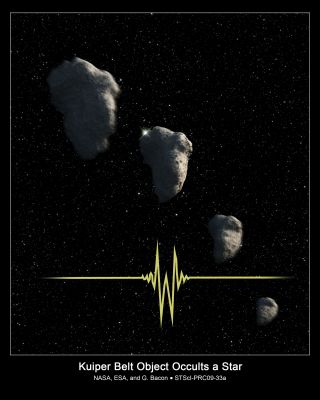
Kuiper's Belt Object occulting a Star
NASA's Hubble Space Telescope has discovered the smallest object ever seen in Visible Light in the Kuiper Belt, a vast ring of icy debris that is encircling the outer rim of the Solar System, just beyond Neptune.

The needle-in-a-haystack object found by Hubble is only 3200 feet across and a whopping 4,2 Billion Miles away. The smallest Kuiper Belt Object (KBO) seen previously in reflected light is roughly 30 miles across, or 50 times larger.

This is the first observational evidence for a population of comet-sized bodies in the Kuiper Belt that are being ground down through collisions. The Kuiper Belt is therefore collisionally evolving, meaning that the region's icy content has been modified over the past 4,5 BYs.

The object detected by Hubble is so faint — at 35th magnitude — it is 100 times dimmer than what Hubble can see directly.

So then how did the space telescope uncover such a small body?
Parole chiave: Drawings

Kuiper's Belt Object occulting a Star

NASA's Hubble Space Telescope has discovered the smallest object ever seen in Visible Light in the Kuiper Belt, a vast ring of icy debris that is encircling the outer rim of the Solar System, just beyond Neptune.

The needle-in-a-haystack object found by Hubble is only 3200 feet across and a whopping 4,2 Billion Miles away. The smallest Kuiper Belt Object (KBO) seen previously in reflected light is roughly 30 miles across, or 50 times larger.

This is the first observational evidence for a population of comet-sized bodies in the Kuiper Belt that are being ground down through collisions. The Kuiper Belt is therefore collisionally evolving, meaning that the region's icy content has been modified over the past 4,5 BYs.

The object detected by Hubble is so faint — at 35th magnitude — it is 100 times dimmer than what Hubble can see directly.

So then how did the space telescope uncover such a small body?

Iustitia.jpg KBO-1-Artist_Conception.jpg KBO-2-Artist_Conception.jpg KBO-3-Artist_Conception.jpg L-Itokawa.jpg
Informazioni sul file
Nome del file:KBO-2-Artist_Conception.jpg
Nome album:MareKromium / Asteroids and Comets
Valutazione (3 voti):55555(Mostra dettagli)
Parole chiave:Drawings
Copyright:NASA, ESA, and G. Bacon (STScI)
Dimensione del file:673 KiB
Data di inserimento:Dic 21, 2009
Dimensioni:2400 x 3000 pixels
Visualizzato:55 volte
URL:https://www.lunexit.it/gallery/displayimage.php?pid=25990
Preferiti:Aggiungi ai preferiti


Powered by Coppermine Photo Gallery