Inizio Registrati Login

Elenco album Ultimi arrivi Ultimi commenti Più viste Più votate Preferiti Cerca

Inizio > THE LUNAR EXPLORER ARCHIVES > The Universe in Super Definition
Ritorna alla pagina delle miniature FILE 121/157 Torna all'inizio Guarda foto precedente Guarda foto successiva Salta alla fine
Baby Dwarf Galaxies
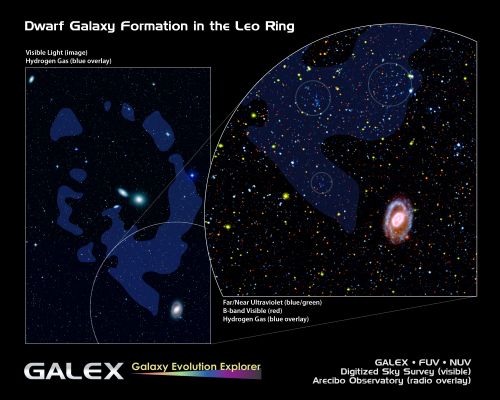
The unique Ultraviolet (UV) Vision of NASA's Galaxy Evolution Explorer reveals, for the first time, dwarf galaxies forming out of nothing more than pristine gas likely leftover from the early universe. Dwarf galaxies are relatively small collections of stars that often orbit around larger galaxies like our Milky Way. 
The forming dwarf galaxies shine in the far UV Spectrum, rendered as blue in the call-out on the right hand side of this image. Near UV Light, also obtained by the Galaxy Evolution Explorer, is displayed in green, and Visible Light from the blue part of the spectrum here is represented by red. The clumps (in circles) are distinctively blue, indicating they are primarily detected in far UV Light. 

The faint blue overlay traces the outline of the Leo Ring, a huge cloud of Hydrogen and helium that orbits around two massive galaxies in the constellation Leo (left panel). The cloud is thought likely to be a primordial object, an ancient remnant of material that has remained relatively unchanged since the very earliest days of the universe. Identified about 25 years ago by radio waves, the ring cannot be seen in Visible Light. 
Only a portion of the Leo Ring has been imaged in the UV, but this section contains the telltale UV signature of recent massive star formation within this ring of pristine gas. Astronomers have previously only seen dwarf galaxies form out of gas that has already been cycled through a galaxy and enriched with metals — elements heavier than Helium — produced as stars evolve. 
The visible data come from the Digitized Sky Survey of the Space Telescope Science Institute in Baltimore, Md. The Leo Ring visible image (left) represents the survey's blue, red, and infrared bands with the colors blue, green, and red. The overlay indicating the location of Hydrogen gas in the Leo Ring is based on observations made at the Arecibo Observatory in Puerto Rico.
Parole chiave: Drawings, Graphs and Spectra

Baby Dwarf Galaxies

The unique Ultraviolet (UV) Vision of NASA's Galaxy Evolution Explorer reveals, for the first time, dwarf galaxies forming out of nothing more than pristine gas likely leftover from the early universe. Dwarf galaxies are relatively small collections of stars that often orbit around larger galaxies like our Milky Way.
The forming dwarf galaxies shine in the far UV Spectrum, rendered as blue in the call-out on the right hand side of this image. Near UV Light, also obtained by the Galaxy Evolution Explorer, is displayed in green, and Visible Light from the blue part of the spectrum here is represented by red. The clumps (in circles) are distinctively blue, indicating they are primarily detected in far UV Light.

The faint blue overlay traces the outline of the Leo Ring, a huge cloud of Hydrogen and helium that orbits around two massive galaxies in the constellation Leo (left panel). The cloud is thought likely to be a primordial object, an ancient remnant of material that has remained relatively unchanged since the very earliest days of the universe. Identified about 25 years ago by radio waves, the ring cannot be seen in Visible Light.
Only a portion of the Leo Ring has been imaged in the UV, but this section contains the telltale UV signature of recent massive star formation within this ring of pristine gas. Astronomers have previously only seen dwarf galaxies form out of gas that has already been cycled through a galaxy and enriched with metals — elements heavier than Helium — produced as stars evolve.
The visible data come from the Digitized Sky Survey of the Space Telescope Science Institute in Baltimore, Md. The Leo Ring visible image (left) represents the survey's blue, red, and infrared bands with the colors blue, green, and red. The overlay indicating the location of Hydrogen gas in the Leo Ring is based on observations made at the Arecibo Observatory in Puerto Rico.

PIA10955.jpg PIA11417.jpg PIA11805.JPG PIA13120.jpg Proxima_Centauri_B_-_1.jpg
Informazioni sul file
Nome del file:PIA11805.JPG
Nome album:MareKromium / The Universe in Super Definition
Valutazione (4 voti):55555(Mostra dettagli)
Parole chiave:Drawings, / Graphs / and / Spectra
Copyright:NASA/JPL-Caltech/DSS
Dimensione del file:3563 KiB
Data di inserimento:Feb 20, 2009
Dimensioni:3000 x 2400 pixels
Visualizzato:55 volte
URL:https://www.lunexit.it/gallery/displayimage.php?pid=23694
Preferiti:Aggiungi ai preferiti


Powered by Coppermine Photo Gallery