Inizio Registrati Login

Elenco album Ultimi arrivi Ultimi commenti Più viste Più votate Preferiti Cerca

Inizio > THE LUNAR EXPLORER ARCHIVES > The Universe in Super Definition
Ritorna alla pagina delle miniature FILE 76/157 Torna all'inizio Guarda foto precedente Guarda foto successiva Salta alla fine
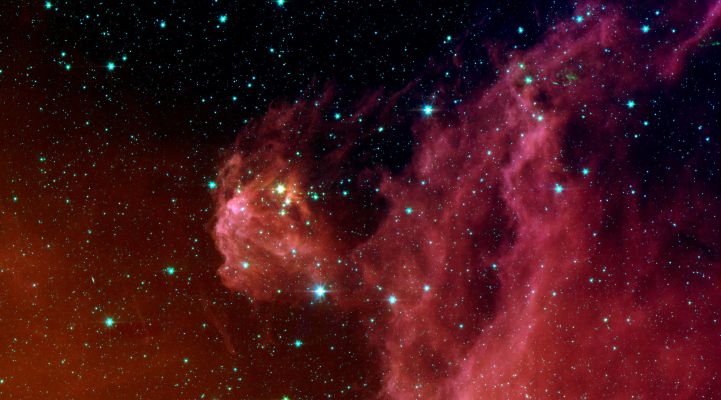
Out of Orion's Head (2)
This image from NASA's SST shows infant stars "hatching" in the Head of the Hunter constellation, Orion. Astronomers suspect that shockwaves from a supernova explosion in Orion's head, nearly 3 MY ago, may have initiated this newfound birth 
The Region featured in this Spitzer image is called Barnard 30. 
It is located approximately 1300 LY away and sits on the right side of Orion's "Head" just North of the massive star Lambda Orionis. Wisps of red in the cloud are organic molecules called polycyclic aromatic hydrocarbons. These molecules are formed anytime carbon-based materials are burned incompletely. On Earth, they can be found in the sooty exhaust from automobile and airplane engines. They also coat the grills where charcoal-broiled meats are cooked. 
This image shows infrared light captured by Spitzer's infrared array camera. Light with wavelengths of 8 and 5.8 microns (red and orange) comes mainly from dust that has been heated by starlight. 
Light of 4.5 microns (green) shows hot gas and dust; and light of 3.6 microns (blue) is from starlight. 

Parole chiave: From Space Images - Spitzer Space Telescope

Out of Orion's Head (2)

This image from NASA's SST shows infant stars "hatching" in the Head of the Hunter constellation, Orion. Astronomers suspect that shockwaves from a supernova explosion in Orion's head, nearly 3 MY ago, may have initiated this newfound birth
The Region featured in this Spitzer image is called Barnard 30.
It is located approximately 1300 LY away and sits on the right side of Orion's "Head" just North of the massive star Lambda Orionis. Wisps of red in the cloud are organic molecules called polycyclic aromatic hydrocarbons. These molecules are formed anytime carbon-based materials are burned incompletely. On Earth, they can be found in the sooty exhaust from automobile and airplane engines. They also coat the grills where charcoal-broiled meats are cooked.
This image shows infrared light captured by Spitzer's infrared array camera. Light with wavelengths of 8 and 5.8 microns (red and orange) comes mainly from dust that has been heated by starlight.
Light of 4.5 microns (green) shows hot gas and dust; and light of 3.6 microns (blue) is from starlight.

M-033-a.jpg M-042-PIA09411.jpg M-042-PIA09412.jpg M-081-PIA09579.jpg M-083-a.jpg
Informazioni sul file
Nome del file:M-042-PIA09412.jpg
Nome album:MareKromium / The Universe in Super Definition
Valutazione (8 voti):55555(Mostra dettagli)
Parole chiave:From / Space / Images / - / Spitzer / Space / Telescope
Copyright:NASA/JPL-Caltech/ Laboratorio de Astrofísica Espacial y Física Fundamental
Dimensione del file:612 KiB
Data di inserimento:Mag 18, 2007
Dimensioni:3086 x 1711 pixels
Visualizzato:53 volte
URL:https://www.lunexit.it/gallery/displayimage.php?pid=16875
Preferiti:Aggiungi ai preferiti


Powered by Coppermine Photo Gallery