Inizio Registrati Login

Elenco album Ultimi arrivi Ultimi commenti Più viste Più votate Preferiti Cerca

Inizio > THE LUNAR EXPLORER ARCHIVES > The Universe in Super Definition
Ritorna alla pagina delle miniature FILE 115/157 Torna all'inizio Guarda foto precedente Guarda foto successiva Salta alla fine
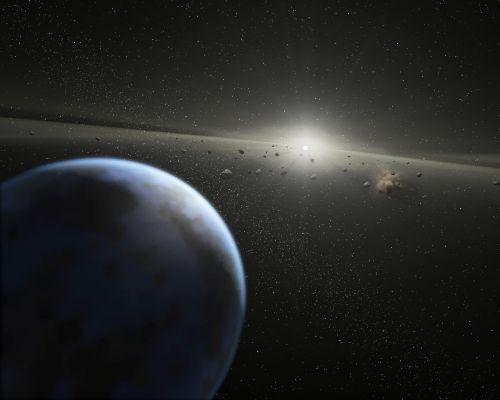
A beautiful "Asteroid Belt"
This artist's animation illustrates a massive asteroid belt in orbit around a star the same age and size as our Sun. Evidence for this possible belt was discovered by NASA's Spitzer Space Telescope when it spotted warm dust around the star, presumably from asteroids smashing together. 

The view starts from outside the belt, where planets like the one shown here might possibly reside, then moves into to the dusty belt itself. A collision between two asteroids is depicted near the end of the movie. Collisions like this replenish the dust in the asteroid belt, making it detectable to Spitzer. 

The alien belt circles a faint, nearby star called HD 69830 located 41 light-years away in the constellation Puppis. Compared to our own solar system's asteroid belt, this one is larger and closer to its star - it is 25 times as massive, and lies just inside an orbit equivalent to that of Venus. Our asteroid belt circles between the orbits of Mars and Jupiter. 

Because Jupiter acts as an outer wall to our asteroid belt, shepherding its debris into a series of bands, it is possible that an unseen planet is likewise marshalling this belt's rubble. Previous observations using the radial velocity technique did not locate any large gas giant planets, indicating that any planets present in this system would have to be the size of Saturn or smaller. 

Asteroids are chunks of rock from "failed" planets, which never managed to coalesce into full-sized planets. Asteroid belts can be thought of as construction sites that accompany the building of rocky planets. 


Parole chiave: Artistic Visions of the Universe

A beautiful "Asteroid Belt"

This artist's animation illustrates a massive asteroid belt in orbit around a star the same age and size as our Sun. Evidence for this possible belt was discovered by NASA's Spitzer Space Telescope when it spotted warm dust around the star, presumably from asteroids smashing together.

The view starts from outside the belt, where planets like the one shown here might possibly reside, then moves into to the dusty belt itself. A collision between two asteroids is depicted near the end of the movie. Collisions like this replenish the dust in the asteroid belt, making it detectable to Spitzer.

The alien belt circles a faint, nearby star called HD 69830 located 41 light-years away in the constellation Puppis. Compared to our own solar system's asteroid belt, this one is larger and closer to its star - it is 25 times as massive, and lies just inside an orbit equivalent to that of Venus. Our asteroid belt circles between the orbits of Mars and Jupiter.

Because Jupiter acts as an outer wall to our asteroid belt, shepherding its debris into a series of bands, it is possible that an unseen planet is likewise marshalling this belt's rubble. Previous observations using the radial velocity technique did not locate any large gas giant planets, indicating that any planets present in this system would have to be the size of Saturn or smaller.

Asteroids are chunks of rock from "failed" planets, which never managed to coalesce into full-sized planets. Asteroid belts can be thought of as construction sites that accompany the building of rocky planets.

NGC-6240-PIA11828.jpg PIA03243.jpg PIA07854.jpg PIA09955_fig1.jpg PIA09955_fig2.jpg
Informazioni sul file
Nome del file:PIA07854.jpg
Nome album:The Universe in Super Definition
Valutazione (13 voti):55555(Mostra dettagli)
Parole chiave:Artistic / Visions / of / the / Universe
Copyright:NASA - JPL - Caltech
Dimensione del file:342 KiB
Data di inserimento:Apr 27, 2006
Dimensioni:3000 x 2400 pixels
Visualizzato:54 volte
URL:https://www.lunexit.it/gallery/displayimage.php?pid=14308
Preferiti:Aggiungi ai preferiti


Powered by Coppermine Photo Gallery