| Piú votate - SOLAR SYSTEM |

Sedna-00.jpgThe discovery of Sedna: the three original frames165 visiteIn queste tre immagini, la prima 'occhiata' ad un minuscolo nuovo mondo chiamato "Sedna." Era il 14 Novembre 2003 ed i 3 frames (ripresi attraverso il Samuel Oschin Telescope - USA) vanno dalle ore 6:32 alle ore 9:38 del Tempo Universale.
Sedna, come quasi tutti i pianeti minori, venne visivamente identificato a causa del suo leggerissimo movimento in rapporto alle stelle fisse che gli facevano da contorno nei diversi frames.
Successive osservazioni, effettuate ad intervalli di tempo sensibilmente maggiori, fornirono gli elementi sufficienti per dedurre che l'orbita completa di questo corpo celeste intorno al nostro Sole (e cioè "l'anno di Sedna") avrebbe dovuto richiedere all'incirca 10.500 anni terrestri.
Nota: il campo visivo di ciascuno di questi 3 frames è pari a 3,4 minuti d'arco, mentre ogni pixel corrisponde ad 1 secondo d'arco.
(13 voti)
|
|

Miranda-PIA00044_modest.jpgMiranda (super close-up of "Verona Rupes") - HR122 visiteCaption NASA originale:"This HR image of Miranda was acquired by Voyager 2 on Jan. 24, 1986, when the spacecraft was 36.250 Km (22.500 miles) from the Uranian moon. In this clear-filter, narrow-angle image, Miranda displays a dramatically varied surface. Well shown at this resolution of 660 meters (2.160 feet) are numerous ridges and valleys - a topography that was probably produced by compressional tectonics. Cutting across the ridges and valleys are many faults. The largest fault scarp, or cliff, is seen below and right of center; it shows grooves probably made by the contact of the fault blocks as they rubbed against each other (leaving what are known as slickensides). Movement of the down-dropped block is shown by the offset of the ridges. The fault may be 5 Km (3 mi) high, or higher than the walls of the Grand Canyon on Earth. NASA's Voyager 2 probe encountered the planet Uranus and its collection of moons in 1986. The small moon Miranda, with a diameter of 472 km, has a surface made up of a jumble of bizarre geological features. One of the most prominent of these features is an enormous cliff with a vertical relief of about 20 km (12 miles). This cliff, named Verona Rupes, is 10 times higher than the walls of the Grand Canyon on Earth. That this towering cliff is so huge is made even more remarkable by the small size of Miranda itself. The white material exposed in the cliff face is probably mostly water ice".
(13 voti)
|
|

Sunrise from Space.jpgSunrise from space...95 visiteCaption NASA originale:"Sunrise seen from low Earth orbit by the shuttle astronauts can be very dramatic indeed. In this view, the Sun is just visible peaking over towering anvil-shaped storm clouds whose silhouetted tops mark the upper boundary of the troposphere, the lowest layer of planet Earth's atmosphere. Sunlight filtering through suspended dust causes this dense layer of air to appear red. In contrast, the blue stripe marks the stratosphere, the tenuous upper atmosphere, which preferentially scatters blue light".
(13 voti)
|
|

EROS-PIA02905-0.jpgEros (the BIG Pseudo-Anomaly)161 visiteThis image of Eros, taken from the NEAR Shoemaker spacecraft on May 1, 2000, is among the first to be returned from "low orbit." Between May and August, the spacecraft orbited at altitudes near 50 Km or less. This will be the prime period of activity for some of the spacecraft's science instruments. The X-ray / gamma-ray spectrometer will build up maps of chemical abundances, while the laser rangefinder measures the shape of Eros to within meters (a few feet). At the same time the magnetometer will watch for indications of Eros' magnetic field and the near-infrared spectrometer will map rock types. The imager will take pictures of the entire surface of Eros that capture features as small as 4 meters (13 feet) across. This particular image, taken from an orbital altitude of 53 Km, shows a scene about 1.8 Km across. Numerous craters and boulders as small as 8 meters (26 feet) across dot the landscape. The large, rectangular boulder at the upper right is about 45 meters across.
(13 voti)
|
|

Sun-TRACE.jpgThe Sun from TRACE in ultra-violet light84 visiteCaption NASA originale:"Shown in ultraviolet light, the relatively cool dark regions have temperatures of thousands of degrees Celsius. Large sunspot group AR 9169 is visible as the bright area near the horizon. The bright glowing gas flowing around the sunspots has a temperature of over 1.000.000° C. The reason for the high temperatures is still unknown but thought to be related to the rapidly changing magnetic field loops that "channel" solar plasma.
Sunspot group AR 9169 moved across the Sun during September 2000 and decayed in a few weeks".
(13 voti)
|
|

Sun surface in 3D.jpgThe "bubbling" surface of the Sun in 3D117 visiteCaption NASA originale" How smooth is the Sun? The new Swedish 1-m Solar Telescope, deployed in the Canary Islands in 2002, allows imaging of objects less than 100-Km across on the Sun's surface. When pointed toward the Sun's edge, surface objects now begin to block each other, indicating true three-dimensional information. Close inspection of the image reveals much vertical information, including spectacular light-bridges rising nearly 500 Km above the floor of sunspots near the top of the image. Also visible in the above false-color image are hundreds of bubbling granules, each about 1000 Km across, and small bright regions known as "faculae".
(13 voti)
|
|

Mars Express-PIA04802_modest.jpgMars Express105 visitenessun commento
(13 voti)
|
|

Io-Sodium cloud-PIA01110.jpgA sodium cloud from Io (3)63 visiteEd infatti la nuvola di Sodio emessa dalla Sonda Lunik-2, in particolare, venne realmente vista, identificata e fotografata dall'Osservatorio Francese di Haute-Provence, in quanto essa si "staccava", debolmente, del fondo del cielo. Per il Lunik-1, invece, il momento del rilascio della nube non fu altrettanto propizio, in quanto la Luna NON era visibile dall'Europa. Tuttavia - a quanto oggi ne sappiamo - anche questa prima nube venne vista, identificata e ripresa da alcuni Osservatori situati nell'URSS meridionale.
(13 voti)
|
|

Io-Sodium cloud-3-PIA00593.jpgA sodium cloud from Io (2)68 visiteE' una tecnica davvero molto antica, a quanto ne sappiamo, risalente addirittura ai tempi delle Sonde Sovietiche "Lunik" (nei loro viaggi del 2 gennaio 1959 e del 12 dicembre dello stesso anno). Queste due Sonde, infatti, furono programmate per emettere, dopo aver percorso all'incirca 100.000 Km, una "nube di vapori di Sodio" così densa da far si che gli Scienziati potessero, individuandola nel cielo, stabilire anche visivamente (oltre che grazie ai segnali radio) se la traiettoria effettivamente percorsa coincideva con quella stimata e progettata a tavolino.
(13 voti)
|
|
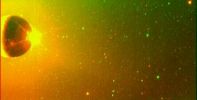
Io-Sodium cloud-PIA01111.jpgA sodium cloud from Io (4)63 visiteForse tutto questo processo potrà sembrare, ad alcuni giovani Ricercatori, come un tantino "naif" (se non addirittura ridicolo), ma occorre ricordare che le tecniche - oggi diventate di uso familiare - di "controllo a distanza" erano, in quegli anni, pura fantascienza e quindi, nel programmare gli eventi, ci si doveva anche affidare, oltre che alla cara, vecchia matematica (e a dei calcoli che, sebbene fatti solo "a mano" o con l'aiuto di un buon "regolo calcolatore", erano tendenzialmente perfetti), anche ad una eccellente dose di "intraprendenza, fantasia e buona sorte".
Non si finisce davvero mai di conoscere ed imparare, vero?!?
(13 voti)
|
|

A-The Sun - filament_trace_big.jpgSun's filaments150 visiteCaption originale NASA: "The filament, although small compared to the overall size of the Sun, measures over 100.000 Km in height, so that the entire Earth could easily fit into its outstretched arms. Gas in the filament is funneled by the complex and changing magnetic field of the Sun. After lifting off from the Sun's surface, most of the filamentary gas will eventually fall back".
(13 voti)
|
|

Sedna-03.jpgSedna from the Hubble Space Telescope (1)173 visiteLa collocazione di Sedna, secondo alcuni Astronomi, è quella di KBO (Kuiper's Belt Object), ma la sua orbita suggerisce scenari diversi. Sebbene non sia ancora possibile tracciarla in grande dettaglio, sappiamo che si tratta di un'orbita fortemente ellittica con un punto di maggior lontananza dal Sole (afelio) pari a 75 UA ed un periodo orbitale (un altro modo di indicare l'anno di Sedna) pari a circa 10.500 anni terrestri.
E' questo dato che ci permette di collocare Sedna ben oltre la Fascia di Kuiper e dunque (ampiamente) all'interno della Nube di Oort, anche nota come "La Fucina delle Comete".
(13 voti)
|
|
| 4547 immagini su 379 pagina(e) |
 |
|
|
|
|
8 | |
|
|
|
|





