| Piú votate - SOLAR SYSTEM |

Mars~1.jpgNot too close, not too far...97 visitenessun commento
(14 voti)
|
|

Venusian_Surface-Venera_13-02.jpgVenus from Venera 13 (camera 2)155 visitenessun commento
(14 voti)
|
|

Venusian_Surface-Venera_14-02.jpgVenus from Venera 14 (camera 2)128 visite"...These images are the original Russian digital images, with a little reprocessing. The original color images were darker and somewhat noisier than the b/w pictures scanned through the clear filter.
In this image, I combined the chroma signal from the color images with the luminance from the clear-filter images. The color chart, extended from the spacecraft was originally painted with gray, red, green and blue silicone enamel. On Venus, its color was shifted by effects of heat and pressure, and tinted by the orange sky. I adjusted the image colors slightly to match the calculated hues of the chart, but these pictures are not precisely color balanced..."
(14 voti)
|
|

Venusian_Surface-Venera_14-00.jpgVenus from Venera 14 (camera 1)148 visite"...The quality (of the Venera frames) is remarkably good, and a nearly perfect transmission can be compiled by carefully merging the information from multiple transmissions. A few sections appear damaged by noise, but these are actually bit synchronization errors which can be repaired in software. For example: work on this data set is in progress. Recovering the radiometric response function and balancing color are the next steps. Since the scene was scanned several times, it may be possible to calculate a super-resolution image from multiple panoramas, as NASA has done with Mars Pathfinder images..."
(14 voti)
|
|
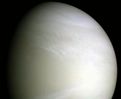
1-Venus_Galileo_Visible.jpgVenus147 visiteUna magnifica ricostruzione di Venere - ad opera dello "Space Artist" Don P. Mitchell - nei colori in cui un umano che fosse nello spazio la vedrebbe.
Queste le annotazioni originali dell'Artista:
Full spectral data is rarely available, and instead we must use views through color filters. Above, the Galileo probe captured Venus through a clear filter (left) and through a 410 nm violet filter, which reveals the subtle yellow and white clouds. Unfortunately, many different color images could result in the same two clear and violet signals above. Even when so-called red, green and blue filters are used, the problem is just as difficult, because the filters are not really the right red, green and blue to just plug into the channels of a color display. Theoretically, information from the two images above and from the Cassini spectrum could be combined using Bayesian decision theory, to compute the most probable color image. If colors are estimated correctly, there is a final issue of tone mapping. How bright does the image appear to the eye in a given context. The image above is the best color image of Venus I've found, showing the planet as it would likely appear to a human observer in space. It was made by Turkish astronomer A. Tayfun Oner, using the two color channels from the Galileo camera, and a third interpolated channel.
(14 voti)
|
|

Uranus-HST-CJH.jpgUranus, from HST101 visitenessun commento
(14 voti)
|
|

Voyagers-Heliosphere4b.jpgThe Voyagers at the "Final Frontier"84 visiteOriginal caption:"In the summer of 1989, NASA's Voyager 2 became the first spacecraft to observe the planet Neptune, its final planetary target. Passing about 4.950 Km (about 3.000 miles) above Neptune's North Pole, Voyager 2 made its closest approach to any planet since leaving Earth 12 years before. Five hours later, Voyager 2 passed about 40.000 Km (about 25.000 miles) from Neptune's largest moon, Triton, the last solid body the spacecraft had an opportunity to study".
(14 voti)
|
|

Neptune-PIA00048.jpgNeptune in true colors, from Voyager 276 visiteOriginal caption:"This image of clouds in Neptune's atmosphere is the first that tests the accuracy of the weather forecast that was made eight days earlier (nota: questa caption è relativa all'Estate del 1989) to select targets for the Voyager narrow angle camera. Three of the four targeted features are visible in this photograph; all 3 are close to their predicted locations.
The "Great Dark Spot" with its bright white companion is slightly to the left of center. The small bright "Scooter" is below and to the left, and the second "Dark Spot" with its bright core is below the Scooter. Strong eastward winds up to 400 mph cause the second dark spot to overtake and pass the larger one every five days. The spacecraft was 6,1 MKM (about 3,8 MMs) from the Planet at the time of camera shuttering, and the images uses the orange, green and clear filters of the camera".
Qualche nota sui Voyager 1 e 2: Voyager 1, launched September 5, 1977, visited Jupiter in 1979 and Saturn in 1980. It is now leaving the solar system, rising above the ecliptic plane at an angle of about 35 degrees, at a rate of about 520 million kilometers a year.
Voyager 2, launched August 20, 1977, visited Jupiter in 1979, Saturn in 1981 and Uranus in 1986 before making its closest approach to Neptune on August 25, 1989. Voyager 2 traveled 12 years at an average velocity of 19 kilometers a second (about 42,000 miles an hour) to reach Neptune, which is 30 times farther from the Sun than Earth is. Voyager observed Neptune almost continuously from June to October 1989. Now Voyager 2 is also headed out of the solar system, diving below the ecliptic plane at an angle of about 48 degrees and a rate of about 470 million kilometers a year.
Both spacecraft will continue to study ultraviolet sources among the stars, and their fields and particles detectors will continue to search for the boundary between the Sun's influence and interstellar space. If all goes well, we will be able to communicate with the two spacecraft for another 20 years, until their radioactive power sources can no longer supply enough electrical energy to power critical subsystems.
(14 voti)
|
|

Image044-Ukert-2.jpgUkert: the "pseudo-triangular" Lunar Crater224 visite"...ma delle immense lastre perforate trasparenti e modellate ad angoli retti nulla si vede nelle foto orbitali (notare, peraltro, i puntini a "foglia di fico" sull'immagine Lunar Orbiter e le notevoli differenze rispetto a quanto appare nella foto Clementine)..."
(14 voti)
|
|

Image043-Ukert-1.jpgUkert: the "pseudo-triangular" Lunar Crater247 visite"I Thunderbolts dicono che se si trovassero nei crateri dei fondi vetrificati e perforati, le loro teorie sarebbero ulteriormente dimostrate" ma - ahinoi - purtroppo non ci sono crateri con tali caratteristiche nelle foto NASA.
O no?!? I Thunderbolts sono arguti, ma...Disattenti: bastava che mi telefonassero...
Già nelle foto panoramiche Ukert si presenta come un rilievo anomalo il quale, per altro, è anche estremente vicino - guarda caso... - alla famosa formazione conosciuta come Los Angeles...".
(14 voti)
|
|

Image043-T-Ukert.jpgUkert: the "pseudo-triangular" Lunar Crater213 visiteQuesta striscia di immagini e di commenti non è un'Investigazione: sono solo frammenti di una conversazione fra Amici (il Dr A. Feltri ed il Dr P. C. Fienga).
L'oggetto? Un Cratere Lunare di grande impatto, di lunga storia e di profonde suggestioni emotive: Ukert.
Ma eccoVi la sua "Carta d'Identità":
Nome ............................... UKERT
Diametro .......................... circa 24 Km
Altezza delle pareti .......... circa 2900 mt
Latitudine ........................ 8° N
Longitudine ..................... 1° E
Posizione ......................... margine Nord-Occidentale di Sinus Medii
"Ti avevo accennato tempo addietro al Cratere (pseudo)triangolare Ukert, profondo circa 2900 metri (come riportato dalla Lunar Chart n.59 - Mare Vaporum). Il suo principale interesse � dato dalle formazioni vetrificate e perforate che lo attorniano".
(14 voti)
|
|

Asteroids-Sylvia_compo680.jpg87 Sylvia and the Founders of Rome67 visiteDa "NASA - Picture of the Day" del 17 Agosto 2005:"Discovered in 1866, Main Belt Asteroid 87 Sylvia lies 3.5 AU from the Sun, between the orbits of Mars and Jupiter. Also shown in recent years to be one in a growing list of double asteroids, new observations during August and October 2004 made at the Paranal Observatory convincingly demonstrate that 87 Sylvia in fact has two moonlets - the first known triple asteroid system. At the center of this composite of the image data, potato-shaped 87 Sylvia itself is about 380 Km wide. The data show inner moon, Remus, orbiting Sylvia at a distance of about 710 Km once every 33 hours, while outer moon Romulus orbits at 1360 Km in 87,6 hours. Tiny Remus and Romulus are 7 and 18 Km across respectively. Because 87 Sylvia was named after Rhea Silvia, the mythical mother of the Founders of Rome, the discoverers proposed Romulus and Remus as fitting names for the two moonlets (...)".
(14 voti)
|
|
| 4547 immagini su 379 pagina(e) |
 |
|
|
5 | |
|
|
|
|
|
|





