| Piú votate - SOLAR SYSTEM |

Tethys-PIA06140_modest.jpgTethys in natural colors76 visiteCaption NASA originale:"Having passed closer to Tethys than the Voyager 2 spacecraft, Cassini has returned the best-ever natural color view of this icy Saturnian moon.
As seen here, the battered surface of Tethys has a neutral hue. The image here is a mosaic of two footprints. Three images taken in the red, green and blue filters were taken to form a natural color composite. The result reveals a world nearly saturated with craters - many small craters lie on top of older, larger ones, suggesting an ancient surface. At the top and along the boundary between day and night, the moon's terrain has a grooved appearance.
This moon is known to have a density very close to that of water, indicating it is likely composed mainly of water ice. Its frozen mysteries await Cassini's planned close flyby in September 2005". 
(24 voti)
|
|

Helene-PIA07547.jpgThe Trojan Moons: Helene, from 760.000 Km81 visiteCaption NASA originale:"Saturn's moons Helene and tiny Polydeuces (not seen here) are Trojan moons of Dione, orbiting about 60° ahead of and behind, the much larger moon. Trojan moons are usually found near gravitationally stable points ahead or behind a larger moon. Polydeuces (or S/2004 S5) was discovered by the Cassini imaging team. Helene is 32 Km (20 miles) across, while Dione is 1.118 Km (695 miles) across.
Tethys also has two of its own Trojan moons.
The image was taken in visible light with the Cassini spacecraft narrow-angle camera on May 20, 2005, at a distance of approx. 760.000 Km (such as about 472.000 miles) from Helene. The image scale is 5 Km (about 3 miles) per pixel. This view of Helene has been magnified by a factor of three and sharpened to aid visibility".
Nota: raffrontate questa immagine di Helene con quella ottenuta dalla Sonda Voyager 2. Ma secondo Voi stiamo guardando sempre lo stesso oggetto?!?
(12 voti)
|
|

B-Mercury-PIA02414.jpgMercury or the Moon?67 visiteCaption NASA originale:"After passing Mercury the first time and making a trip around the Sun, Mariner 10 again flew by Mercury on September 21, 1974, at 1:59 PMPDT. This encounter brought the spacecraft in front of Mercury in the Southern Hemisphere.
Much of Mercury looks like the lunar highlands, a scene carved by billions of years of impact craters. This image (FDS 166724)was taken when Mariner 10 was near its closest approach to the planet during the second encounter, from about 50.000 Km. This image is found near the center of the area not imaged during the first encounter".
(12 voti)
|
|

Titan-Huygens_Landing_Site-11-PIA07229_modest.jpgHuygens' descent map (3) 68 visiteThe octagons indicate anticipated fields of view of panoramic mosaics of images taken by Huygens' descent imager and spectral radiometer instrument as the probe reaches certain altitudes during its descent. This map shows the footprints for mosaics to be assembled from 36 individual images at each altitude, with the field of view cut off at 75° from straight down although the actual images will extend all the way to the hazy horizon. Each mosaic made this way will be about 1.300 by 1.300 pixels. The largest octagon (in red) is about 1.120 Km across and represents the field of view for the mosaic of images taken at an altitude of 150 Km. From that height, individual pixels in the center of the image will be about 150 mts across, though haze between the ground and the camera at that height will likely degrade the resolution in those images. The location of the anticipated landing site is based on modeling of Titan's winds, and the actual landing site will be different if the actual winds experienced by Huygens during descent differ from this model.
(12 voti)
|
|

Titan-PIA06996_modest.jpgDoes Titan have a so-called "weather-pattern"?66 visiteIn the first image (left), obtained on the 1st Titan flyby, from a distance of 200.000 Km, Titan's skies are cloud-free, except for a patch of clouds observed over the South Pole near the bottom of the image. In contrast, the image on the right shows a recent view of this same area of Titan obtained 7 weeks later on the 2nd close Titan flyby, from a distance of 225.000 Km. This image clearly shows that several extensive patches of clouds have formed over temperate latitudes. The appearance of these clouds reveals the existence of weather. Tracking these features is currently underway by scientists, who hope to gain a better understanding of global circulation, regional weather patterns and localized meteorology in Titan's skies. The red color images the surface at a wavelength (2.01 micron) where the surface is relatively bright, making the surface appear reddish in these color images. The green color (2.83 micron) images the surface as well, but due to enhanced absorption of sunlight by the surface and lower atmosphere, the surface is relatively dark here compared to the red. The blue color (2.13 micron) is at a wavelength where sunlight cannot reach the surface at all due to strong absorption by the atmospheric gas methane. In contrast to the reddish surface, bright clouds at a relatively high altitude (here, about 30 kilometers (19 miles) above the ground) residing above most of the atmospheric absorption appear whitish in these representations, as they reflect sunlight effectively in all three near-infrared colors.
(12 voti)
|
|

Mimas-PIA06142_modest.jpgMimas and Saturn in real colors82 visiteCaption NASA originale:"In a splendid portrait created by light and gravity, Saturn's lonely moon Mimas is seen against the cool, blue-streaked backdrop of Saturn's northern hemisphere. Delicate shadows cast by the rings arc gracefully across the planet, fading into darkness on Saturn's night side. The bright blue swath near Mimas is created by sunlight passing through the Cassini division (4.800 Km wide). The rightmost part of this distinctive feature is slightly overexposed and therefore bright white in this image. Shadows of several thin ringlets within the division can be seen here as well. The dark band that stretches across the center of the image is the shadow of Saturn's B-Ring, the densest of the main rings. Part of the actual Cassini division appears at the bottom, along with the A-Ring and the narrow, outer F-Ring. The A-Ring is transparent enough that, from this viewing angle, the atmosphere and threadlike shadows cast by the inner C-Ring are visible through it".
(12 voti)
|
|

Mars Odyssey.jpgMars Odyssey92 visiteDa "NASA - Picture of the Day" del 25.10.2001:"After an interplanetary journey lasting 200 days, the Mars Odyssey spacecraft has entered orbit around the Red Planet on October, 25, 2001. This success is welcome as in the past Mars has often seemed a difficult planet to visit. Beginning with the first Soviet attempts in 1960, around 30 missions have tried while only 10 or so have gone without serious mishap (...) Cautiously dipping into the Martian atmosphere, the spacecraft will gradually adjust its present wide and elliptical 20-hour orbit to a circular 2-hour orbit only 400 Km above the planet's surface. Then, its instruments and cameras will focus on exploring the climate and geologic history of Mars, including the search for water and evidence of life-sustaining environments. In the artist's conception above, the spacecraft with wing-like solar panels is imagined firing its rocket engine for Mars orbit insertion over terrain seen in natural and false-color".
(12 voti)
|
|

The limb of the Sun.jpgThe limb of the Sun84 visiteFotografia amatoriale della corona solare durante l'ultima grande eclissi totale del 1999.
(12 voti)
|
|

EROS-PIA03143.jpgEros: NEAR-Shoemaker's Probe landing site102 visiteThe location of NEAR Shoemaker's landing site is shown in this image mosaic taken on December 3, 2000, from an orbital altitude of about 200 Km (approx. 124 miles). In this view, south is to the top and the terminator (the imaginary line dividing day from night) lies near the equator. The landing site (at the tip of the arrow) is near the boundary of two distinctly different provinces, both of which the spacecraft will photograph as it descends. To the south and east (above and to the left) lies older, cratered terrain, while to the north (down) is the saddle-shaped feature Himeros, whose lesser density of superposed craters indicates relatively recent resurfacing by geologic processes.
(12 voti)
|
|

The Sun_s Corona.jpgThe "Corona"98 visiteIn sede di commento a questa immagine (amatoriale, ma non per questo meno bella) della corona solare - come visibile durante un'eclissi totale - una piccola curiosità: sapevate che alcune delle sfumature della corona sono visibili (anzi: percepibili) soltanto dall'occhio umano?
(12 voti)
|
|
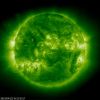
The Sun.jpgThe Sun83 visiteCaption NASA originale:"The ultraviolet light emitted by eleven times ionized iron at temperatures over 2 million degrees Farenheit was used to record the above picture of the Sun on September 22, 2001, the date of that year's autumnal equinox. The image was made by the EIT camera onboard the SOHO spacecraft, a space observatory which can continuously observe the Sun. Eleven times ionized iron is atomic iron with eleven of its electrons stripped away. Here the electrons are stripped by the frantic collisions with other atoms and electrons which occur at the extreme temperatures in the Solar Corona. Since electrons are negatively charged, the resulting ionized iron atom is highly positively charged. Astronomer's "shorthand" for eleven times ionized iron is written "Fe XII", the chemical symbol for iron followed by a Roman numeral 12 (Fe I is neutral iron)".
(12 voti)
|
|

Saturn storms_-PIA06477_modest.jpgAn "oval" storm near Saturn's South Pole75 visiteCaption NASA originale:"The region near Saturn's south pole shows a great deal of fascinating detail in this view from Cassini. Near upper right, an oval-shaped storm is bordered to the north and south by bright streaks of cloud, and two dark storms hover in a brighter cloud lane near the center.
The image was taken with the Cassini spacecraft narrow angle camera on Aug. 7, 2004, at a distance of 8.4 million kilometers (5.2 million miles) from Saturn through a filter sensitive to wavelengths of infrared light. The image scale is 50 kilometers (31 miles) per pixel".
(12 voti)
|
|
| 4547 immagini su 379 pagina(e) |
 |
|
|
|
|
|
|
376 | |
|
|





