| Piú votate - SOLAR SYSTEM |

Saturn-PIA06619.jpgThe Southern Side of Saturn76 visiteCaption NASA originale:"Viewed nearly edge-on, Saturn's rings appear dark and pencil-thin against the backdrop of the planet's swirling clouds. Notable here are the shadows cast by the rings onto the northern hemisphere, as well as details of the banded atmosphere, such as the bright equatorial region. The image was taken with the Cassini spacecraft wide-angle camera on Feb. 18, 2005, at a distance of approximately 1,2 MKM from Saturn through a filter sensitive to wavelengths of infrared light centered at 727 nnmts, where gaseous methane absorbs. The image scale is 67 Km per pixel".
(8 voti)
|
|

Lakhshmi_Planum-PIA00249.jpgMagellan Probe: radio image of Lakhsmi Planum and Danu Montes89 visiteCaption NASA originale:"Southwest Lakshmi Planum is bounded on the south by the Danu Montes. Lakshmi Planum is an elevated plateau that is bounded on all sides by mountain chains. Here, the Danu mountains have an angular fractured appearance. Chasms slice diagonally across the mountains in the lower left (southwest) corner of the image. Because of the steep slopes and the local relief of the mountains of several kilometers, these fault-bounded troughs appear to zig-zag through the mountains when, in fact, they are probably straight if viewed from above. The radar view provides a perspective that would place the viewer's eye to the right, 27° above the horizon. Thus, slopes facing to the right can be seen completely, though dark, and slopes facing away to the left appear shortened, often seen only as thin bright lines. In the center of the image is a low volcanic dome 20 Km in diameter. This type of volcanic feature frequently occurs on the low plains. This dome on the edge of Lakshmi is deformed and faulted where it has been affected by the forces that created the Danu mountains".
(8 voti)
|
|

Epimetheus from Voyager 1.jpgEpimetheus from Voyager 188 visiteUn'altra "Luna Minore" di Saturno, dalla forma bizzarra.
Forse un'altra "preda" dell'abbraccio gravitazionale di Saturno?
(8 voti)
|
|

TITAN-N00006532.jpgTitan from app.x 340.000 Km away - Lightnings on Titan or a scratch in the picture?76 visitenessun commento
(8 voti)
|
|

SATURN-PIA06097_modest.jpgThe "F" Ring - first picture75 visitenessun commento
(8 voti)
|
|
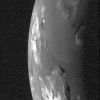
Io-PIA03530-1.jpgIo: the Loki Volcano from Galileo (RAW-HR and b/w Original NASA-Galileo Spacecraft Frame)70 visiteCaption NASA:"Light from the setting Sun falls across the Loki Volcanic Region on Jupiter's moon Io in this image taken by NASA's Galileo Spacecraft taken on October, 16, 2001.
The image was taken to examine the relative depths and heights of the major Surface Features existing in the Region. The Sun illuminates the surface from the right. Galileo's camera caught the large Volcanic Crater, or "Patera" of Loki near the Terminator (such as the boundary line between night and day). The image also shows several smaller craters plus shadows cast by the high peaks of several mountains.
Shadows cast by the low Sun should reveal any topography associated with Loki, such as a plateau in the center of the Patera or high Patera Walls. The near absence of shadows in this Region surprised Galileo scientists, as they had expected much more pronounced topography near Loki.
Another surprising aspect of this image is that features that have been black in previous Voyager and Galileo images of Loki, such as the dark Lava Flows visible inside the Patera, are here brighter than their surroundings. The best explanation is that the shiny, glassy surfaces of chilled Lava Flows look extremely dark when the Sun is directly overhead, but they reflect the Sun's light comparatively well when it shines at a low angle, in a similar manner to the reflective surfaces of bodies of water.
Other Volcanic Paterae in this image show the same unusual reflectance as seen at Loki. Some of them are being viewed at such an angle that these reflections from Lava Flows are the brightest features in the image. This image tells us that Lava Flows on Io chill quickly and form glassy surfaces, not unlike recently cooled lava flows in Hawaii.
The image has a resolution of about 1,1 Km (approx. 0,7 miles) per picture element. North is to the top of the picture".
(37 voti)
|
|

Dione-PIA07745-5.jpgDione's horizon - HD (5)73 visitenessun commento
(21 voti)
|
|

Uranus from Keck Obs..jpgUranus from Keck Observatory112 visiteCaption NASA originale:"These sharp views of tilted gas giant Uranus show dramatic details of the planet's atmosphere and ring system. The remarkable ground-based images were made using a near-infrared camera and the Keck Adaptive Optics system to reduce the blurring effects of Earth's atmosphere. Recorded in July 2004, the pictures show two sides of Uranus. In both, high, white cloud features are seen mostly in the northern (right) hemisphere, with medium level cloud bands in green and lower level clouds in blue. The artificial color scheme lends a deep reddish tint to the otherwise faint rings. Because of the severe tilt of its rotational axis, seasons on Uranus are extreme and last nearly 21 Earth years on the distant planet. Uranus is now slowly approaching its southern autumnal equinox - the beginning of fall in the southern hemisphere - in 2007".
(21 voti)
|
|

URANUS from HST.jpgUranus from the Hubble Space Telescope106 visiteUrano, il terz'ultimo Pianeta del Sistema Solare, fa parte della famiglia dei "Giganti Gassosi", assieme a Giove, Saturno e Nettuno. In ordine di grandezza Urano è il terzo Pianeta dopo Giove e Saturno e, dal punto di vista della sua struttura, esso assomiglia (quasi) come una goccia d'acqua a Nettuno.
Al pari di questo, infatti, la (spessissima) atmosfera di Urano appare costituita principalmente da Idrogeno ed Elio con una sensibile presenza, nei suoi strati più alti, di Metano (il quale conferisce al Pianeta il suo caratteristico colore azzurrino).
(26 voti)
|
|

EROS-nea_0144528838_mos.jpgAsteroid 433-Eros from NEAR (9) - Original and HR120 visiteDettaglio del rilievo che, anche senza ingrandimento, già ci appare ben visibile nel frame che precede. Si tratta, con ogni probabilità, della parte superiore di una collinetta (anche se - forse - sarebbe meglio parlare di un semplice "outcrop", date le modeste dimensioni dell'Asteroide).
La NASA, purtroppo, non ci è stata di aiuto quando abbiamo chiesto delle delucidazioni al riguardo.
(13 voti)
|
|

Mimas-N00055623.jpgMimas (2)78 visiteCaption originale:"N00055623.jpg was taken on March 21, 2006 and received on Earth March 22, 2006. The camera was pointing toward Mimas that, at the time, was approximately 190.524 Km away.
The image was taken using the CL1 and CL2 filters".
(13 voti)
|
|

Mimas&Titan-PIA07666.jpgBig Brother, Little Brother...61 visiteOriginal caption:"Titan, the Saturn's largest moon and Mimas - in the foreground - are seen together in this view from Cassini.
Titan's gravity is weaker than Earth's, so the moon's atmosphere is quite extended - a "quality" that is very well hinted at in this view.
Part of Mimas' dark side is illuminated by reflected light from nearby Saturn.
The image was taken in visible light with the Cassini spacecraft narrow-angle camera on Dec. 3, 2005, at a distance of approx. 3,6 MKM (about 2,2 MMs) from Titan and 2,5 MKM (1,6 MMs) from Mimas.
Both moons are seen at a phase angle of 110°.
The image scale is 22 Km (roughly 14 miles) per pixel on Titan and 15 Km (about 9 miles) per pixel on Mimas".
(13 voti)
|
|
| 4547 immagini su 379 pagina(e) |
 |
|
|
|
|
370 | |
|
|
|
|





