| Piú votate - SOLAR SYSTEM |

ZD-Pluto.jpgPluto and the stars around...99 visiteUn'immagine, a nostro parere, altamente suggestiva di Plutone e del campo stellato che lo circonda. Anche questo frame è stata estratto dalla "2MASS Atlas Image Gallery at IPAC".
Plutone è l'oggetto posizionato ESATTAMENTE AL CENTRO della fotografia.
(15 voti)
|
|

ZA-Sunspot.jpgSunspot and Solar "granules" (detail mgnf)96 visiteCaption NASA originale:"Sometimes, small regions of the Sun appear unusually dark. Visible above is a close-up picture of a sunspot, a depression on the Sun's face that is slightly cooler and less luminous than the rest of the Sun. Sunspots can be larger than the Earth and usually last for only a few days. As you can see, the Sun's face is a bubbling sea of separate cells of hot gas. These cells are known as "granules" and a solar "granule" is about 1000 Km across and "lives" for + or - 10 minutes, then explodes".
(15 voti)
|
|
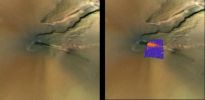
Io-Pele Volcano-PIA02560_modest.jpgThe "Pele" Volcano87 visitePele, one of Io's best-known volcanoes, was observed by the infrared spectrometer, an instrument onboard NASA's Galileo spacecraft, during the flyby of Jupiter's moon Io on February 22, 2000. The temperature map is shown here on the left in false color, superimposed on a visible color image of the Pele region obtained by the Voyager spacecraft in 1979. The red color represents the hottest lava flows. The purple colors are cooler materials. Preliminary results show that the temperatures of the hottest lava flows are at least 1,400 Kelvin (about 2,000 Fahrenheit), consistent with the temperatures of basaltic lava seen on the Kilauea volcano in Hawaii. It is possible that the eruption temperatures at Pele are even higher, as lava cools quickly once it starts to spread over the surface. The Voyager context image is 200 kilometers (124 miles) across.
(15 voti)
|
|
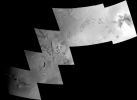
Io-Zamama Plume-PIA03531_modest.jpgThe "Zamama" flow field64 visiteThe source area of what had been a towering volcanic plume two months earlier lies in the far-right frame of this mosaic of images taken of Jupiter's moon Io by NASA's Galileo spacecraft on Oct. 16, 2001.
The region in the images includes the Zamama lava flow in Jupiter's northern hemisphere. The Zamama flow field emanates from the northernmost of two small volcanoes in the far left frame. These lava flows were not present in Voyager images of Io, so they formed some time between the Voyager 1 flyby in 1979 and the first Galileo observations of Io in 1996. Galileo also observed Zamama during Io encounters in 1999, and scientists identified narrow, long, dark lava flows thought to be similar to lava flows in Hawaii.
Moving northeast, the second and third frames of this mosaic contain lava flow fields and several unnamed volcanic depressions, called "paterae." It is unclear whether the broad, shield-like features or plateaus on which the paterae rest were created by eruptions from the paterae, or if they were preexisting features. Some fractures and dark lines suggest that the crust here is breaking up, creating cracks that magma can use to rise to the surface.
The far-right frame of this mosaic shows dark lava flows and bright spots. The bright spots are probably sulfur-bearing plume deposits, which are thought to be associated with the source of a plume eruption 500 kilometers (310 miles) high that was observed by the Galileo spacecraft in August, 2001. It was the largest plume eruption ever observed on Io.
(15 voti)
|
|

Neptune-PIA01539_modest.jpgFarewell Neptune: a "bright smile" for the Earthlings...78 visiteCaption NASA originale:"Voyager 2's post-encounter view of Neptune's South Pole as the spacecraft sped away on a southward trajectory".
E con la Sonda Voyager 2 che sfiorava Nettuno e poi si dirigeva verso i più estremi confini del Sistema Solare - perdendosi per sempre nello spazio interstellare - quest'ultimo frame ci mostra (passateci il termine) il "sorriso" di Nettuno per noi Terrestri.
Un "luminoso sorriso" che a noi piace pensare sia il suo modo di dire "Arrivederci"...
(15 voti)
|
|

Neptune-PIA02245.jpgNeptune from 16.000.000 Km60 visiteCaption NASA originale:"This color image, produced from a distance of about 16 MKM, shows several complex and puzzling atmospheric features. The Great Dark Spot (GDS) seen at the center is about 13.000 Km by 6.600 km in size - as large along its longer dimension as the Earth. The bright, wispy "cirrus-type" clouds seen hovering in the vicinity of the GDS are higher in altitude than the dark material of unknown origin which defines its boundaries".
(15 voti)
|
|

Ganymede-PIA01618.jpgGanymede's surface (detail mgnf)77 visiteView of the Marius Regio and Nippur Sulcus area of Jupiter's moon, Ganymede showing the dark and bright grooved terrain which is typical of this satellite. This regional scale view was imaged near the terminator (the line between day and night) and provides geologic context for small areas that were imaged at much higher resolution earlier in the tour of NASA's Galileo spacecraft through the Jovian system. The older, more heavily cratered dark terrain of Marius Regio is rutted with furrows, shallow troughs perhaps formed as a result of ancient giant impacts. Bright grooved terrain is younger and is formed through tectonism probably combined with icy volcanism. The lane of grooved terrain in the lower left, Byblus Sulcus, was imaged during the spacecraft's second orbit, as were Philus Sulcus and Nippur Sulcus, seen here in the upper left. Placing the small higher resolution targets of Galileo's second orbit into the context of more distant, lower resolution views of the areas surrounding and connecting them, and imaging them along Ganymede's terminator, allows for an integrated understanding of Ganymede' s geology.
North is to the top left of the picture and the sun illuminates the surface from the lower right. The image, centered at 43 degrees latitude and 194 degrees longitude, covers an area approximately 664 by 518 kilometers. The resolution is 940 meters per picture element. The image was taken on May 7, 1997 at 12 hours, 50 minutes, 11 seconds Universal Time at a range of 92,402 kilometers by the Solid State Imaging (SSI) system on NASA's Galileo spacecraft.
(15 voti)
|
|

ZN-Messenger to Mercury.jpgMessenger going to Mercury93 visiteE, per concludere questo brevissimo "fly-by" fotografico di Mercurio, Vi offriamo una fotografia che contiene, in fondo, un pò di "speranza": è l'immagine della partenza della Sonda Messenger verso Mercurio.
Ci rivedremo fra qualche anno - se tutto andrà bene - con nuove fotografie ed informazioni provenienti da un mondo davvero poco conosciuto.
Se saremo bravi (e fortunati) troveremo senz'altro alcune risposte a molti quesiti, e certo non mancherà del materiale per porsi nuove domande e sbirciare nell'Ignoto, nei suoi Misteri, nei suoi Enigmi e nelle sue Anomalie.
Ed è per questi motivi (e per mille altri che non conosciamo ma che certamente esistono) che il Viaggio della Scienza è - e rimane - sempre e comunque, un Viaggio Infinito!
(15 voti)
|
|

TITANIA.jpgTitania from Voyager 2 (1)136 visiteQualche immagini di Titania.
Questo Satellite di Urano assomiglia decisamente ad Oberon e le sue caratteristiche superficiali lo rendono anche molto simile alla nostra Luna.
In questa immagine appare piuttosto chiaramente, verso il basso ed esattamente sulla linea del terminatore, un profondo canale (crepaccio?). Reminiscenze di antiche eruzioni ed eventi sismici collegati o è forse il segno dell'impatto con un altro corpo celeste che si è abbattuto su Titania con un angolo di incidenza estremamente basso? Onestamente non lo sappiamo. Gli Studiosi di Scienze Planetarie e gli Esperti di geologia potrebbero esserci di aiuto al riguardo. Noi abbiamo scambiato qualche parola con uno di questi e ci è stato detto che le "scalfitture" visibili sulla superficie di Titania dovrebbero essere il risultato di violentissimi cataclismi i quali hanno, in un certo senso, fratturato la crosta del Satellite.
Ma relativamente all'origine (interna od esterna?) di questi eventi la risposta, ovviamente, non può essere data.
(15 voti)
|
|

NeptuneandTriton_vg2_big.jpgNeptune and Triton from Voyager 293 visiteNettuno possiede, così come Giove, Saturno ed Urano, un Sistema di lune estremamente complesso, dal quale spiccano Tritone (qui in foto accanto a Nettuno) e Nereide.
Si tratta, come testimoniano le immagini che possediamo, di corpi rocciosi sostanzialmente privi di atmosfera (anche se per Tritone quest'ultima asserzione sembra essere non veritiera) e pertanto soggetti - anche ai giorni nostri - ad un'elevata attività di bombardamento meteorico.
Le altre lune che fanno parte del Sistema di Nettuno (a parte Proteus, di cui possediamo qualche immagine) sono troppo piccole per essere esaminate nei particolari ma si presume che possa trattarsi di corpi (in origine) cometari o di altri corpi "erranti" sfuggiti, a seguito di impatti e/o di influenze mareali (o per altre cause a noi ignote), alla Fascia di Kuiper ed in seguito "catturati" dalla gravità del Pianeta.
(15 voti)
|
|

002.jpgSpace Heat-Shields - The Heat-Shield (specs)153 visite2 - LO SCUDO TERMICO
La tesi NASA è che l'oggetto luccicante adagiato sul bordo del Cratere Bonneville - mostratoVi nel frame precedente ed il quale appare completamente deformato (a seguito dell'impatto?) - sarebbe/è l’Heat-Shield della Sonda Spirit (che in questo frame vediamo in una versione "integra").
(12 voti)
|
|

ZZ-ZZ-ZZ-ZZ-ZZ-ZZ-ZZ-ZZ-ZZ-ZZ-ZZ-ZZ-APOLLO 12 AS 12-46-6868 HR.jpgAS 12-46-6868 (HR) - Superimposed Photoartifacts?205 visiteLe piccole "bolle di luce" che avete visto accanto alla Bandiera Americana nel frame precedente oppure accanto ai cavi distesi sulla superficie della Luna o "in emersione" da un cratere in questo frame, sono la versione digitale (rectius: digitalizzata) della famosissima "flare-like light" del frame Apollo 11 AS 11-37-5455.
In quel caso ed in quel contesto, la piccola "bolla di luce" fu un'autentica e (quasi) unica "chicca" per gli Anomaly Hunters: un insperato benefit che fu concesso da una censura scarsa e poco filtrante. Come fare, quindi, a screditare la rivelazione di AS 11-37-5455? Riprendendo la medesima Anomalìa e riproponendola (incollandola digitalmente) come un VISTOSO Photoartifact in "n" altri frames in cui non è difficile notare l'incongruenza del dettaglio con il panorama ripreso.
E l'Anomaly Hunter inesperto o "troppo mite" si ritroverà a pensare:"Ma se questo è un photoartifact allora forse anche quello di AS 11-37-5455 doveva esserlo...". Ed il gioco è fatto: auto-screditando un numero "n" di frames innocui e privi di "spunti", si annulla il valore storico di UN frame estremamente periglioso.
E così via.
A nostro modo di vedere - e sperando di essere stati abbastanza chiari su questa spinosissima questione - i photoartifacts del frame precedente e di questo, sono TUTTI "Superimposed Photoartifacts".
L'ottimo Dr Barca ne ha trovati alcuni ma, credeteci, ce ne sono centinaia di altri: tutti ingannevoli, tutti creati ex-post.
E se Vi chiedete come facciamo ad esserne così sicuri, Vi diremo che di questi due frames (come di molti altri) abbiamo non solo le versioni HR, ma anche quelle Original and uncompressed ed in esse...Le "fiammelle volanti" NON ci sono!
Ovviamente.
(12 voti)
|
|
| 4547 immagini su 379 pagina(e) |
 |
|
|
|
|
363 | |
|
|
|
|





