| Piú votate - SOLAR SYSTEM |

Io-Emakong patera-PIA02598_modest.jpgThe "Emakong" Patera (HR)79 visiteCaption NASA originale:"Clues about how lava spreads great distances on Jupiter's volcanic moon Io come from HR views taken by NASA's Galileo spacecraft of a lava channel flowing out of Emakong Patera near Io's equator.
The lava channel is dark and runs to the right from the dark patera, or large depression, at the left of this mosaic. The 1999 images showed a dark channel though which molten material once fed a broad, bright lava flow that extended for hundreds of Km".

(17 voti)
|
|

Io-Eruption on Tvashtar Catena-PIA02584_modest.jpgIo: eruption in Tvashtar Catena93 visiteThis pair of images taken by NASA's Galileo spacecraft captures a dynamic eruption at Tvashtar Catena, a chain of volcanic bowls on Jupiter's moon Io. They show a change in the location of hot lava over a period of a few months in 1999 and early 2000.
The image on the left uses data obtained on Nov. 26 and July 3, 1999, at resolutions of 183 meters (600 feet) and 1.3 kilometers (0.8 miles) per pixel, respectively. The red and yellow lava flow itself is an illustration based upon imaging data. The image on the right is a composite using a five-color observation made on Feb. 22, 2000, at 315 meters (1030 feet) per pixel.
These are among the most fortuitous observations made by Galileo because this style of volcanism is too unpredictable and short-lived to plan to photograph.
Short-lived bursts of volcanic activity on Io had been previously detected from Earth-based observations, but interpreting the style of volcanic activity from those lower-resolution views was highly speculative. These Galileo observations confirm hypotheses that the initial, intense thermal output comes from active lava fountains. Galileo's high-resolution observations of volcanic activity on Io have also confirmed other hypotheses based on earlier, low-resolution data. These include interpretations of slowly spreading lava flows at Prometheus and Amirani and an active lava lake at Pele. These tests of earlier hypotheses increase scientists' confidence in interpreting volcanic activity seen in low-resolution remote sensing data of Earth as well as Io. However, these data are still of insufficient resolution to adequately test the more quantitative models that have been applied to volcanic eruptions on Earth and Io.
These images also show other geologic features on Io, such as the scalloped margins of the plateau to the northeast of the active lavas. These margins appear to have formed by sapping, a process usually associated with springs of water. Liquid sulfur dioxide might be the fluid responsible for sapping on Io. A better understanding of sapping on Io will influence how scientists interpret similar features on Mars(where the viability of carbon dioxide or water as the sapping fluid remains controversial).
(17 voti)
|
|

A-THE SUN-SOHO.jpgThe Sun, stars and planets from Soho166 visite...che si vede con grande chiarezza nell'immagine più grande, circa ad ore 01:00 del disco solare.
Ricordate quanto scrivemmo, nella Sezione dedicata a Mercurio, a proposito di un enigmatico "corpo celeste" il quale orbiterebbe intorno al Sole lungo un'orbita ancora più interna rispetto a quella dello stesso Mercurio? Ecco, l'immagine da alcuni Studiosi ritenuta come una prova fondamentale dell'esistenza di "qualcosa" nelle immediate vicinanze del Sole (il Decimo Pianeta) è proprio quella che Vi abbiamo offerto nel frame precedente.
(17 voti)
|
|

OBERON.jpgOberon from Voyager 2139 visiteA parte i consueti segni (crateri) lasciati da un innumerevole quantitativo di impatti, risulta abbastanza agevole notare l'esistenza di "mari" simili a quelli della nostra Luna. Si tratta di ampie distese, relativamente lisce, che si estendono per circa un quarto della superficie totale del Satellite. Da osservare, inoltre, la protuberanza semiconica che appare sul bordo del Satellite, alla Sn dell'Osservatore, a ore 8 (un rilievo alto circa 6 Km).
Si tratta di una montagna o di un antico vulcano?
(17 voti)
|
|

Venusian_Surface-Venera_13-07.jpgVenus from Venera 13 (HR) - March, 1, 1982 - true color image243 visiteUna rarissima immagine a colori della superficie Venusiana scattata DALLA superficie del Pianeta dalla Sonda Sovietica Venera 13, prima di essere distrutta (comunque dopo 2 ore e 7 minuti di attività e 14 fotografie scattate - a proposito: le altre 13 sono introvabili e l'Agenzia Spaziale Russa non sembra interessata a divulgarle...) dalla pressione, dal calore e dalla pioggia corrosiva.
Una curiosità: l'atmosfera di Venere assorbe completamente la radiazione corrispondente al colore che noi percepiamo come "blu". Cosa significa? Significa che il blu, su Venere, non esiste (almeno per i nostri occhi).
Certo che sarebbe davvero interessante - oltre che strano - 'vedere' un mondo in cui il blu...Non esiste!
(17 voti)
|
|

NEPTUNE_S EYE.jpgNeptune from Voyager 2 - The "Blue Spot"107 visiteA questo proposito c'è pure chi sostiene che Plutone stesso, in un remoto passato, fosse un satellite di Nettuno e che, forse, tornerà ad esserlo - sia pure solo in un lontano futuro.
In questa foto: l'Occhio di Nettuno o, come dicono gli astronomi, la "Grande Macchia Blu" (The Big Blue Spot).
(17 voti)
|
|

Hyperion-N00040280.jpgHyperion (8)60 visiteLa distanza si accorcia, anche se non di molto: siamo a circa 31.000 Km da Hyperion. Non molto da dire per quanto attiene questo frame il quale è molto simile al precedente.
(10 voti)
|
|

Hyperion-N00040201.jpgHyperion (3)68 visiteQuali altri processi possano aver condotto ad un simile risultato, però, è ancora un mistero e noi non pensiamo che sarà uno scherzo giungere alla Verità (con tutto il rispetto per le interessanti Teorie del Gruppo che si chiama "Thunderbolts")...
In questo frame, siamo a poco più di 100.000 Km da Hyperion.
(10 voti)
|
|

Amalthea-PIA01074.jpgFour views of Amalthea89 visiteThese 4 images of Amalthea were taken by Galileo's Solid State Imaging System at various times between February and June 1997. North is approx. up in all cases. Amalthea, whose longest dimension is about 247 Km (154 miles) across, is tidally locked (like Thebe) so that the same side of the moon always points towards Jupiter. In such a tidally locked state, one side of Amalthea always points in the direction in which Amalthea moves as it orbits about Jupiter. This is called the "leading side" of the moon and is shown in the top 2 images. The opposite side of Amalthea, such as the "trailing side," is shown in the bottom pair of images. The Sun illuminates the surface from the left in the top left image and from the right in the bottom left image. Such lighting geometries, similar to taking a picture from a high altitude at sunrise or sunset, are excellent for viewing the topography of the satellite's surface such as impact craters and hills. In the two images on the right, however, the Sun is almost directly behind the spacecraft. This latter geometry, similar to taking a picture from a high altitude at noon, washes out topographic features and emphasizes Amalthea's albedo (light/dark) patterns. It emphasizes the presence of surface materials that are intrinsically brighter or darker than their surroundings. The bright albedo spot that dominates the top right image is located inside a large south polar crater named Gaea.
(13 voti)
|
|

Coronal Loops-TRACE.jpgCoronal loops81 visiteDa "NASA - Picture of the Day" del 14 Agosto 2005:"Why is the Corona of the Sun so hot? Extending above the photosphere or visible surface of the Sun, the faint, tenuous Solar Corona can't be easily seen from Earth, but it is measured to be hundreds of times hotter than the photosphere itself. Astronomers have long sought the source of the Corona's heat in magnetic fields which loft monstrous loops of solar plasma above the photosphere. Detailed observations of coronal loops from the orbiting TRACE satellite are pointing more closely to the unidentified energy source. Recorded in extreme ultraviolet light, this and other TRACE images indicate that significant heating occurs low in the corona, near the bases of the loops as they emerge from and return to the solar surface. This tantalizing TRACE image shows clusters of the majestic, hot coronal loops which span 30 or more times the diameter of planet Earth".
(13 voti)
|
|

Japetus-A-W-Deathstar-28.jpgThe "Pentagon", again104 visite...alla fine - ed a nostro modesto parere - scarsamente credibile o, comunque, da "prendersi con estrema cautela" e da " raffinare a lungo", prima di essere "assunto e metabolizzato". La Scienza Convenzionale - e questo lo andiamo dicendo sian dall'inizio delle nostre 'prolusioni/conversazioni' - NON è in grado di spiegare tutto. Pensare fermamente il contrario, non è da Scienziati nè da persone razionali: è da stupidi. Ma è anche da stupidi (diciamo che è "indice di leggerezza"...) credere altresì che la Scienza Convenzionale NON sia in grado di spiegare alcunchè. Giapeto, la Luna e Marte, inter alia, tentano di essere capiti e spiegati - dal CICAP, per esempio - solo alla luce del loro (presunto) pensiero razionale. Errore! Costoro non arriveranno mai, a nostro parere, da nessuna parte. Il Prof. Hoagland, invece, sta accantonando (sempre più nettamente e decisamente) la Scienza Convenzionale per cercare SOLO spiegazioni esotiche e sensazionalistiche alle (tante) Singolarità che il Cosmo ci offre.
(13 voti)
|
|
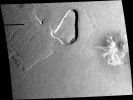
Io-Volcanic_Depression-PIA03532_modest1.jpgVolcanic Depression near the Equator (Original NASA/Galileo b/w Frame)67 visiteThis image taken by NASA's Galileo spacecraft on Oct. 16, 2001, near the equator of Jupiter's moon Io shows the contrast in volcanism styles found on Io.
The central feature is a large patera, or volcanic depression, almost 100 kilometers (60 miles) long. It may have formed after eruptions of lava emptied a subsurface magma chamber and left an empty space into which the crust collapsed. Evidence of lava flows associated with this patera, however, is difficult to find. Either the flows have been buried, or perhaps they never erupted and simply drained back deep into the crust.
On the right of the image is a small shield volcano, similar to volcanoes in Hawaii. It is rare for lavas on Io to be thick enough to pile up into shields around vents. They usually run out in thin, long flows instead. This shield abuts some very pale lava flows that emerged from a small vent to the west. These flows could be made of sulfur, like flows at Io's Emakong Patera. The vent is also surrounded by dark, diffuse material, which may be the result of lava erupted in an explosive, gas-rich eruption, similar to the 1980 eruption of Mount Saint Helens in Washington.
North is to the top of the image and the illumination is from the right. The image has a resolution of 330 meters (1,080 feet) per picture element and is 340 (211 miles) kilometers across.
(13 voti)
|
|
| 4547 immagini su 379 pagina(e) |
 |
|
|
|
|
361 | |
|
|
|
|





