| Piú votate - SOLAR SYSTEM |

TitanandHuygens_968A4_L.jpgTitan, Huygens and Saturn in the sky128 visiteUna "visione" davvero bellissima di Titano: forse la migliore.
(19 voti)
|
|

9-Venus.jpgVenus from 2.700.000 Km (Galileo Probe)226 visiteLa competizione USA/URSS, finchè l'URSS è esistita, ha dato grandi risultati in termini di inventiva, volontà, capacità di fronteggiare le difficoltà e superare gli ostacoli (il Programma Apollo ne è la prova lampante!) ma poi...Dissoltasi l'Unione Sovietica e svanita la 'corsa' verso le Stelle, si è incominciato a guardare il 'portafogli' e, dato che le missioni spaziali "costano care", la NASA (o dovremmo dire "Il Congresso"?!?) ha ritenuto più saggio, sicuro ed economico limitarsi ad inviare sonde programmate per entrare in orbita attorno a Venere e poi scattare foto a raggi X della superficie, così da superare l'ostacolo costituito dalla coltre perenne di nubi che sovrasta il Pianeta, SENZA dover ricorrere al landing ed alla successiva, rapida ed inevitabile perdita della navicella.
(18 voti)
|
|

Quaoar.jpgQuaoar124 visitenessun commento
(17 voti)
|
|

Voyagers-Heliosphere3b.jpgThe "Voyagers" at the Final Frontier98 visiteVoyager 1 and 2 are still going strong and are returning valuable science data. Each Voyagers' Cosmic Ray Detector, Magnetometer, Plasma Wave Detector and Low-Energy Charged Particle Detector all still operational. In addition, the Ultraviolet Spectrometer on Voyager 1 and the Plasma Science instrument on Voyager 2 continue to return data. Both spacecraft are expected to continue to operate and send back valuable data until at least the year 2020.
The mission currently employs the equivalent of about 10 full-time people at JPL, significantly less than the approximately 300 during the height of its famed "Grand Tour" of the planets through 1989. Only two veterans of the Voyager launches still work on the flight team. Some of the summer interns the team has employed were not even born when the spacecraft were launched. The project scientist, Dr. Ed Stone of the California Institute of Technology has been with the mission since inception and two original principal investigators - Dr. Stamatios Krimigis of the Applied Physics Laboratory and Dr. Norman Ness of the University of Delaware - remain.
During the journey, the Voyagers flew by Jupiter, Saturn, Uranus and Neptune and returned nearly 80 thousand images and more than 5 trillion bits of data. After traveling through space for more than 27 years, Voyager 1 is now more than 14 billion kilometers (94 AU) from the Sun, heading in a northerly direction toward interstellar space. Voyager 2, closer at about 11 billion kilometers (75 AU), is headed on a southerly path toward interstellar space. Voyager 1 is now the furthest human-made object from the Sun, having surpassed Pioneer 10 on February 17, 1998.
Since the beginning of the Interstellar Mission in 1990, the two spacecraft have returned well more than 65 billion bits of data, though at lower data rates than during the Grand Tour. The data continue to reveal new characteristics of the effects of the sun in the distant solar wind. As an example, a Coronal Mass Ejection (CME) shock wave from the October 2003 solar storms was detected at Voyager 2 in mid-April 2004. Some of the most powerful flares in recorded history hurled billion-ton clouds of gas, called coronal mass ejections (CMEs), into the solar system. By the time the resulting shocks reached Voyager 2, about 6 months later, they had combined into Merged Interaction Regions and had slowed considerably. Traveling at 600 km/sec, it had slowed considerably from the 1500-2000 km/sec detected last Fall as the storms left the Sun. Voyager 2 measured the speed of the shock, its composition, temperature and magnetism. When combined with measurements from SOHO, Mars Odyssey, Ulysses, Cassini and other spacecraft, the Voyager data show how far-ranging CMEs evolve and dissipate.
For the past two years or so, Voyager 1 has detected phenomena unlike any encountered before in all its years of exploration. These observations and what they may infer about the approach to the termination shock have been the subject of on-going scientific debates. While some of the scientist believed that the passage past the termination shock had already begun, some of the phenomena observed were not what would have been expected. So the debate continues while even more data are being returned and analyzed. However, it is certain that the spacecraft are in a new regime of space. The observed plasma wave oscillations and increased energetic particle activity may only be the long-awaited precursor to the termination shock. If we have indeed encountered the termination shock, Voyager 1 would be the first spacecraft to enter the solar system's final frontier, a vast expanse where wind from the Sun blows hot against thin gas between the stars: interstellar space.
(17 voti)
|
|

MarsAtmosphere.jpgHow Mars lost its atmosphere...109 visitenessun commento
(17 voti)
|
|

Image050-Ukert-4.jpgUkert: the "pseudo-triangular" Lunar Crater795 visitenessun commento
(17 voti)
|
|
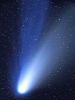
Comets-Hale_Bopp-02.jpgThe "Dust" and "Ion" Tails of Hale-Bopp93 visiteLo splendore e la magnificenza della Cometa Hale-Bopp, durante il suo passaggio del 1997. Nell'immagine, vediamo le due code di Hale-Bopp: la coda ionica (blu intenso), composta da molecole di gas ionizzati - è il monossido di carbonio che, quando viene 'eccitato', risplende di luce azzurra - la quale si crea dall'interazione fra le particelle contenute nel Vento Solare ed i gas presenti in prossimità del nucleo della cometa. La coda ionica, in quanto spinta dal Vento Solare, si muove come una sorta di banderuola e si dirige sempre in posizione diametralmente opposta rispetto al Sole (la sorgente del "Vento"). Anche la coda di polveri (grigio-celeste) segue le leggi della coda ionica, ma essa si orienta in maniera meno netta rispetto al Sole. Questa seconda coda è formata da particelle di roccia e polveri - le cui dimensioni variano dal micron al metro ed oltre - staccatisi dal nucleo della cometa durante - ed a causa - della sua "Corsa verso il Sole".
(17 voti)
|
|

000.jpgTable of contents246 visiteCon questa (splendida) immagine di un tramonto marziano (come ripreso dalla Sonda Pathfinder), inauguriamo una nuova Sezione del Sito "Lunar Explorer" in cui tratteremo, ogni qual volta ci sarà possibile, delle tematiche specifiche (e CONTROVERSE) sulle quali interverranno opinioni "esperte" ed "accreditate". Sarà una sorta di "on line investigation" su cui - se vorrete - potrete intervenire notificandoci le Vostre opinioni e sensazioni. La prima indagine sarà affidata al Dr Alessio FELTRI - che ringraziamo di cuore, congiuntamente al Sito "Space Freedom" - il quale, oltre ad essere un Ricercatore valido, equilibrato ed obiettivo, ha la (rara) virtù di rendere semplice e agevolmente comprensibile ciò che semplice ed agevolmente comprensibile - di regola - NON lo è!
Buona lettura, dunque!...
(17 voti)
|
|

Comets-Comet_Ikeya_Zhang_4.jpgComet Ikeya-Zhang - the "ion tail"87 visiteAs Comet Ikeya-Zhang approached the Sun, it developed a complex blue "ion tail". The "ion tail" is composed of ions that boiled off the nucleus and were pushed away from the Sun by the out-flowing fast-moving particles of the solar wind. Complexity in the tail is created by comet nucleus rotation, variability in the comet surface evaporation rate and variability of the Sun's magnetic field and solar wind.
(17 voti)
|
|
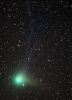
Comets-Comet_Mach_Holz.jpgThe C/2004 Q2 Comet110 visiteScoperta solo pochi mesi fa, la Cometa C/2004 Q2 (Machholz) è già chiaramente visibile (a magn. 5 o superiore) nei Cieli del Sud. Ma nessuna paura, non occorrerà viaggiare per vederla: essa si sta rapidamente portando verso i nostri Cieli e, nel frattempo, continuerà ad aumentare il suo splendore (probabilmente sino alla prima metà di Gennaio 2005). La luminosità massima che C/2004 Q2 potrà raggiungere non ci è ancora nota; ciò che sappiamo, invece, è che essa resterà nei "nostri" Cieli per buona parte del 2005 e la potremo anche vedere in prossimità della Stella Polare nei primi giorni di Marzo. L'immagine che Vi proponiamo (da "NASA - Picture of the Day" del 13.12.2004) è stata ripresa ai primi di Dicembre e, come potete vedere, la cometa già ci mostra una consistente "chioma", un'abbondante coda di polveri e detriti (di colore bianco e verde) ed un'abbastanza intricata "coda ionica" (andante verso la Dx dell'Osservatore), che presenta delle increspature verso la fine.
(17 voti)
|
|

Io-Flares from V2-PIA01362_modest.jpgBlue flares and eruptions on the limb of crescent Io88 visiteAncora flares (di colore blu, questa volta), riprese da una distanza approssimativa di 1,2 milioni di kilometri da Io.
La ripresa, in questo caso (e si tratta comunque di un'immagine di splendida qualità e fattura), è stata effettuata dalla Sonda Voyager 2 il 9 Luglio 1979. Ci pensate? Più di 25 anni fa...
Voyager 2 took this picture of Io on the evening of July 9, 1979, from a range of 1.2 million kilometers. On the limb of Io are two blue volcanic eruption plumes about 100 kilometers high. These two plumes were first seen by Voyager 1 in March, 1979, and are designated Plume 5 (upper) and Plume 6 (lower). They have apparently been erupting for a period of at least 4 months and probably longer. A total of six plumes have been seen by Voyager 2, all of which were first seen by Voyager 1. The largest plume viewed by Voyager 1 (Plume 1) is no longer erupting. Plume 4 was not viewed on the edge of the moon's disc by Voyager 2 and therefore it is not known whether or not it is still erupting. This picture is one of a series taken to monitor the eruptions over a 6 hour period.
(17 voti)
|
|

ZA-Uranus-LP-PIA00143.jpgFarewell Uranus... (2)120 visiteCaption NASA originale:"This view of Uranus was recorded by Voyager 2 on Jan 25, 1986, as the spacecraft left the planet behind and set forth on the cruise to Neptune. Voyager was 1 MKM (about 600.000 miles) from Uranus when it acquired this wide-angle view. The picture - a color composite of blue, green and orange frames - has a resolution of 140 Km (90 mi) per pixel".
(17 voti)
|
|
| 4547 immagini su 379 pagina(e) |
2 |  |
|
|
|
|
|
|
|
|
|





