| Piú votate - SOLAR SYSTEM |
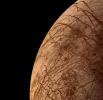
Europa-V2-PIA00459.jpgEuropa from Voyager 2 - the closest approach69 visiteCaption NASA originale:"This color image of the Jovian moon Europa was acquired by Voyager 2 during its close encounter on Monday morning, July 9, 1979. Europa, the size of our Moon, is thought to have a crust of ice perhaps 100 kilometers thick which overlies the silicate crust. The complex array of streaks indicate that the crust has been fractured and filled by materials from the interior. The lack of relief, any visible mountains or craters, on its bright limb is consistent with a thick ice crust hypothesis".
(11 voti)
|
|

Io-Eruptions-PIA00293.jpgContinuous eruptions on Io71 visiteThis image, taken by NASA's Galileo spacecraft, shows a new blue-colored volcanic plume extending about 100 kilometers (about 60 miles) into space from Jupiter's moon Io (see inset at lower left). The blue color of the plume is consistent with the presence of sulfur dioxide gas and 'snow' condensing from the gas as the plume expands and cools. Galileo images have also shown that the Ra Patera plume glows in the dark, perhaps due to the fluorescence of sulfur and oxygen ions created by the breaking apart of sulfur dioxide molecules by energetic particles in the Jovian magnetosphere. The images at right show a comparison of changes seen near the volcano Ra Patera since the Voyager spacecraft flybys of 1979 (windows at right show Voyager image at top and Galileo image at bottom). This eruptive plume is an example of a new type of volcanic activity discovered during Voyager's flyby in 1979, believed to be geyser-like eruptions driven by sulfur dioxide or sulfur gas erupting and freezing in Io's extremely tenuous atmosphere. Volcanic eruptions on Earth cannot throw materials to such high altitudes. Ra Patera is the site of dramatic surface changes. An area around the volcano of about 40,000 square kilometers, area about the size of New Jersey, has been covered by new volcanic deposits. The image was taken in late June 28, 1996 from a distance of 972,000 kilometers (604,000 miles).
(11 voti)
|
|

Titan-Atmosphere_and_Haze-00.jpgTitan from approx. 789.000 Km (The "Double Purple Haze")67 visitenessun commento
(11 voti)
|
|

AA-Anomaly - Saturn_s Sky from Cassini-Huygens.jpgA bright light in the Space of Saturn: Saturn overexposed (1)225 visiteMa adesso che ci troviamo nello Spazio Esterno; che non c'è nessuna atmosfera di sorta da chiamare in causa e non ci sono neppure vecchie Sonde che possono precipitare ed alle quali si potrebbe "dare la colpa" per la presenza di "strisce di luce nel cielo", che cosa si inventeranno le Agenzie Spaziali per negare ancora l'evidenza?
(11 voti)
|
|

Volcanoes-Ammavaru.jpgMagellan Probe: radio image of Ammavaru Volcano & surroundings135 visiteGli scopi di Magellano consistevano, sommariamente, nella tracciatura di un modello relativo all'interno di Venere, nonchè nell'effettuazione di una serie di osservazioni di supporto allo studio della tettonica di Venere, nonchè delle sue vere e proprie forme esteriori, ivi inclusi i processi di superficie susseguenti ad impatti, erosioni, depositi ed altre reazioni chimiche.
(11 voti)
|
|

Venusian_Surface-Venera_09-002.jpgVenus from Venera 9 - October, 22, 1975 - The Original Frame190 visiteEd ora qualche dato ottenuto dalle Sonde: temperatura minima al suolo: 465°C, max 485°C; pressione superficiale minima: tra le 90 e le 94 volte la press. terr. al livello del mare.
Alcuni elementi atmosferici: HCl, HF, I e Br; vento: intorno ai 3,5 Km/ora; non si sono rilevate polveri in sospensione; altezza delle nuvole dal suolo: circa 30 Km.
Un mondo decisamente diverso dal nostro e dall'ormai familiare Marte, non credete?!?
(11 voti)
|
|

IO - TRUE COLOR FROM GALILEO.jpgIo in true colors97 visiteNASA's Galileo spacecraft acquired its highest resolution images of Jupiter's moon Io on 3 July 1999 during its closest pass to Io since orbit insertion in late 1995. This color mosaic uses the near-infrared, green and violet filters (slightly more than the visible range) of the spacecraft's camera and approximates what the human eye would see. Most of Io's surface has pastel colors, punctuated by black, brown, green, orange, and red units near the active volcanic centers. A false color version of the mosaic has been created to enhance the contrast of the color variations.
The improved resolution reveals small-scale color units which had not been recognized previously and which suggest that the lavas and sulfurous deposits are composed of complex mixtures (Cutout A of false color image). Some of the bright (whitish), high-latitude (near the top and bottom) deposits have an ethereal quality like a transparent covering of frost (Cutout B of false color image). Bright red areas were seen previously only as diffuse deposits. However, they are now seen to exist as both diffuse deposits and sharp linear features like fissures (Cutout C of false color image). Some volcanic centers have bright and colorful flows, perhaps due to flows of sulfur rather than silicate lava (Cutout D of false color image). In this region bright, white material can also be seen to emanate from linear rifts and cliffs.
Comparison of this image to previous Galileo images reveals many changes due to the ongoing volcanic activity.
Galileo will make two close passes of Io beginning in October of this year. Most of the high-resolution targets for these flybys are seen on the hemisphere shown here.
North is to the top of the picture and the sun illuminates the surface from almost directly behind the spacecraft. This illumination geometry is good for imaging color variations, but poor for imaging topographic shading. However, some topographic shading can be seen here due to the combination of relatively high resolution (1.3 kilometers or 0.8 miles per picture element) and the rugged topography over parts of Io. The image is centered at 0.3 degrees north latitude and 137.5 degrees west longitude. The resolution is 1.3 kilometers (0.8 miles) per picture element. The images were taken on 3 July 1999 at a range of about 130,000 kilometers (81,000 miles) by the Solid State Imaging (SSI) system on NASA's Galileo spacecraft during its twenty-first orbit.
(11 voti)
|
|

N-M0137673654F4.pngRocky Outcrop on 433-Eros (3D - credits: Dr G. Barca - Lunexit Team)65 visitenessun commentoMareKromium
(10 voti)
|
|

Enceladus-N00146851_53.jpgFountains of Light (Natural Colors; image processing credits: Dr M. Faccin)75 visiteCon questa meravigliosa fotocomposizione rappresentativa delle "Fontane di Luce" che, come sapete, caraterizzano il Polo Sud di Encelado, ci pregiamo ed onoriamo di salutare l'Amico (o gli Amici) che ci legge (o leggono) dall'Osservatorio Astronomico di Arcetri.
Un Caro Saluto e Cieli Sereni a Voi dal Lunexit-Team!MareKromium
(10 voti)
|
|

Enceladus-N00145393lll.jpgFountains of Light (Natural Colors; image processing credits: Dr M. Faccin)80 visitenessun commentoMareKromium
(10 voti)
|
|
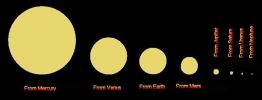
000-The_Sun_from_Space.JPGThe Sun from all the Planets of the Solar System179 visiteCome appare (o meglio: "Quanto grande" dovrebbe apparire) il Disco Solare allorchè osservato da un Mondo diverso dalla Terra?
Senza pretesa di assolutezza matematica, questa Tavola dovrebbe fornirVi un'idea più precisa della questione su cui tanto ci siamo arrovellati sino ad ora.
Nota: i diversi diametri sono stati ipotizzati ragionando in termini di UA (Unità Astronomiche), laddove 1 UA = distanza Sole / Terra = 149.597.970 Km
ergo la distanza fra il Sole e Mercurio viene fatta mediamente pari a (circa *) 0,4 UA
fra il Sole e Venere è mediamente pari a (circa) 0,7 UA
fra il Sole e Marte è mediamente pari a (circa) 1,5 UA
fra il Sole e Giove è mediamente pari a (circa) 5,2 UA
fra il Sole e Saturno è mediamente pari a (circa) 9,5 UA
fra il Sole ed Urano è mediamente pari a (circa) 19,6 UA
fra il Sole e Nettuno è mediamente pari a (circa) 30 UA
fra il Sole ed il Sistema Binario Plutone-Caronte è mediamente pari a (circa) 39 UA
* diciamo circa perchè le orbite dei diversi Pianeti attorno al Sole NON descrivono cerchi perfetti (e quindi con raggio - distanza dal Sole - fisso), bensì delle ellissi più o meno allungate (le quali implicano l'esistenza di un "perielio" - o punto di massima vicinanza del Corpo Celeste considerato rispetto al Sole - ed un "afelio" - o punto di massima lontananza del Corpo Celeste considerato rispetto al Sole.MareKromium
(10 voti)
|
|

UnusualObject-N00122114-1.jpgUnusually-looking "Object" in the Space of Saturn78 visiteSi tratta, senza dubbio (!), di una delle tantissime Lune Saturniane, ma quale? Scherzi ed ironie a parte, l'Oggetto Anomalo che Vi proponiamo appare solo in un frame, ottenuto dalla distanza di 433.941 Km dall'Anello "F" di Saturno.
Nel frame successivo (distanza 433.359 Km) e nel frame precedente (distanza 434.224 Km dal Main Target) nulla appare nella porzione alta dell'inquadratura.
L'Oggetto Anomalo, come l'edm ci mostra, possiede una forma piuttosto allungata ed irregolare (e attenzione: l'irregolarità del Corpo Celeste NON E' stata creata, ma solo ACCENTUATA dalla circostanza per cui il frame è leggermente "mosso") e la sua albedo ci sembra alquanto alta.
Non si distinguono (o almeno: noi non riusciamo a distinguere) rilievi superficiali idonei a consentirci l'identificazione dell'Oggetto, ma la nostra sensazione è che POTREBBE trattarsi della Luna Saturniana "Hyperion" (la quale, in determinate inquadrature, pare effettivamente assomigliare ad una sorta di "oliva" - un pà raggrinzita).
Ad ogni modo, questo frame è indubbiamente interessante e meriterebbe qualche approfondimento...MareKromium
(10 voti)
|
|
| 4547 immagini su 379 pagina(e) |
 |
|
|
|
|
18 | |
|
|
|
|





