| Piú votate - SOLAR SYSTEM |

Titan-PIA06122_modest.jpgTitan from about 1.000.000 Km (true colors)65 visiteUn'immagine davvero molto ben definita in cui si può distinguere nettamente, nonostante la distanza della Sonda dal Pianeta sia ancora considerevole, la particolare tessitura (oltre al colore davvero curioso - grigio/viola?) degli strati alti dell'atmosfera di Titano.
(11 voti)
|
|

VG-Desdemona-V2.jpgDesdemona - Voyager 293 visitenessun commento
(11 voti)
|
|

VF-Cressida, Ophoelia, Portia.jpgCressida, Ophoelia and Portia - Voyager 296 visiteUn piccolissimo commento (forse abbastanza scontato): noi non sappiamo chi, fisicamente, abbia dato i nomi a queste Lune Minori di Urano ma, certamente, si trattava di un appassionato lettore di Sir William Shakespeare.
Non credete?!?...
(11 voti)
|
|

Miranda-V2-PIA01980_modest.jpgMiranda: a funny shaped Moon99 visiteIn questa seconda immagine di Miranda risulta ben visibile una vastissima depressione situata in prossimità del suo Polo Nord la quale potrebbe aver avuto origine a seguito di un impatto con un altro corpo celeste di notevoli dimensioni.
Una luna che ha "sofferto", dunque, e la cui storia risale - molto probabilmente - alle stesse origini del nostro Sistema Solare, quando gli impatti - specie nella sua "periferia" - avvenivano con una frequenza di gran lunga maggiore rispetto a quanto accade ai giorni nostri.
(11 voti)
|
|

AB-Ariel-V2-PIA01534_modest.jpgBright Ariel!91 visiteSe osservata da una certa distanza (come in questa fotografia, ripresa da circa 150.000 Km), Ariel si dimostra essere una Luna decisamente luminosa, in particolar modo in alcune sue aree: a ridosso del Polo Sud ed in prossimità di alcuni dei suoi "Mari". L'elevatissima albedo di queste aree (ben visibili in questo frame) ci fa supporre che si possa trattare di una conseguenza della presenza di ghiaccio il quale, come sapete, assieme alle nuvole (laddove esistono), è causa dell'elevatissima albedo di alcuni corpi celesti (p.e.: Venere, Giove, Saturno ed alcune delle loro Lune maggiori).
(11 voti)
|
|

AB-Ariel-V2-PIA01356_modest.jpgAriel (detail mgnf)128 visiteIn questo terzo frame potete vedere davvero bene un dettaglio, rilevabile quasi a ridosso della Linea del Terminatore, di alcuni dei crepacci che avevamo intravisto nella prima immagine. Questa ripresa ravvicinata ci permette - con l'aiuto delle ombre che si sono formate sui rilievi - di percepire non solo la profondità, ma anche l'estremo intreccio di questa rete di solchi.
(11 voti)
|
|

Sun - Coronal holes.jpgCoronal "Holes"66 visiteCaption NASA originale:"The ominous, dark shapes haunting the left side of the Sun are coronal holes - low density regions extending above the surface where the solar magnetic field opens freely into interplanetary space. Studied extensively from space since the 1960s in ultraviolet and x-ray light, coronal holes are known to be the source of the high-speed solar wind, atoms and electrons which flow outward along the open magnetic field lines. During periods of low activity, coronal holes typically cover regions just above the Sun's poles. These coronal holes, however, have just moved into view near the Sun's equator, and particles escaping them have already caused notable aurora here on Earth. Coronal holes like this one may last for a few solar rotations before the magnetic fields shift and change configurations. Shown in false-color, this picture of the Sun on March 9, 2003, was made in extreme ultraviolet light by the EIT instrument on board the space-based SOHO observatory".
(11 voti)
|
|

Sun & Comet (dtl-mgnf).jpgA comet approaching the Sun (from SOHO) - detail mgnf83 visiteCaption NASA originale:"Based on their similar orbits, as first worked out by 19th century German astronomer Heinrich Kreutz, all "sungrazers" are believed to originate from a single large "parent comet" which broke up during a perihelion passage perhaps 2.000 years ago. Over time, pieces have continued to split off producing a family of smaller comets which seem to travel in the same orbit".
(11 voti)
|
|
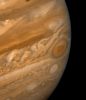
Jupiter-V2-LAFT-PIA01370_modest.jpgLate afternoon on Jupiter...64 visiteCaption NASA originale:"This color composite made from Voyager 2 narrow-angle camera frames shows the Great Red Spot during the late Jovian afternoon. North of the Red Spot lies a curious darker section of the South Equatorial Belt (SEB), the belt in which the Red Spot is located. A bright eruption of material passing from the SEB northward into the diffuse equatorial clouds has been observed on all occasions when this feature passes north of the Red Spot. The remnants of one such eruption are apparent in this photograph".
(11 voti)
|
|

Jupiter_s limb-Gal-PIA00896_modest.jpgJupiter's limb, from Galileo78 visiteCaption NASA originale:"North is at the top. The images are projected on a sphere, with features being foreshortened towards the north. The planetary limb runs along the right edge of the mosaic. Cloud patterns appear foreshortened as they approach the limb. The smallest resolved features are tens of kilometers in size. These images were taken on April 3, 1997, at a range of 1.4 MKM by the Solid State Imaging system (CCD) on NASA's Galileo spacecraft".
(11 voti)
|
|

Jupiter-V1-PIA01324_modest.jpgCrescent Jupiter (from Voyager 1)64 visiteCaption NASA originale:"This crescent view of Jupiter was taken by Voyager 1 on March 24, 1979. This image was taken through three color filters and recombined to produce the color image. This photo was assembled from three black and white negatives by the Image Processing Lab at Jet Propulsion Laboratory".
(11 voti)
|
|

Jupiter-HW-PIA00360_modest.jpgHigh Winds on Jupiter (from appx. 4.000.000 Km)66 visiteCaption NASA originale:"A high resolution image of the Jovian mid-latitudes taken by Voyager 1 on March 2, 1979, shows distinctly differing characteristics of the planet's meteorology. The well defined pale orange line running from southwest to northeast (North is at the top) marks the high speed north temperate current with wind speeds of about 120 meters p/s. These high winds produce a cleaner flow pattern in the surrounding clouds whose average lifetime is of about 2 years".
(11 voti)
|
|
| 4547 immagini su 379 pagina(e) |
 |
|
|
|
|
17 | |
|
|
|
|





