| Piú votate - SOLAR SYSTEM |

Saturn-N00063521-04.jpgSaturnian "Shooting Star" and a Shooting Star from Earth195 visiteIl raffronto fra queste immagini ci sembra una prova sufficiente per poter rivendicare, come Lunar Explorer Italia - e diremmo definitivamente - la paternità di questa piccola (ma, secondo noi, splendida e significativa) scoperta: la prima Stella Cadente colta nello spazio di un mondo diverso dalla Terra!
Peccato che la NASA non abbia niente da dire...
(11 voti)
|
|

Solar Eclypse 2006-tse2006_ayiomamitis_f.jpgThe "Diamond Ring"64 visiteDa "NASA - Picture of the Day" del 30 Marzo 2006:"The track of totality for the first solar eclipse of 2006 began early yesterday on the East coast of Brazil and ended half a world away at sunset in Western Mongolia. In between, the shadow of the Moon crossed the Atlantic Ocean, Northern Africa, central Asia and so came for a moment to the small Greek island of Kastelorizo in the Eastern Aegean.
Astronomer Anthony Ayiomamitis reports that the islanders and many eclipse-watching visitors were indeed treated to an inspiring display of the beautiful Solar Corona as totality lasted about 3 minutes.
As the total phase of the eclipse ended, he was able to capture this striking "Diamond Ring" image. In it, the first rays of sunlight shining through edge-on lunar valleys create the fleeting appearance of glistening diamonds set in a bright ring around the Moon's silhouette".
(11 voti)
|
|

Comets-Comet_Pojmanski-4.jpgThe "Pojmanski" Comet (HR)70 visiteComet Pojmanski flew by planet Earth last weekend (March 4/5, 2006) on a surprise trip through the Inner Solar System. (...)
Pojmanski ultimately showed off a long tail, but also presented some lovely green-blue hues as gas molecules in its tenuous coma and tail fluoresced in the sunlight. Astronomers Adam Block and Jay GaBany recorded this colorful HR view on March 3rd, 2006, in the darkness just before twilight. The picture spans about two full moons on the sky. Comet Pojmanski (C/2006 A1) is outward bound and fading now, still visible in binoculars for northern hemisphere observers.
(11 voti)
|
|

Terminator.jpgLunar Terminator90 visitenessun commento
(11 voti)
|
|

A-Venus.gifThe Phases of Venus (2) - GIF114 visiteCaption originale:"Venus goes through phases. Just like our Moon, Venus can appear as full as a disk or as a thin as a crescent. Venus, frequently the brightest object in the post-Sunset or pre-Sunrise Sky, appears so small, however, that it usually requires binoculars or a small telescope to clearly see its current phase. The above time-lapse sequence, however, was taken over the course of many months and shows not only how Venus changes phase but how it's apparent angular size also changes. In the middle negative image, Venus is in a new phase, the same phase that occurred during its rare partial eclipse of the Sun in 2004".
(11 voti)
|
|

Venusian_Surface-Venera_13-03.jpgVenus from Venera 13 (detail mgnf)132 visiteSpettacolare dettaglio di un frame originale Venera 13 il quale ci mostra, molto vicino al Lander, delle rocce che - ad occhio - sembrano essere di natura basaltica (ergo avere un'origine vulcanica).
Molto intrigante il dettaglio, visibile in alto a Sx e proprio a ridosso della linea dell'orizzonte, di un rilievo immerso nella nebbia. Si direbbe una modesta collina dal profilo smussato (simile alla famosa Husband Hill di Gusev Crater). Un profilo così smussato da farla somigliare ad una sorta di "cupola".
Una splendida elaborazione, davvero.
(11 voti)
|
|

Itokawa-03.pngThe Southern Hemisphere of Itokawa66 visiteAfter reaching the sub-solar point, Hayabusa started to travel out of the ecliptic plane to observe the polar regions of Itokawa. This image shows the Southern Hemisphere
of Itokawa. Due to the low altitude and solar elevation angles, we can see detailed topography in the high-latitude regions. There are even some boulders on Muses-Sea, which looked very smooth in previous observations. Imagine one of these boulders flying in space. If it came to the Earth's vicinity, we would observe it as a tiny independent near-Earth asteroid. It has long been conjectured that meteorites are fragments of asteroids delivered to the Earth's surface, but it remains to be proven. The samples of Itokawa collected and returned by Hayabusa could provide the first direct evidence of the link between asteroids and meteorites.
(11 voti)
|
|

Pandora-PIA07632.jpgBeautiful Pandora (false colors)96 visiteCassini's best close-up view of Saturn's F-Ring shepherd moon, Pandora, shows that this small ring-moon is coated in fine dust-sized icy material.
Craters formed on this object by impacts appear to be covered by debris, a process that probably happens rapidly in a geologic sense. The grooves and small ridges on Pandora suggest that fractures affect the overlying smooth material. The crisp craters on another Saturn moon, Hyperion, provide a contrasting example of craters on a small object.
Cassini acquired infrared, green and ultraviolet images on Sept. 5, 2005, which were combined to create this false-color view. The image was taken with the Cassini spacecraft narrow-angle camera at a distance of approx. 52.000 Km from Pandora and at a phase angle of 54°. Resolution in the original image was about 300 mt per pixel".
Nota: un'immagine stupenda e spettacolare e poi, per i più attenti, come non notare l'incredibile somiglianza (troppo grande per essere casuale...) di questa luna con Phobos?
(11 voti)
|
|
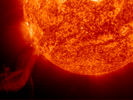
SunFlame-Soho.jpgSolar Prominence70 visiteCaption NASA originale:"What happened to the Sun? Nothing very unusual: the strange-looking solar appendage on the lower left is actually just a spectacular looking version of a common solar prominence. A solar prominence is a cloud of solar gas held above the Sun's surface by the Sun's magnetic field. Pictured above in 2002 October, NASA's Sun-orbiting SOHO spacecraft imaged an impressively large prominence hovering over the surface, informally dubbed a flame. Over 40 Earths could line up along the vast length of the fireless flame of hovering hot gas. A quiescent prominence typically lasts about a month, and may erupt in a Coronal Mass Ejection (CME) expelling hot gas into the Solar System. Although somehow related to the Sun's changing magnetic field, the energy mechanism that creates and sustains a Solar prominence is still a topic of research".
(11 voti)
|
|

AAA-NeptuneandTriton-CJH.gifNeptune and Triton in natural colors - from Voyager 267 visiteNon si possono fare commenti ad immagini suggestive come questa: Vi lasciamo con la Vostra Fantasia ed Immaginazione, per provare a sentire che cosa questa "corsa infinita" del Voyager 2 Vi suggerisce...
(11 voti)
|
|

AAA-Uranus&Co..jpgThe Uranus' "Family"102 visitenessun commento
(11 voti)
|
|
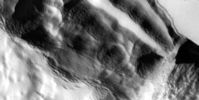
Io-PIA02597.jpgTelegonus Mensa in HR64 visiteA cliff slumps outward in these HR view that NASA's Galileo spacecraft captured of the edge of a mountain named Telegonus Mensa on Jupiter's moon Io. When Galileo flew near the South Pole of Io in October 2001, scientist's targeted this cliff to study the process of erosion. Water and wind cause most erosion on Earth, but Io has neither surface water nor atmosphere. The cliff is slumping due to gravity (?). The picture has a resolution of about 10 mt (33 feet) per picture element. Galileo's camera took it from a distance of about 1000 Km (about 620 miles). North is to the top and the Sun illuminates the surface from the upper right.
(11 voti)
|
|
| 4547 immagini su 379 pagina(e) |
 |
|
|
|
|
14 | |
|
|
|
|





