| Piú votate - SOLAR SYSTEM |

Io-Sulphur volcanism-PIA03887_modest.jpgPotential Source of Sulphur Flow on Io75 visiteA field of bright lava flows next to a shield volcano could be a source of recent sulfur volcanism on Io, as detected by instruments aboard NASA's Galileo spacecraft.
The mosaic at left combines higher-resolution images (330 meters or about 1080 feet per picture element) taken in October 2001 with lower-resolution color images (1.4 kilometers or 0.9 mile per picture element) taken in July 1999 by Galileo's solid-state imaging camera.
By comparing these images with a map of hot spots taken in February by Galileo's near-infrared mapping spectrometer (lower right), Galileo scientists noted that a new hot spot west of the active volcano Prometheus became bright in February 2000 and dimmed later. This hot spot appears to correspond with the bright flow field just west of a recently discovered shield volcano (see PIA03532), which is the only fresh volcanic material in the area.
The relatively low intensity of the February 2000 hot spot in the infrared data suggests a low-temperature eruption, consistent with sulfur lava rather than silicate lava as found elsewhere on Io and also on Earth. Sulfur lavas are thought to cool to a gray-yellow color on Io, as seen in the new flow field visible in the camera image. This bright flow field could be the best example of active sulfur lava flows deposited on Io during the Galileo mission. At upper right is a global view of Io showing the location of the more-detailed images.
The low temperature of this hot spot differs from many of Io's other active volcanoes, such as Pele, Tvashtar and Prometheus. Intense tidal flexing of Io helps keep the moon's interior molten, at some places producing silicate lavas hotter than any seen on Earth in billions of years. Io has the greatest known diversity of volcanic activity in the solar system.
North is to the top of all these images.

(12 voti)
|
|

Landing on Titan (3).jpgSaturn, through the fog of Titan123 visiteTitan's surface may hold lakes of liquid ethane and methane, sprinkled over a thin veneer of frozen methane and ammonia. Most of the brownish-orange color comes from more heavily processed hydrocarbons present in Titan's atmosphere and on its surface. Artistic license has been used to exaggerate the size of the orbiter, the sharpness of the icy features, the tilt of Saturn's rings, and the visibility of the planet through Titan's atmosphere.
(12 voti)
|
|

Jupiter-WO-PIA01513_modest.jpgWhite Ovals on Jupiter63 visiteCaption NASA originale:"This photo of Jupiter was taken by Voyager 1 on March 1st, 1979, from a distance of 4.300.000 Km. The region shown is just to the southeast of the Great Red Spot. A small section of the spot can be seen at upper left. One of the 40-year-old white ovals in Jupiter's atmosphere can also be seen at middle left, as well as a wealth of other atmospheric features, including the flow lines in and around the ovals.
The smallest details that can be seen in this photo are about 80 Km across".
(12 voti)
|
|
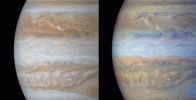
Jupiter-CH-PIA02877_modest.jpgReal Colors and False Colors of Jupiter71 visiteCaption NASA originale:"These color composite frames of the mid-section of Jupiter were of narrow angle images acquired on December 31, 2000, a day after Cassini's closest approach to the planet. The smallest features in these frames are roughly ~ 60 kilometers. The left is natural color, composited to yield the color that Jupiter would have if seen by the naked eye. The right frame is composed of 3 images: two were taken through narrow band filters centered on regions of the spectrum where the gaseous methane in Jupiter's atmosphere absorbs light, and the third was taken in a red continuum region of the spectrum, where Jupiter has no absorptions".
(12 voti)
|
|
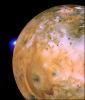
Io-Plumes from Loki-V1-PIA00010_modest.jpgLoki's eruption on Io (the "Plume")73 visiteUn'informazione importante per chi volesse provare a calcolare le dimensioni effettive della "piuma vulcanica" (conoscendo, ovviamente, le dimensioni di Io): l'immagine è stata scattata da (circa) 490.000 Km.
Original caption:"Voyager 1 image of Io showing active plume of Loki on limb. Heart-shaped feature southeast of Loki consists of fallout deposits from active plume Pele. The images that make up this mosaic were taken from an average distance of approximately 490.000 Km (about 340.000 miles)".
(12 voti)
|
|

Io-Sodium cloud-2-PIA01109.jpgA sodium cloud from Io (1)90 visiteUna "Nube di Sodio da Io", intitola questa serie di 4 immagini. Ma di che cosa si tratta realmente?
Ebbene, in questo specifico frangente si tratta della ripresa di una "ondata" (letteralmente) di vapori di sodio provenienti da Io a seguito di una delle (tante) eruzioni che lo caratterizzano. Nulla di speciale, insomma.
Ma c'è una curiosità, a proposito dei "vapori di Sodio", che ci farebbe piacere raccontare: solo pochi Appassionati e Cultori della Materia, infatti, conoscono e sanno che cosa significa, in termini di navigazione interplanetaria, "rilasciare una nube di Sodio". Ebbene si tratta di un esperimento relativo alla verifica empirica circa la correttezza della traiettoria assunta da una qualsiasi Sonda interplanetaria durante il suo percorso (un check, insomma, che i campi gravitazionali degli astri accanto ai quali essa deve passare, passa o è passata, non abbiano, in qualche modo, determinato delle "deviazioni" impreviste).
(12 voti)
|
|

Io-Southern Polar Region-PIA00327.jpgThe Southern Polar Region of Io64 visitenessun commento
(12 voti)
|
|

Io-The eruption of Pele-PIA00323.jpgThe eruption of "Pele" on Io64 visitenessun commento
(12 voti)
|
|

Io-Southern Limb and light-PIA02250.jpgThe Southern Limb of Io and a possible "Transient Phoenomenon"74 visiteUn'immagine interessantissima del bordo dell'emisfero sud di Io. Elevatissimo dettaglio e grande suggestione del paesaggio. Io è un mondo violento ed in costante tumulto: il numero di vulcani attivi su questo Pianeta è elevatissimo (gli ultimi dati in nostro possesso parlavano di 6 vulcani attivi contemporaneamente), dunque non ci meravigliamo se vediamo delle flares, come quella alla Dx di questo frame, splendere nel buio. Potrebbe trattarsi di un outgassing: un classico fenomeno transitorio.
Original caption:"NASA's Galileo spacecraft captured this dramatic image of mountains on Io in February 2000. The image was taken when the Sun was low in the sky, illuminating the scene from the left, so it reveals topographic details of Io's surface. A low scarp, roughly 250 meters (820 feet) high, runs from the upper left toward the center of the image. Mongibello Mons, the jagged ridge at the left of the image, rises 7 kilometers (23,000 feet) above the plains of Io, higher than any mountain in North America. Few of Io's mountains (see also PIA02526) resemble volcanoes. Instead, Galileo scientists believe that the mountains are formed when blocks of Io's crust are uplifted along thrust faults. Angular mountains are thought to be younger, while older mountains have more subdued topography, such as the rise near the top center of this image.
The image has a resolution of 335 meters (1,100 feet) per picture element. North is to the top of the image.
(12 voti)
|
|

Io-Ionian Mountains and calderas-PIA02526.jpgIonian Mountains and Calderas on Io (real colors)92 visitenessun commento
(12 voti)
|
|

A-The Sun from Soho~0.jpgA colorful Sun, a Solstice celebration146 visiteCaption NASA originale: "This composite image combines Extreme Ultravoilet Imaging Telescope (EIT)images from three wavelengths(171, 195 and 284 angstrom) into one that reveals solar features unique to each wavelength. Since the EIT images come to us from the spacecraft in black and white, they are color coded for easy identification. For this image, the nearly simultaneous images from May 1998 were each given a color code (red, yellow and blue) and merged into 1. SOHO is a project of international cooperation between ESA and NASA".
(12 voti)
|
|

Venusian_Surface-Venera_09-001.jpgVenus from Venera 9 - October, 22, 1975 - enhanced and processed image312 visiteOsservate ora il panorama ripreso da Venera 9, sette anni prima: tutto quanto molto simile tranne, forse, la sensazione che in quest'area, al momento dello scatto della fotografia, non stesse "piovendo" (guardate bene l'immagine scattata da Venera 13 e cercate di cogliere la diversità, in termini di riflettenza, fra le due superfici riprese).
Notate, infine, che questa fotografia è l'UNICA che Venera 9 riuscì a scattare e ad inviare a Terra durante la sua breve permanenza sul Pianeta: solo 53 minuti, ma comunque un'eternità ed un grandissimo successo, considerata la tecnologia disponibile negli anni '70/'80 (in rapporto a quella posseduta oggi)!
(12 voti)
|
|
| 4547 immagini su 379 pagina(e) |
 |
|
|
|
|
12 | |
|
|
|
|





