| Piú votate - SOLAR SYSTEM |

ZZ-PIA00450.jpgThe Sun from 4 Billion Miles - Voyager 276 visiteCaption NASA originale:"This image of the Sun was taken by the Voyager 1 on Feb. 14, 1990, when it was approximately 32° above the plane of the ecliptic and at a slant-range distance of approximately 4BM. It is the first - and may be the only - time that we will ever see our Solar System from such a vantage point. This image is a portion of a wide-angle image containing the Sun and the region of space where the Earth and Venus were at the time. The wide-angle was taken with the camera's darkest filter (a methane absorption band) and the shortest possible exposure (5/1000 sec.) to avoid saturating the camera's vidicon tube with scattered sunlight. The Sun is not large in the sky as seen from Voyager's perspective at the edge of the Solar System but is still 8M times brighter than the brightest star in Earth's sky: Sirius.
The result of the brightness is a bright burned out image with multiple reflections from the optics in the camera. The "rays" around the Sun are just a diffraction effect".
(12 voti)
|
|

AA-Neptune-HST-PIA01284.jpgNeptune in "Primary Colors" - HST70 visiteCaption NASA originale:"These 2 NASA HST images provide views of weather on opposite hemispheres of Neptune. Taken Aug. 13, 1996, with Hubble's Wide Field Planetary Camera 2, these composite images blend information from different wavelengths to bring out features of Neptune's blustery weather. The predominant blue color of the planet is a result of the absorption of red and infrared light by Neptune's methane atmosphere. Clouds elevated above most of the methane absorption appear white, while the very highest clouds tend to be yellow-red as seen in the bright feature at the top of the right-hand image. Neptune's powerful equatorial jet - where winds blow at nearly 900 mph! - is centered on the dark blue belt just south of Neptune's equator. Farther south, the green belt indicates a region where the atmosphere absorbs blue light".
(12 voti)
|
|
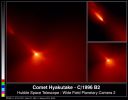
Comets-Comet_Hyakutake-PIA01290_modest.jpgThe "Hyakutake" Comet71 visiteFULL-FIELD VIEW (Left)--->This image is 3340 Km acroos and shows that most of the dust is being produced on the sunward-facing hemisphere of the comet. Also at upper left are 3 small pieces which have broken off the comet and are forming there own tails. Icy regions on the nucleus are activated as they rotate into sunlight, ejecting large amounts of dust in the jets that are faintly visible in this image. Sunlight striking this dust eventually turns it around and "blows" it into the tailward hemisphere. What might be another jet is emanating from the nightside of the nucleus, but this direction might be misleading due to the angle of the jet relative to our line-of-site.
CLOSE-UP OF NUCLEUS (Bottom Right) This expanded view of the near-nucleus region is only 760 Km across. The nucleus is near the center of the frame, but the brightest area is probably the tip of the strongest dust jet rather than the nucleus itself. Presumably, the nucleus surface lies just below this bright jet.
CLOSE-UP OF COMET FRAGMENTS (Top Right) This image shows pieces of the nucleus that apparently broke off and were first detected during ground-based observations on March 24. The Hubble image shows at least three separate objects that are probably made up of coarse-grained dust. Large fragments of the nucleus would not be accelerated into the tail, which appears to be the case in this image.
(12 voti)
|
|
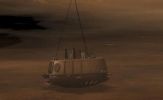
Titan-IMG001293-br500.jpgHuygens is landed on Titan!97 visitenessun commento
(12 voti)
|
|

Miranda-PIA00038_modest.jpg"Chevron grooves" on Miranda - HR113 visiteCaption NASA originale:"This image of Miranda, obtained by Voyager 2 on approach, shows an unusual 'chevron' figure and regions of distinctly differing terrain on the Uranian moon. Voyager was 42.000 Km (26.000 miles) away when its narrow-angle camera acquired this clear-filter view. Grooved areas baring light and dark bands, distinct from other areas of mottled terrain, are visible at this resolution of about 600 meters (2.000 feet). The bright V-shaped feature in the grooved areas is the 'chevron' observed in earlier, lower-resolution images. Cutting across the bands are sinuous scarps, probably faults. Superimposed on both types of terrain are many bowl-shaped impact craters less than 5 Km (3 mi) wide. The entire picture spans an area about 220 Km (140 mi) across".
(12 voti)
|
|

Saturn.jpgSaturn in real colors74 visitenessun commento
(12 voti)
|
|

Dione-PIA06155-1.jpgDione and Saturn in natural colors98 visiteCaption NASA originale:"Cassini captured Dione against the globe of Saturn as it approached the icy moon for its close rendezvous on Dec. 14, 2004. This natural color view shows the moon has strong variations in brightness across its surface, but a remarkable lack of color, compared to the warm hues of Saturn's atmosphere. Several oval-shaped storms are present in the planet's atmosphere, along with ripples and waves in the cloud bands.
The images used to create this view were obtained with the Cassini spacecraft wide-angle camera at a distance of approximately 603.000 Km from Dione through a filter sensitive to wavelengths of ultraviolet light centered at 338 nanometers. The Sun-Dione-spacecraft, or phase, angle is 34°. The image scale is about 32 Km per pixel".
(12 voti)
|
|

Miranda-V2-PIA00141_modest.jpgMiranda's limb from Voyager 2 - January 24, 1986112 visiteEd ecco ora Miranda, la Luna più interna di Urano. Essa ha una forma decisamente irregolare ed evidenzia molto chiaramente - come in questo frame - delle profonde "cicatrici" superficiali le quali rivelano, come dicono alla NASA, una "complessa storia geologica". EccoVi parte della caption originale NASA per questa foto:"...At least 3 terrain types of different age and geologic style are evident at this resolution of about 700 (2.300 feet) meters. Visible in this clear-filter, narrow-angle image are, from left: (1) an apparently ancient, cratered terrain consisting of rolling, subdued hills and degraded medium-sized craters (2) a grooved terrain with linear valleys and ridges developed at the expense of, or replacing, the first terrain type and (3) a complex terrain seen along the terminator, in which intersecting curvilinear ridges and troughs are abruptly truncated by the linear, grooved terrain. Voyager scientists believe this third terrain type is intermediate in age between the first two".
(12 voti)
|
|

AA-Neptune-HST-PIA01287_modest.jpgNeptune from HST86 visiteLa seconda serie di immagini del Pianeta Nettuno, ripreso dal Telescopio Spaziale Hubble. Poco da aggiungere rispetto a quanto già detto in precedenza se non che la (quasi totale) impossibilità di fotografare amatorialmente Nettuno dalle nostre latitudini dipende da un continuo e costante degrado dell'atmosfera che ci circonda: inquinamento gassoso ed inquinamento luminoso fanno a gara per vedere quale dei due sia il peggiore.
Purtroppo, sebbene per motivi ed in ambiti diversi, sono entrambi "letali"!
(12 voti)
|
|
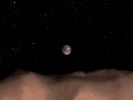
Toutatis.jpgEarth from the asteroid "Toutatis"101 visiteOn September 29, 2004, the Earth came within 1 million miles of the asteroid Toutatis - the closest predicted approach of our fair planet to a sizable asteroid or comet in this century. Coming within 1 million miles (or about 4 times the Earth-Moon distance), Earth would appear to be nearly the size of the full moon in the asteroid's sky, as suggested in this illustration. In Earth's sky, Toutatis appeared only as a faint object rapidly moving against a background of stars. Also known as Earth-Crossing Asteroid (ECA) 4179, Toutatis is in an eccentric 4 year orbit which moves it from the asteroid belt between Mars and Jupiter to just inside Earth's orbit. When the Earth passed near it in 1992 Toutatis was imaged by radar and seen to be 2 irregularly shaped lumps, perhaps joined by a narrow neck. This bizarre object is about 3 Km wide, 5,5 Km long and is tumbling through space. Studies of Toutatis and other ECA's help reveal connections between the Solar System's meteorites main-belt asteroids and comets.
(12 voti)
|
|

Landing on Mars.jpgLanding on Mars151 visiteA livello di curiosità Vi suggeriamo, se volete vedere una ricostruzione davvero molto credibile di un futuro "landing on Mars" (a base di paracadute prima ed airbags poi), la sequenza della discesa della capsula di emergenza con 5 astronauti a bordo che viene presentata nel discreto Sci-Fi Movie "Red Planet".
(12 voti)
|
|
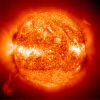
Sun-prom1743_eit_big.jpgAnother "Solar Prominence" from Soho93 visiteCaption NASA originale:"This large prominence is significant not only for its size, but also for its shape. The picture was taken early in the year 2000 by the Sun-orbiting SOHO satellite. Although large prominences and energetic Coronal Mass Ejections (CMEs) are relatively rare, they are occurred more frequently near Solar Maximum, such as the time of peak sunspot and solar activity in the 11 year solar cycle".
(12 voti)
|
|
| 4547 immagini su 379 pagina(e) |
 |
|
|
|
|
11 | |
|
|
|
|





