| |

| Piú votate - SOLAR SYSTEM |

Saturn_s Rings.jpgTouchin' "The Rings"...95 visitenessun commento
(12 voti)
|
|

Comets-Comet_Pojmanski-2.jpgThe "Pojmanski" Comet66 visiteE' passata inosservata, lontana dalla nostra Terra, ed è stata ben lungi dall'essere spettacolare come lo fu, qualche anno fa, la meravigliosa Hale-Bopp.
Certo, la cometina Pojmanski non aveva - forse - i numeri giusti per entrare nell'Albo delle (cosiddette) Grandi Comete, ma certo è che i media (TUTTI!) se ne sono guardati bene dal pubblicizzarla. E la NASA? Leggerete Voi stessi le scarne note prodotte al riguardo nel "NASA - Picture of the Day" del giorno 6 Marzo 2006. Noi, nel nostro piccolo, dato che ci meravigliamo per niente, siamo andati in cerca di fotografie di questa cometa ed abbiamo "scoperto" una straordinaria somiglianza fra C/2006 A1 (la Pojmanski Comet appunto) e la C/2004 Q2 (meglio nota come Machholz Comet). Uguale tipologia - o classe visuale - di appartenenza (nucleo sferico e chioma filiforme) e, soprattutto, uguale colore (ergo uguale - o comunque molto simile - composizione chimica). Deduzione logica: si tratta di "Sister-Comets". Domanda: ci sono altre "sorelle" in arrivo?!?
Have you ever seen a comet? Comets bright enough to be visible to the unaided eye appear only every few years. Right now, however, a new comet has brightened unexpectedly and is visible as a faint streak to the unaided northern observer in the eastern morning sky just before sunrise. Binoculars may help. Comet Pojmanski, officially designated C/2006 A1 and discovered only in January, now sports a turquoise tail several times longer than the full moon. Comet Pojmanski's ion tail is due to gas particles expelled by the comet being pushed away from the Sun by the solar wind, the same wind that ionizes gas in the tail causing its blue tint. Pictured above as it appeared only last week, Comet Pojmanski has now begun to fade as its orbit around the Sun takes it further from the Earth.
(12 voti)
|
|

Voyagers-Heliosphere6b.JPGWhere are the "Pioneers"?91 visitePioneer 10 will continue into interstellar space, heading generally for the red star Aldebaran, which forms the eye of Taurus. Aldebaran is about 68 LY away and it will take Pioneer over 2 MY to reach it.
The Mission of Pioneer 11 has ended: the last communication from
Pioneer 11 was received in November 1995, shortly before the Earth's motion carried it out of view of the spacecraft antenna. The spacecraft is headed toward the constellation of Aquila, Northwest of the constellation of Sagittarius. Pioneer 11 will pass near one of the stars of Sagittarius in about 4 MY.
PIONEER SPACECRAFT CONDITIONS: very cold with most temperature readings at the bottom of their scale. Bus voltage about 26 volts (nominal is 28). Uplink received from DSS 14 at -131.7 dbm. Two commands received, both confirmed as executed. Geiger Tube Telescope Instrument on, and data received.
Project Phoenix has been observing Pioneer 10 at Arecibo in Puerto Rico through the auspices of the SETI Institute. The signal from Pioneer 10 was also picked up at Arecibo on 2 March 2002.
The last telemetered data from the University of Iowa cosmic ray instrument were as follows: 2 March 2002 (39 minutes of clean data) (r = 79.83 AU) 27 April 2002 (33 minutes of clean data) (r = 80.22 AU)
At GMT 17:27:30, Saturday, 4/28/01, the signal from Pioneer 10 was received at station 63 in Madrid, the first time since August 5/6 of 2000. So it appears that Pioneer 10 has life, albeit in another mode - i.e., only in a two-way coherent mode. We have been listening for the Pioneer 10 signal in a one-way downlink non-coherent transmission mode since last summer with no success. We therefore conclude that in order [for Pioneer 10] to talk to us, we need to talk to it. This means from now on, we need two-way round-trip light time (RTLT) passes to allow the Deep Space Network (DSN) to send up a strong stable signal to lock up with a coherent downlink signal.
(12 voti)
|
|
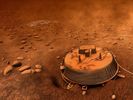
Titan-IMG001958-br500.jpgHuygens' Landing Site102 visiteThis is an artist's interpretation of the area surrounding the Huygens Landing Site, based on images and data returned on Jan. 14, 2005.
On January 14, 2005, the European Space Agency's (ESA) Huygens Probe reached the upper layer of Titan's atmosphere and landed on the surface after a parachute descent 2 hours and 28 minutes later.
As part of the joint NASA/ESA/ASI mission to Saturn and its Moons, the Huygens Probe was sent from the Cassini spacecraft to explore Titan, Saturn's largest moon. Titan's organic chemistry may be like that of the primitive Earth around 4000 MY ago, and it may hold clues about how life began on our Planet.
Nota: permetteteci un piccolo commento su questo "grande successo". Di dati significativi sull'ambiente di Titano (p.e.: temperature medie nel ciclo giorno/notte; presenza o meno di venti; presenza o meno di polveri in sospensione; componenti primari dell'atmosfera a varie altitudini etc.), ad oggi, non ci pare ne sìano emersi. A parte qualche "sembra" e qualche "si sta ancora studiando" non c'è ancora nulla di solido su cui lavorare (o almeno speculare). E questo per non dire delle fotografie di Titano al suolo: dovevano dirci tanto. Alla fine, quelle poche (ed orrende) immagini ricevute non ci hanno detto assolutamente niente.
La "Discesa dell'Europa su Titano" (come si scrisse in tono trionfalistico un anno fa - per poi dimenticare tutto in 24 ore...) fu dunque vera gloria?
Ai posteri l'ardua sentenza...
(12 voti)
|
|

024-Vesta.jpg4-Vesta67 visite4-Vesta (o anche solo Vesta) è uno dei tanti asteroidi conosciuti da tantissimo tempo e che sembra, di quando in quando, avvicinarsi (in senso cosmico...) in maniera "perigliosa" al nostro pianeta.
Ma lo sanno tutti - gli Scienziati per primi - che, un giorno o l'altro, da oggi a fra qualche milione di anni nel futuro, qualche "roccia vagante" finirà con l'incrociare la sua orbita con quella della Terra e, quindi, con il produrre - con ogni probabilità - una catastrofe di dimensioni globali la quale sarà causa di sostanziali cambiamenti dell'intero ecosistema.
E' inevitabile, si sa.
Così come si sa che, quando questo momento arriverà, gli ultimi a prenderne atto saranno proprio quelli che, questo Pianeta, lo abitano...
(12 voti)
|
|
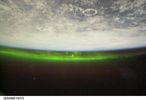
Coronal Aurora - ISS.jpgCoronal Aurora from Space74 visiteOriginal caption:"From the ground, spectacular auroras seem to dance high above. But the International Space Station (ISS) orbits at nearly the same height as many auroras, sometimes passing over them, and sometimes right through them. Still, the auroral electron and proton streams pose no direct danger to the ISS. In 2003, ISS Science Officer Don Pettit captured the green aurora, pictured above in a digitally sharpened image. From orbit, Pettit reported that changing auroras appeared to crawl around like giant green amoebas. Over 300 Km below, the Manicouagan Impact Crater can be seen in northern Canada, planet Earth".
(12 voti)
|
|

Jupiter-1994-33-a-full_jpg.jpgJupiter in natural colors, after being struck by Shoemaker-Levy 966 visiteThis image of the giant planet Jupiter, by NASA's HST, reveals the impact sites of fragments "D" and "G" from Comet Shoemaker-Levy 9.
The large feature was created by the impact of fragment "G" on July 18, 1994 at 3:28 a.m. EDT. It entered Jupiter's atmosphere from the south at a 45° angle and the resulting ejecta appears to have been thrown back along that direction. The smaller feature to the left of the fragment "G" impact site was created on July 17, 1994, at 7:45 a.m. EDT by the impact of fragment "D".
This image was taken 1h and 45' after fragment "G" impacted the Planet. The "G" impact has concentric rings around it, with a central dark spot that is about 2.500 Km in diameter. Such a dark spot is surrounded by a thin, dark, ring whose diameter is roughly 7.500 Km.
Last (but not least...), the dark, thick, outermost ring's inner edge has a diameter of approx. 12.000 Km (the size of Earth...).
The impact sites are located in Jupiter Southern Hemisphere at a latitude of about 44°.
(12 voti)
|
|

Jupiter-1994-35-a-web_print.jpgJupiter in ultraviolet light, after being struck by Shoemaker-Levy 965 visiteUltraviolet image of Jupiter taken by the Wide Field Camera of the HST. The image shows Jupiter's atmosphere at a wavelength of 2550 Angstroms after many impacts by fragments of comet Shoemaker-Levy 9. The most recent impactor is fragment R which is below the center of Jupiter (third dark spot from the right). This photo was taken 3:55 EDT on July 21, 1994, about 2,5 hours after R's impact. A large dark patch from the impact of fragment H is visible rising on the morning (left) side. Proceeding to the right, other dark spots were caused by impacts of fragments Ql, R, D and G (now one large spot) and L, with L covering the largest area of any seen thus far.
The spots are all very dark in ultraviolet light because - we think - a large amount of dust, right after the impacts, was being deposited on the upper layers of Jupiter stratosphere - and dust absorbs Sunlight.
The dark, round spot just above the center of Jupiter is the moon "Io".
(12 voti)
|
|

Neptune_sEye-TheDarkSpot-V2-CJH.gifThe "Dark Spot" of Neptune69 visitenessun commento
(12 voti)
|
|

Tenth_Planet-03.jpgThe 10th Planet? (3)63 visiteDa "NASA - Picture of the Day", del 1mo Agosto 2005:"Has a tenth planet been discovered? A newly discovered object, designated 2003 UB313 and located more than twice the distance of Pluto, is expected to be at least as large as Pluto and probably larger, given current measurements. 2003 UB313's dimness and highly tilted orbit (44°) prevented it from being discovered sooner. Many astronomers speculate that numerous other icy objects larger than Pluto likely exist in the Kuiper Belt of the far distant Solar System. If so, and if some are found closer in than 2003 UB313, it may be premature to call 2003 UB313 the tenth planet. Illustrated above is an artist's drawing showing what 2003 UB313 might look. The unusually bright star on the right is the Sun. Much of the world eagerly await the decision by the International Astronomical Union on whether 2003 UB313 will be designated a planet or given a name without subscripts".
(12 voti)
|
|

TheRings-PIA07522.jpgFour versions of the "F-Ring"66 visiteCaption NASA originale:"This montage of 4 images of Saturn's knotted F-Ring shows different locations around the Ring itself. Even though all the images were taken within a few hours of each other, there is remarkable variation in the structure of the F-Ring at these four locations.
For example, the number of ring strands differs from image to image and in some images, kinks are clearly visible in the F-Ring, while other regions appear more smooth.
Astronomers believe that the structure of Saturn's F-Ring is governed by its shepherding moons, Prometheus and Pandora. The F-Ring's appearance is expected to vary depending on how recently a ring section has encountered each moon and how close the moon came to the ring".
Nota: nel primo quadro (in alto a Sx) c'è qualcosa, posto proprio al di sopra del 'nodo' centrale visibile sull'intreccio più luminoso dell'Anello F, che sembra un 'filamento' o, comunque, un oggetto estraneo all'Anello F stesso, ma reale (NON crediamo che sia un photo-artifact). Cos'è?
(12 voti)
|
|

Neq-Neptune-PIA00057.jpgThe "haze" of Neptune (false colors)73 visiteCaption NASA originale:"This false color photograph of Neptune was made from Voyager 2 images taken through 3 filters: blue, green and a filter that passes light at a wavelength that is absorbed by methane gas. Thus, regions that appear white or bright red are those that reflect sunlight before it passes through a large quantity of methane. The image reveals the presence of a ubiquitous haze that covers Neptune in a semitransparent layer. Near the center of the disk, sunlight passes through the haze and deeper into the atmosphere, where some wavelengths are absorbed by methane gas, causing the center of the image to appear less red. Near the edge of the Planet, the haze scatters sunlight at higher altitude, above most of the methane, causing the bright red edge around the planet. By measuring haze brightness at several wavelengths, scientists are able to estimate the thickness of the haze and its ability to scatter sunlight. The image is among the last full disk photos that Voyager 2 took before beginning its endless journey into interstellar space".
(12 voti)
|
|
| 4547 immagini su 379 pagina(e) |
|
|
|
|
|
10 | |
|
|
|
|
|
|





