| Piú votate - MARS |

SOU-SOL011-marspath_sunset.jpgMartian Sunset... - Sol 11107 visiteColori veri, quasi-veri o falsi?
Uno scorcio bellissimo, comunque, di un Cielo Marziano che si tinge di un intenso color rosso-fuoco, nelle ore del tardo pomeriggio.
Caption NASA originale:"This highly color-enhanced and horizontally stretched image shows layering of dust in the Martian Atmosphere brought out by the Martian Sunset of Sol 11 at the Pathfinder Landing Site. The dust is distributed high in the martian atmosphere, causing the sky to remain light over an hour after Sunset. The point of Sunset is off the right side of the frame".
(11 voti)
|
|
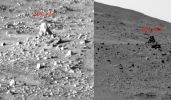
SOL813-825-A_P2408_R1b-A813R1-3.jpgThe "Totem" is alive! - Sol 813/825145 visitePer coloro i quali avessero avuto dei dubbi e/o per quanti pensano che gli Anomaly Hunters sono individui che soffrono di "traveggole", un nuovo mosaico del Dr Gianluigi Barca che ci mostra altri due "momenti" del rilievo superficiale che abbiamo battezzato "Totem".
Gli angoli visuali sono - e lo si vede bene - leggermente diversi, certo, ma le fattezze del Totem, invece, sono RADICALMENTE diverse (non nella loro forma esteriore bensì nella..."espressività" del rilievo)!
Nel Sol 813, il Totem è quasi del tutto piatto e "dormiente"; nel Sol 825, tutti i fori che caratterizzano la sua "faccia" sono aperti.
Attenzione: forse il Totem è "vivo" e forse non lo è, ma la NASA...Si rende conto, la "Grande NASA", di quello che "espone" sul suo Sito?!?
(11 voti)
|
|

ZE-I-Viking1Sky.jpgFrom the "Viking Archive" - Viking 1: late afternoon138 visiteThis is a Viking One late afternoon view on a fairly clear day. The bright sky near the Sun is apparently a lighter bluish color due to 'forward scattering'. The blue seen here is probably more camera induced than real. On Mars the 'Raleigh Scattering' which colors our sky blue is greatly diminished by the low atmospheric pressure. Although no obvious clouds were reported, The horizontal texture in the sky to the left of the overexposed region might just be some weak cloud detail.
(11 voti)
|
|

SOL731-PIA06102.jpgMartian "Corals" (approx. true colors) - Sol 73180 visiteThe change in textures and the location of the basalts may be signs that Spirit is driving along the edge of a lava flow. This lava may be the same as the basalt blanketing the plains of Spirit's Landing Site, or it may be different. The large size and frothy nature of the boulders around Lorre Ridge might indicate that eruptions once took place at the edge of the lava flow, where the lava interacted with the rocks of the basin floor. Scientists hope to learn more as Spirit continues to investigate these rocks.
As Earth approaches the Chinese New Year (The Year of the Dog), the Athena Science Team decided to use nicknames representing Chinese culture and geography to identify rocks and features investigated by Spirit during the Chinese New Year celebration period. In ancient Chinese myth, FuYi was the first great emperor and lived in the East. He explained the theory of "Yin" and "Yang" to his people, invented the net to catch fish, was the first to use fire to cook food, and invented a musical instrument known as the "Se" to accompany his peoples' songs and dances. Other rocks and features are being informally named for Chinese gods, warriors, inventors, and scientists, as well as rivers, lakes, and mountains.
Spirit took this image on the rover's Martian day, or sol, 731 (Jan. 23, 2006). This is an approximate true color rendering combining images taken with the Pancam's 750-nanometer, 530-nanometer and 430-nanometer filters.
(11 voti)
|
|

SOL731-PIA06101.jpgMartian "Corals" (false colors) - Sol 73168 visiteIn recent weeks, as NASA's MER Spirit has driven through the basin south of Husband Hill, it has been traversing mainly sand and dune deposits. This week, though, Spirit has been maneuvering along the edge of an arc-shaped feature called Lorre Ridge and has encountered some spectacular examples of basaltic rocks with striking textures. This PanCam image shows a group of boulders informally named "FuYi". These basaltic rocks were formed by volcanic processes and may be a primary constituent of Lorre Ridge and other interesting landforms in the basin.
Spirit first encountered basalts at its landing site 2 years ago, on a vast plain covered with solidified lava that appeared to have flowed across Gusev Crater. Later, basaltic rocks became rare as Spirit climbed Husband Hill. The basaltic rocks that Spirit is now seeing are interesting because they exhibit many small holes or vesicles, similar to some kinds of volcanic rocks on Earth. Vesicular rocks form when gas bubbles are trapped in lava flows and the rock solidifies around the bubbles. When the gas escapes, it leaves holes in the rock. The quantity of gas bubbles in rocks on Husband Hill varies considerably; some rocks have none and some, such as several here at FuYi, are downright frothy.
(11 voti)
|
|
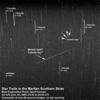
SOL643-PIA03613_fig1.jpgSpirit's search for meteors - Sol 64380 visiteSi vedano i commenti (nonchè la Original Caption) riportati nelle note al frame relativo al Sol 668.
(11 voti)
|
|

SOL643-2P183484842EFFAI38P2734L1M1.jpgA "streak" in the Martian Sky - Sol 643100 visiteUna "striscia" di luce decisamente lunga illumina il cielo notturno di Marte: sono appena passate le 22 MLT quando questo interessante fenomeno viene ripreso dalla Left PanCam di Spirit. Voi penserete che si tratta di uno dei 'soliti' raggi cosmici, magari un pò più intenso del solito, ma la realtà, a nostro parere, è che questa traccia appartiene ad un oggetto volante in movimento. Le strisce lasciate dai raggi cosmici - almeno sino ad ora - sono molto più brevi e meno intense (verificate Voi stessi: abbiamo svariati esempi di questo tipo di anomalìa nei nostri archivi).
In questo caso specifico, invece, la scia che appare nel cielo di Marte è identica a quella che caratterizza i Satelliti Iridium i quali, mentre ruotano su loro stessi, sembrano variare di luminosità ed emettere una sorta di flash (causato dai raggi del Sole che si riflettono sui loro pannelli). Se riuscite a "cogliere il momento" del flash ed a fotografarli, sulla foto che avrete ottenuto ci sarà una traccia IDENTICA a questa. Provate...
(11 voti)
|
|

SOL519-Husband5-PIA04180.jpgLooking at Husband's Summit - Sol 519 (Natural Colors; credits: NASA/JPL-Caltech)81 visiteEd ecco, così come accennavamo in sede di commento al sub-frame precedente, l'accecante biancore che, unito alla nebbiolina Marziana, copre, in parte, i rilievi più lontani di Gusev Crater e conferisce a questa visione un quid di vagamente 'familiare'.
Una bella immagine, ripetiamo, decisamente (ed almeno in accordo ai nostri mezzi ed alle nostre competenze ed esperienze) più realistica di quelle - svariate - ricostruzioni in pseudo-colori-quasi-veri che hanno caratterizzato le produzioni NASA degli ultimi mesi.
(11 voti)
|
|

032-Mars_Interior.jpgWhat's inside Mars?193 visiteMars interior is simply modeled as a core and mantle with a thin crust, similar to Earth. Mars' size and total mass are known. Given four parameters, the core size and mass and mantle size and mass can be determined.
The combination of Pathfinder Doppler data with earlier data from the Viking Landers has determined a very important parameter, the "Moment of Inertia", through measurement of Mars' precession rate. A fourth measurement is needed to complete the interior model. This may be achieved through future Doppler tracking of Pathfinder, since the presence of a fluid core may be detectable through its effect on Mars' nutation. The determination of the moment of inertia is a significant constraint on possible models for Mars' interior. If the core is as dense as possible (i.e. completely iron) and the mantle is similar to Earth's (or similar to the SNC meteorites thought to originate on Mars) then the minimum core radius is about 1300 Km. If the core is made of less-dense material (i.e. a mixture of iron and sulfur) than the core radius is probably no more than 2000 Km.
(11 voti)
|
|

ZH-Viking2-vlfmos21.jpgFrom the "Viking Archive" - Viking 2: full panorama154 visiteCaption NASA originale:"The Viking Lander 2 site in Utopia Planitia has more and larger blocks of stone than does the Viking Lander 1 site in Chryse Planitia. The stones are probably ejecta from impact craters near the Lander 2 site. Many of the rocks are angular and are thought to be only slightly altered by the action of wind and other forms of erosion. Drifts of sand and dust are smaller and less noticeable at the Lander 2 site. The overall red/orange coloring of the Martian terrain is due to the presence of oxidized iron in the regolith. The pink color of the sky is caused by extremely fine dust that is suspended in Mars' thin atmosphere".
Nota: 1) il cielo, in questa immagine in "almost true colors", noi lo vediamo verdastro e non rosa; 2) se l'atmosfera Marziana fosse davvero sottilissima, il cielo dovrebbe apparire MOLTO più SCURO di quanto invece non appare nelle immagini (rosso/arancio scuro nelle ore del giorno pieno - e cioè fra le 10 e le 15 MLT -, azzurro scuro con il "dimming").
(11 voti)
|
|

ZE-I-Viking2-21d049.jpgFrom the "Viking Archive" - Viking 2: surroundings226 visite...e Scienziati si sono concentrati?
Se l'atmosfera Marziana fosse davvero così sottile come ci dicono (anzi: come i rilievi effettuati da Sonde e Landers suggeriscono), il cielo di Marte dovrebbe apparire, semplicemente, quasi NERO!!!
Certo NON rosa, NON giallo (rectius: "butterscotch"), NON celeste e NON rosso, come invece appare in innumerevoli frames Viking, Soujourner/Pathfinder, Spirit ed Opportunity.
Allora, che cosa ne dite? La NASA si è 'incartata' da sola o - forse - siamo riusciti, con il prezioso aiuto del Dr Hamilton, a trovare una crepa nel muro compatto delle certezze scientifiche ufficiali?!?
(11 voti)
|
|

ZE-I-Viking1-12f010.jpgFrom the "Viking Archive" - Viking 1: Sunset145 visiteComposizione a colori dei Viking Lander frames n. 12f010.red, 12f010.grn, and 12f010.blu.
Come potete vedere, negli istanti che seguono la scomparsa del Sole dietro l'orizzonte Marziano, il cielo di Marte appare di un colore "blu-scuro" piuttosto cupo, decisamente intenso e, apparentemente, "soffocato" da una incombente oscurità.
Si tratta di un ennesimo effetto collaterale del cosiddetto "dimming"? Forse, ma anche questa istantanea entra nella galleria dei "frames belli ma discutibili", specialmente se la mettiamo a confronto con altre immagini similari (cioè relative a tramonti Marziani), riprese sempre a colori veri o quasi/veri, ed ottenute dalle Sonde Soujourner/Pathfinder e Spirit (le troverete pubblicate nella Sezione "Mars in Colors").
Guardate, fate i confronti e poi provate a dare qualche risposta agli interrogativi che inevitabilmente emergeranno.
(11 voti)
|
|
| 13505 immagini su 1126 pagina(e) |
 |
|
|
|
|
17 | |
|
|
|
|





