| Piú votate - MARS |
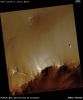
PSP_010437_1655_RED_abrowse.jpgSample of Southern Surface (Natural Colors; credits: Lunar Explorer Italia)100 visiteMars Local Time: 15:42 (middle afternoon)
Coord. (centered): 14,5° South Lat. and 253,6° East Long.
Spacecraft altitude: 251,9 Km (such as about 157,5 miles)
Original image scale range: 25,2 cm/pixel (with 1 x 1 binning) so objects ~ 76 cm across are resolved
Map projected scale: 25 cm/pixel
Map projection: EQUIRECTANGULAR
Emission Angle: 0,2°
Phase Angle: 62,3°
Solar Incidence Angle: 62° (meaning that the Sun is about 28° above the Local Horizon)
Solar Longitude: 143,3° (Northern Summer)
Credits: NASA/JPL/University of Arizona
Additional process. and coloring: Lunar Explorer ItaliaMareKromium 
(2 voti)
|
|
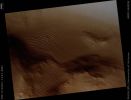
PSP_010447_1525_RED_abrowse.jpgKashira Crater (Natural Colors; credits: Lunar Explorer Italia)78 visiteMars Local Time: 15:44 (middle afternoon)
Coord. (centered): 27,0° South Lat. and 342,2° East Long.
Spacecraft altitude: 257,4 Km (such as about 160,8 miles)
Original image scale range: 51,5 cm/pixel (with 1 x 1 binning) so objects ~ 1,54 mt across are resolved
Map projected scale: 50 cm/pixel
Map projection: EQUIRECTANGULAR
Emission Angle: 0,3°
Phase Angle: 68,8°
Solar Incidence Angle:69° (meaning that the Sun is about 21° above the Local Horizon)
Solar Longitude: 143,7° (Northern Summer)
Credits: NASA/JPL/University of Arizona
Additional process. and coloring: Lunar Explorer ItaliaMareKromium
(2 voti)
|
|
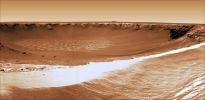
OPP-SOL953-Victoria1c_opportunity-01.jpgThe "colors of Victoria", according to "Aviation Week" (2)101 visitenessun commento
(16 voti)
|
|
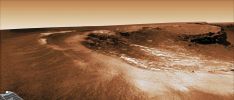
OPP-SOL953-Victoria1c_opportunity-00.jpgThe "colors of Victoria", according to "Aviation Week" (1)88 visite...In un "Mondo di Idee", un "Mondo di Interpretazioni": questa ci viene proposta dalla Rivista "Aviation Week", ripresa da "NASA - Picture of the Day" del giorno 2 Ottobre 2006.
Bene: chissā se la NASA, un giorno, non prenderā ispirazione anche dai "Colori di Marte" proposti da Lunar Explorer Italia... In fondo, siamo nel campo - ed ormai lo avrete capito benissimo - del "TOTALMENTE OPINABILE" e quindi...Una opinione vale l'altra!
(16 voti)
|
|
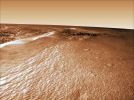
OPP-SOL953-Victoria1c_opportunity-02.jpgThe "colors of Victoria", according to "Aviation Week" (3)90 visitenessun commento
(15 voti)
|
|
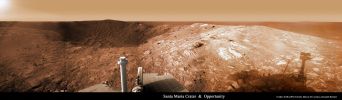
OPP-SOL2476-Kremer.jpgSanta Maria Crater - Sol 2476 (an Image-Mosaic by NASA/JPL- Cornell; credits for the additional process. and color.: Marco Di Lorenzo & Kenneth Kremer)134 visiteCaption NASA:"Celebrating 7 years on the Surface of the Red Planet, MER Opportunity now stands near the Rim of an about 90 meters wide Crater known as "Santa Maria".
Remarkably, Opportunity and its fellow Rover Spirit were initially intended for a 3 month long primary mission. Still exploring, the golf cart-sized robot and shadow (far right) appear in the foreground of this Panoramic View of its current location.
The mosaic was constructed using images from the Rover's NavCam.
On its 7 year anniversary, Opportunity can boast traversing a total of 26,7 Km along the Martian Surface.
After investigating Santa Maria Crater, the MER controllers plan to have Opportunity resume a long-term trek toward Endeavour, an approx. 22 Km wide Impact Crater which is now about 6 Km away from Santa Maria.
During the coming Soles, communication with the Rover will be more difficult as Mars moves close to alignment with the Sun as seen from Earth's perspective".
Nota Lunexit: questa elaborazione, secondo noi, č davvero scadente ed inoltre se alla NASA rileggessero le loro Captions prima di pubblicarle, probabilmente farebbero qualche meschina figura in meno (nella caption che descrive questa immagine, infatti - guardate la "NASA - Astronomy Picture of the Day" del giorno 29 Gennaio 2011 -, nonchč in svariate Captions inserite sul "NASA - Planetary Photojournal", il grande Cratere Endeavour viene spesso menzionato come Cratere Endurance).
Si, direte Voi, č una svista, una sciocchezza.
E invece NO, diciamo noi, non lo č affatto. E' un indice di poca accuratezza e di minima cura ed attenzione su quanto "diffuso" (diciamo "comunicato", valā, che č pių realistico...) al Grande Pubblico.
E se i Ricercatori Privati, quando prendono una (anche minima) svista possono - anzi "devono", secondo alcuni! - essere "messi in croce", allora che anche i grandi Enti Spaziali, quando scrivono sciocchezze (e non parliamo degli innumerevoli strafalcioni grammaticali e sintattici che caratterizzano tantissime captions NASA e pure ESA...), vengano additati al pubblico ludibrio.
E anche questa č Democrazia.MareKromium
(7 voti)
|
|
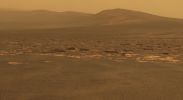
OPP-SOL2678-PIA14508NASA-JPL.jpgThe West Rim of Endeavour Crater - Sol 2678 (Natural Colors; credits: NASA/JPL-Caltech/Cornell/ASU)124 visiteCaption NASA:"A portion of the Western Rim of Endeavour Crater sweeps Southward in this color view from NASA's Mars Exploration Rover Opportunity. This Crater -- with a diameter of about 14 miles (approx 22 Km) -- is more than 25 times wider than any that Opportunity has previously approached during the Rover's 90 months on Mars.
This view combines exposures taken by Opportunity's PanCam on the 2678th Martian day, or Sol, of the Rover's work on Mars (Aug. 6, 2011) before driving on that sol. The subsequent Sol 2678 drive covered 246 feet (75,26 meters), more than half of the remaining distance to the Rim of the Crater. Opportunity arrived at the Rim during its next drive, such as on Sol 2681 (meaning Aug. 9, 2011).
Endeavour Crater has been the Rover Team's destination for Opportunity since the Rover finished exploring Victoria Crater in August 2008. Endeavour offers access to older geological deposits than any Opportunity has seen before.
The closest of the distant Ridges visible along the Endeavour Rim is informally named "Solander Point". Opportunity may investigate that area in the future. The Rover's first destination on the Rim, called "Spirit Point" in tribute to Opportunity's now-inactive twin, Spirit, is to the left (North) of this scene.
The lighter-toned Rocks closer to the Rover in this view are similar to the rocks Opportunity has driven over for most of the mission. However, the darker-toned and rougher Rocks just beyond that might be a different type for Opportunity to investigate. The ground in the foreground is covered with iron-rich Spherules, nicknamed "Blueberries," which Opportunity has observed frequently since the first days after landing. They are about 0,2" (5 millimeters) or more in diameter.
This view combines images taken through three different PanCam filters admitting light with wavelengths centered at 753 nanometers (near infrared), 535 nanometers (green) and 432 nanometers (violet). This "Natural Color" is the Rover Team's best estimate of what the scene would look like if humans were there and able to see it with their own eyes. Seams have been eliminated from the Sky portion of the mosaic to better simulate the vista a person standing on Mars would see".MareKromium
(18 voti)
|
|

Psp_009488_2485_red.jpgPhoenix Landing Site (possible True Colors; credits: Lunar Explorer Italia)81 visiteMars Local Time: 15:23 (early afternoon)
Coord. (centered): 68,2° North Lat. and 234,3° East Long.
Spacecraft altitude: 338,8 Km (such as about 211,8 miles)
Original image scale range: 67,8 cm/pixel (with 1 x 1 binning) so objects ~2,03 mt across are resolved
Map projected scale: 50 cm/pixel
Map projection: EQUIRECTANGULAR
Emission Angle: 24,2°
Phase Angle: 33,2°
Solar Incidence Angle: 54° (meaning that the Sun is about 36° above the Local Horizon)
Solar Longitude: 108,2° (Northern Summer)
Credits: NASA/JPL/University of Arizona
Additional process. and coloring: Lunar Explorer ItaliaMareKromium
(3 voti)
|
|
![ZZ-ZZ-ThePaving-1P185709063ESF64BNP2574L456]-00.jpg](albums/userpics/10060/small_ZZ-ZZ-ThePaving-1P185709063ESF64BNP2574L456%5D-00.jpg "Nome del file=ZZ-ZZ-ThePaving-1P185709063ESF64BNP2574L456]-00.jpg
Dimensione del file=1167KiB
Dimensioni=1600x800
Aggiunta il=Ago 20, 2007")
ZZ-ZZ-ThePaving-1P185709063ESF64BNP2574L456]-00.jpgThe "Martian Paving" (natural colors - elab. Keith Laney)77 visitenessun commentoMareKromium
(18 voti)
|
|
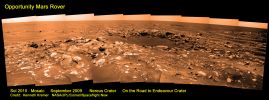
OPP-SOL2010.jpgNereus Crater - Sol 2010 (Natural Colors; credits: Kenneth Kramer)116 visitenessun commentoMareKromium
(27 voti)
|
|
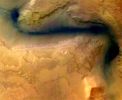
Reull_Vallis-ESA-1-PCF-LXTT.jpgPseudo-Lake in Reull Vallis (Absurde Colors; credits: ESA/DLR/FU Berlin, Dr G. Neukum)112 visite...senza parole...MareKromium
(17 voti)
|
|

OPP-SOL653-1P186154379EFF64KCP2424L2M1-2.jpgA reasonable color for Erebus' Pavings - Sol 653 (False Colors)66 visiteAbbiamo guardato e studiato, nei limiti del possibile e del ragionevole, i frames in "almost e/o approximately true colors" in arrivo da Meridiani.
In realtā, sebbene molti frames - specie i primi - mostrassero la pianura di Meridiani di color rosso o arancione (almeno prevalentemente), adesso la sensazione č che il colore dominante - dati NASA - sia un verdastro scuro, con qualche traccia di arancio pallido e di giallo. E allora, dato che i frames a colori sono sempre (diremmo che sono ormai "per definizione") questionabili, ne abbiamo elaborato anche noi uno.
Tuttavia, nella nostra interpretazione, non si parla nč di colori approssimativamente veri, nč di colori quasi veri.
I colori che proponiamo sono solo colori "ragionevoli": e cioč basati sui dati NASA pių recenti e sul buon senso, insomma. Il risultato? Giudicate Voi!
(6 voti)
|
|
| 13505 immagini su 1126 pagina(e) |
 |
|
|
|
|
|
|
|
|
1125 |
|





