| Piú votate - MARS |
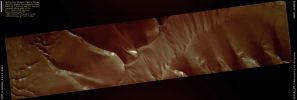
PSP_010090_1255_RED.jpgSpring over Russel Crater (natural colors; credits: Lunexit)70 visiteSpring is already starting to show its influence at the Russell Crater field of sand dunes. Channels down the face of the largest dune show dark spots where the sublimation of the seasonal carbon CO2 Ice Cap has begun.
This active process (where ice evaporates directly to gas) dislodges loose material, leaving dark streaks down steep slopes. The process starts when the Sun peeks above the horizon at the end of Antarctic Night.
Bright streaks may be loose frost cascading down steep slopes.MareKromium 
(3 voti)
|
|

ZZ-ColorMars-02.jpgMars from Orbit, as a "Human" would see it...by Don Davis (3)81 visitenessun commento
(18 voti)
|
|

PSP_006679_1680_RED_abrowse-PCF-LXTT.jpgLayered Features in Noctis Labyrinthus (Absolute Natural Colors; credits for the additional process. and color.: Dr Paolo C. Fienga - Lunexit Team)266 visitenessun commentoMareKromium
(2 voti)
|
|
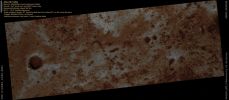
PSP_010882_2040_RED_abrowse-PCF-LXTT.jpgFeatures of Mawrth Vallis (Absolute Natural Colors; credits for the additional process. and color.: Dr Paolo C. Fienga - Lunexit Team)116 visitenessun commentoMareKromium
(2 voti)
|
|
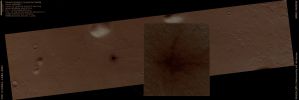
PSP_010862_1880_RED_abrowse-00-PCF-LXTT.jpgRecent Impact in Amazonis Planitia (Absolute Natural Colors; credits for the additional process. and color.: Dr Paolo C. Fienga - Lunexit Team)108 visitenessun commentoMareKromium
(2 voti)
|
|

ZZ-ZZ-Horizon-Span1.jpgGusev's Horizon (natural colors - elab. Keith Laney)92 visitenessun commentoMareKromium
(17 voti)
|
|

ZZ-ZZ-Horizon-Columbia2.jpgApproaching the Hills (natural colors - elab. Keith Laney)101 visitenessun commentoMareKromium
(18 voti)
|
|

ZZ-ColorMars-03.jpgMars from Orbit, as a "Human" would see it...by Don Davis (4)96 visitenessun commento
(20 voti)
|
|

ZZ-ZZ-Horizon-pan12.jpgOn the Way to the Top (natural colors - elab. Keith Laney)80 visiteBellissima interpretazione questa, ma...Gusev Crater (in accordo alla stessa "visione" di Keith Laney), č "verdognolo" o "arancione"?
Difficile risultare credibili a 360° allorchč non si riesce ad essere coerenti neppure a 180°...Non credete?!?MareKromium
(17 voti)
|
|
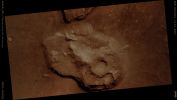
Psp_009497_2210_red.jpgEroded Mesa in Western Cydonia Region (possible True Colors; credits: Lunar Explorer Italia)76 visiteMars Local Time: 15:25 (early afternoon)
Coord. (centered): 40,7° North Lat. and 351,0° East Long.
Spacecraft altitude: 307,8 Km (such as about 192,4 miles)
Original image scale range: 30,8 cm/pixel (with 1 x 1 binning) so objects ~92 cm across are resolved
Map projected scale: 25 cm/pixel
Map projection: EQUIRECTANGULAR
Emission Angle: 14,8°
Phase Angle: 31,0°
Solar Incidence Angle: 46° (meaning that the Sun is about 44° above the Local Horizon)
Solar Longitude: 108,5° (Northern Summer)
Credits: NASA/JPL/University of Arizona
Additional process. and coloring: Lunar Explorer ItaliaMareKromium
(4 voti)
|
|
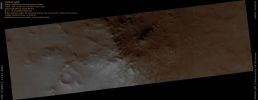
PSP_010877_1610_RED_abrowse-PCF-LXTT.jpgCentral Uplift (Absolute Natural Colors; additional process.: Dr Paolo C. Fienga - Lunexit Team)102 visitenessun commentoMareKromium
(2 voti)
|
|
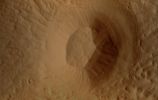
PSP_010630_2115_RED_abrowse-01.jpgCraters and possible "Pingo" in Mamers Vallis (edm - Natural Colors; credits: Lunar Explorer Italia)96 visite"At first this resembles a cinder cone volcano on Earth. However, when magnified, it reveals a feature [found in Arctic regions] on Earth called "Pingo". These are caused by ice protruding through the soil creating a positive-relief geologic feature. If you examine the smaller craters in the surrounding terrain you'll see a checkerboard pattern in each one. These closely resemble melted Pingos on Earth, again suggesting an area of Mars that was once rich with water."
While the student's suggestion that the mound-like structure is a Pingo is reasonable, there is yet no scientific consensus for the origin of these interesting structures.
Nota Lunexit: con tutto il rispetto per le brillanti intuizioni dei ragazzini "sponsorizzati" dalla NASA, l'idea del "Pingo" non stā - davvero - nč in cielo, nč in Terra. Eppure, come leggete, anche a queste boutades (perchč provengono da fanciulli - probabilmente - "quotati" a tutti i livelli), viene dato spazio. Poi perō, se chiedi ai Signori di Pasadena o della University of Arizona, ad esempio, cosa potrebbe essere la Silver Sphere (o altri rilievi anomali simili, a parer nostro - e NON SOLO nostro - MOLTO pių intriganti dello "pseudo Pingo")...Ecco che cala il silenzio pių totale.
Che tristezza...MareKromium
(2 voti)
|
|
| 13505 immagini su 1126 pagina(e) |
 |
|
|
|
|
|
|
|
1124 | |
|





