| Piú votate - MARS |

ZZ-ZZ-Horizon-2P227744645EFFAS4JP2629L4Mblueskies.jpgMartian Sky over Gusev (natural colors - elab. Keith Laney)97 visitenessun commentoMareKromium 
(17 voti)
|
|

ZZ-ColorMars-00.jpgMars from Orbit, as a "Human" would see it...by Don Davis (1)88 visiteUna serie di quattro bellissimi frames "dipinti a mano" - letteralmente - del bravo Ricercatore/Artista Americano Don Davis il quale, a quanto pare, fa "consulenza" alla NASA sulla materia della "colorizzazione" dei frames. Si, avete letto bene: un pittoree fotografo (un artista, insomma) fa da Consulente alla NASA per quanto attiene le modalità più realistiche di colorizzazione delle immagini.
Tra le dichiarazioni che ha rilasciato, ci piace sottolineare questa (anche perchè, in fondo, sposa bene il punto di vista cromato-filosofico di Lunar Explorer Italia):"...la maniera migliore per colorare Marte - in maniera tale da farlo vedere così come un occhio umano lo vedrebbe - deriva dall'osservazione diretta di Marte: sia dalla Terra, sia - anche e soprattutto - mediante le fotografie ottenute in "natural colors" dall'Hubble Space Telescope...Se Marte appare, in alcune zone, color arancio, in altre verdastro e grigio ed in altre ancora blu o bianco, perchè colorare tutto di giallo ocra o di rosso?...".
Don Davis: un Artista ed un Uomo intelligente, come ce ne sono pochi. Ad ogni modo, dopo aver preso atto dello splendido lavoro fatto per la NASA (Missione Odyssey), suggeriamo ai Fenomeni dell'ESA di contattarlo ed ingaggiarlo come consulente per la colorizzazione dei loro "disegnini"...
(16 voti)
|
|

ZZ-ColorMars-04.JPGMars from Orbit, as a "Human" would see it...by Don Davis (5)113 visiteThis color treatment is the result of a collaboration between THEMIS team members at Cornell University and space artist Don Davis, who is an expert on true-color renderings of planetary and astronomical objects. Davis began with calibrated and co-registered THEMIS VIS multi-band radiance files produced by the Cornell group. Using as a guide true-color imaging from spacecraft and his own personal experience at Mt. Wilson and other observatories, he performed a manual color balance to display the spectral capabilities of the THEMIS imager within the context of other Mars observations. He also did some manual smoothing along with other image processing to minimize the effects of residual scattered light in the images. This image shows the bright deposit remaining on the floor of Pollack Crater.
(19 voti)
|
|

SOL1559-2P264763301EFFAY00P2272R1M1.jpgHorizon... - Sol 1559 (MULTISPECTRUM; credits: Lunexit)68 visitenessun commentoMareKromium
(15 voti)
|
|
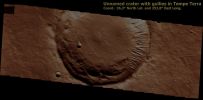
Craters-Unnamed_Crater-TempeTerra-PCF-LXTT.jpgUnnamed Crater in Tempe Terra (Natural Colors; credits for the additional process. and color.: Dr Paolo C. Fienga - Lunexit Team)74 visitenessun commentoMareKromium
(3 voti)
|
|
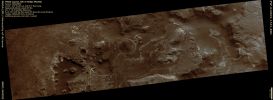
PSP_010839_1525_RED_abrowse.jpgPitted Layers, N/E of Hellas Planitia Region (Natural Colors;: credits: Lunexit)90 visitenessun commentoMareKromium
(3 voti)
|
|
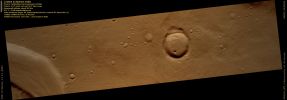
PSP_010630_2115_RED_abrowse-00.jpgCraters and possible "Pingo" in Mamers Vallis (ctx frame - Natural Colors; credits: Lunar Explorer Italia)76 visiteThis image was suggested by Mr. Dennis Mitchell's 8th grade NASA team, Evergreen Middle School, Cottonwood, CA, as part of the HiRISE Quest Student Image Challenge.
They write: "Located near Mamers Valles, this image shows numerous fluvial features that indicate this area was once rich with water. The lineated valley fill suggests an ice-rich soil. [Of particular interest] is a small cone-like feature [located on the floor of a 2 Km-diameter] impact crater in the center of the ctx frame.MareKromium
(3 voti)
|
|
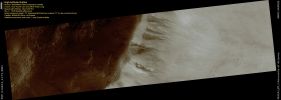
PSP_010833_1275_RED_abrowse.jpgHigh-Latitude Gullies (Natural Colors; credits: Lunar Explorer Italia)90 visitenessun commentoMareKromium
(3 voti)
|
|
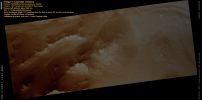
PSP_010857_1650_RED_abrowse.jpgRidge in Coprates Chasma (Natural Colors; credits: Lunar Explorer Italia)85 visitenessun commentoMareKromium
(3 voti)
|
|
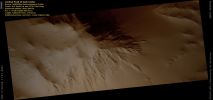
PSP_010428_1745_RED_abrowse.jpgThe Central Peak of Gale Crater (Natural Colors; credits: Lunar Explorer Italia)88 visitenessun commentoMareKromium
(3 voti)
|
|
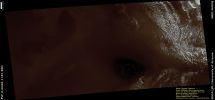
PSP_010449_1745_RED_abrowse.jpgPossible Hematite Deposits in West Candor Chasma (Natural Colors; credits: Lunar Explorer Italia)79 visitenessun commentoMareKromium
(3 voti)
|
|
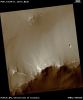
PSP_010437_1655_RED_abrowse~0.jpgOn the edge... (Natural - but lightly enhanced - Colors; credits: Lunar Explorer Italia)81 visiteMars Local Time: 15:42 (middle afternoon)
Coord. (centered): 14,5° South Lat. and 253,6° East Long.
Spacecraft altitude: 251,9 Km (such as about 157,5 miles)
Original image scale range: 25,2 cm/pixel (with 1 x 1 binning) so objects ~76 cm across are resolved
Map projected scale: 25 cm/pixel
Map projection: EQUIRECTANGULAR
Emission Angle: 0,2°
Phase Angle: 62,3°
Solar Incidence Angle: 62° (meaning that the Sun is about 28° above the Local Horizon)
Solar Longitude: 143,3° (Northern Summer)
Credits: NASA/JPL/University of Arizona
Additional process. and coloring: Lunar Explorer ItaliaMareKromium
(3 voti)
|
|
| 13505 immagini su 1126 pagina(e) |
 |
|
|
|
|
|
1122 | |
|
|
|





