| Piú votate - MARS |
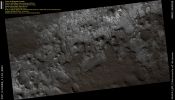
PSP_010888_1510_RED_abrowse.jpgClays and other "Hydrated Materials" in Sirenum Fossae Region (Natural Colors; credits: Lunar Explorer Italia)89 visitenessun commentoMareKromium 
(3 voti)
|
|
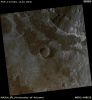
PSP_010580_1630_RED_abrowse.jpgPlains near Valles Marineris (possible Natural Colors; credits: Lunar Explorer Italia)122 visiteMars Local Time: 15:44 (middle afternoon)
Coord. (centered): 17,0° South Lat. and 309,6° East Long.
Spacecraft altitude: 257,0 Km (such as about 160,6 miles)
Original image scale range: 25,7 cm/pixel (with 1 x 1 binning) so objects ~77 cm across are resolved
Map projected scale: 25 cm/pixel
Map projection: EQUIRECTANGULAR
Emission Angle: 0,2°
Phase Angle: 63°
Solar Incidence Angle: 63° (meaning that the Sun is about 27° above the Local Horizon)
Solar Longitude: 149,0° (Northern Summer)
Credits: NASA/JPL/University of Arizona
Additional process. and coloring: Lunar Explorer ItaliaMareKromium
(3 voti)
|
|
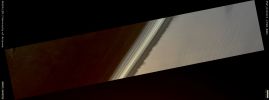
PSP_010472_2590_RED_abrowse.jpgStreaks on Exposure of North Polar Layered Deposits (Natural Colors; credits: Lunar Explorer Italia)94 visiteMars Local Time: 14:47 (early afternoon)
Coord. (centered): 78,8° North Lat. and 357,2° East Long.
Spacecraft altitude: 317,4 Km (such as about 198,4 miles)
Original image scale range: 63,5 cm/pixel (with 1 x 1 binning) so objects ~ 1,91 mt across are resolved
Map projected scale: 50 cm/pixel
Map projection: EQUIRECTANGULAR
Emission Angle: 0,9°
Phase Angle: 66,9°
Solar Incidence Angle: 68° (meaning that the Sun is about 22° above the Local Horizon)
Solar Longitude: 144,7° (Northern Summer)
Credits: NASA/JPL/University of Arizona
Additional process. and coloring: Lunar Explorer ItaliaMareKromium
(3 voti)
|
|
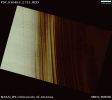
PSP_010463_2735_RED_abrowse.jpgNorth Polar Layers (Natural Colors; credits: Lunar Explorer Italia)99 visiteMars Local Time: 07:04 (early morning)
Coord. (centered): 86,5° North Lat. and 126,1° East Long.
Spacecraft altitude: 315,9 Km (such as about 197,4 miles)
Original image scale range: 63,2 cm/pixel (with 1 x 1 binning) so objects ~ 1,90 mt across are resolved
Map projected scale: 50 cm/pixel
Map projection: EQUIRECTANGULAR
Emission Angle: 0,0°
Phase Angle: 74,7°
Solar Incidence Angle: 75° (meaning that the Sun is about 15° above the Local Horizon)
Solar Longitude: 144,4° (Northern Summer)
Credits: NASA/JPL/University of Arizona
Additional process. and coloring: Lunar Explorer ItaliaMareKromium
(3 voti)
|
|
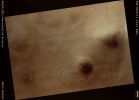
PSP_009713_2415_RED.jpgVastitas' Rocky Terrain (possible True Colors; credits: Lunar Explorer Italia)66 visiteMars Local Time: 15:10 (early afternoon)
Coord. (centered): 61,4° North Lat. and 208,0° East Long.
Spacecraft altitude: 310,1 Km (such as about 193,8 miles)
Original image scale range: 31,0 cm/pixel (with 1 x 1 binning) so objects ~93 cm across are resolved
Map projected scale: 25 cm/pixel
Map projection: EQUIRECTANGULAR
Emission Angle: 0,3°
Phase Angle: 50,8°
Solar Incidence Angle: 51° (meaning that the Sun is about 39° above the Local Horizon)
Solar Longitude: 116,2° (Northern Summer)
Credits: NASA/JPL/University of Arizona
Additional process. and coloring: Lunar Explorer ItaliaMareKromium
(3 voti)
|
|
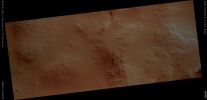
PSP_009714_1725_RED.jpgPeriequatorial Surface Sample (natural colors; credits: Lunar Explorer Italia)68 visiteMars Local Time: 15:31 (middle afternoon)
Coord. (centered): 7,5° South Lat. and 191,3° East Long.
Spacecraft altitude: 265,0 Km (such as about 165,6 miles)
Original image scale range: 26,5 cm/pixel (with 1 x 1 binning) so objects ~80 cm across are resolved
Map projected scale: 25 cm/pixel
Map projection: EQUIRECTANGULAR
Emission Angle: 0,1°
Phase Angle: 59,8°
Solar Incidence Angle: 60° (meaning that the Sun is about 30° above the Local Horizon)
Solar Longitude: 116,2° (Northern Summer)
Credits: NASA/JPL/University of Arizona
Additional process. and coloring: Lunar Explorer ItaliaMareKromium
(3 voti)
|
|
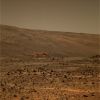
SOL758-5.jpgRocky Landscape - Sol 758 (possible True Colors; credits: Dr G. Barca & Lunexit)70 visitenessun commentoMareKromium
(2 voti)
|
|
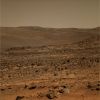
SOL758-6.jpgRocky Landscape - Sol 758 (possible True Colors; credits: Dr G. Barca & Lunexit)64 visitenessun commentoMareKromium
(2 voti)
|
|
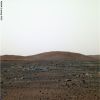
SOL004-2P127071642-2416colorbestcopy_sm.jpgThe "True Colors" of Mars: a new interpretation - Sol 496 visitenessun commento
(13 voti)
|
|

ZZ-ColorMars-01.jpgMars from Orbit, as a "Human" would see it...by Don Davis (2)84 visitenessun commento
(18 voti)
|
|
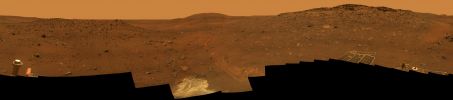
SOL1906-1943-Calypso_L257atc_br2.jpgCalypso Panorama - from Sol 1906 to Sol 1943 (Natural Colors; credits: NASA/JPL-Caltech/Cornell University)68 visiteCaption NASA:"This full-circle view from the Panoramic Camera (Pancam) on NASA's Mars Exploration Rover Spirit shows the terrain surrounding the location called "Troy", where Spirit became embedded in soft soil during the Spring of 2009. The hundreds of images combined into this view were taken beginning on the 1906th Martian Day (or Sol) of Spirit's Mission on Mars (such as May, 14, 2009) and ending on Sol 1943 (such as June, 20, 2009).
North is at the center; South at both ends. The Western Edge of the low plateau called Home Plate dominates the right half of the panorama. At the far right is a bright-topped mound called "Von Braun", a possible future destination for Spirit's exploration. Near the center of the panorama, in the distance, lies Husband Hill, where Spirit recorded views from the Summit in 2005. The ridge on the left, near the Rover Tracks leading to Troy from the North, is called "Tsiolkovsky".
For scale, the parallel tracks are about 1 meter (39 inches) apart. The track on the right is more evident because Spirit was driving backwards, dragging its right-front wheel, which no longer rotates.
The bright soil in the center foreground is soft material in which Spirit became embedded after the wheels on that side cut through a darker top layer. The composition of different layers in the soil at the site became the subject of intense investigation by tools on Spirit's Robotic Arm.
The PanCam Team named this scene the camera's Calypso Panorama.
This version is an Approximate True-Color, red-green-blue composite panorama generated from images taken through the Pancam's 750-nanometer, 530-nanometer and 480-nanometer filters.
This "Natural Color" view is the Rover Team's best estimate of what the scene would look like if we were there and able to see it with our own eyes.
Spirit has been investigating a region within Mars' Gusev Crater for more than 67 months in what was originally planned as a three-month mission".
Note Lunexit: la NASA, a quanto pare, confonde/mischia in maniera scandalosa il concetto di "True Colors" (ancorchè "approximate") con il concetto di "Natural Colors" - rileggete attentamente se non ci avete fatto caso.
Se la colorizzazione di questa immagine è, come scrivono gli Amici di Pasadena, la Best Estimate del Rover Team sul come la Piana di Gusev dovrebbe apparire ad occhi umani...beh, scusateci la presunzione, ma il loro livello tecnico a noi appare piuttosto imbarazzante...MareKromium
(8 voti)
|
|
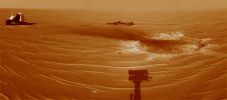
OPP-SOL330-1NN325EFF40CYLA3P0685L000M1-crop-B330R1.jpgThe Heat-Shield and its surroundings - full panorama - Sol 330 (Extremely Enhanced and Saturated Natural Colors; credits for the additonal process. and color.: Dr Paolo C. Fienga - Lunexit Team)71 visitenessun commentoMareKromium
(8 voti)
|
|
| 13505 immagini su 1126 pagina(e) |
 |
|
|
|
|
1121 | |
|
|
|
|





