| Piú votate - MARS |

Psp_009657_2660_red.jpgSmall Crater on the North Polar Layered Deposits (possible True Colors; credits: Lunar Explorer Italia)77 visiteMars Local Time: 12:33 (early afternoon)
Coord. (centered): 86,0° North Lat. and 255,9° East Long.
Spacecraft altitude: 317,4 Km (such as about 198,4 miles)
Original image scale range: 31,8 cm/pixel (with 1 x 1 binning) so objects ~95 cm across are resolved
Map projected scale: 25 cm/pixel
Map projection: EQUIRECTANGULAR
Emission Angle: 1,7°
Phase Angle: 64,5°
Solar Incidence Angle: 63° (meaning that the Sun is about 27° above the Local Horizon)
Solar Longitude: 114,2° (Northern Summer)
Credits: NASA/JPL/University of Arizona
Additional process. and coloring: Lunar Explorer ItaliaMareKromium 
(4 voti)
|
|
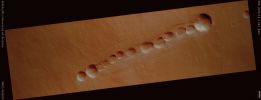
PSP_009712_1785_RED.jpgPit-Chain in South-Western Pavonis Mons (possible True Colors; credits: Lunar Explorer Italia)79 visiteMars Local Time: 15:30 (middle afternoon)
Coord. (centered): 1,4° South Lat. and 245,1° East Long.
Spacecraft altitude: 254,6 Km (such as about 159,1 miles)
Original image scale range: 50,9 cm/pixel (with 1 x 1 binning) so objects ~1,53 mt across are resolved
Map projected scale: 50 cm/pixel
Map projection: EQUIRECTANGULAR
Emission Angle: 0,5°
Phase Angle: 56,9°
Solar Incidence Angle: 56° (meaning that the Sun is about 34° above the Local Horizon)
Solar Longitude: 116,2° (Northern Summer)
Credits: NASA/JPL/University of Arizona
Additional process. and coloring: Lunar Explorer ItaliaMareKromium
(4 voti)
|
|
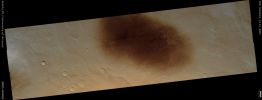
Psp_009652_2115_red.jpgOlivine Deposits (possible True Colors; credits: Lunar Explorer Italia)77 visiteMars Local Time: 15:25 (early afternoon)
Coord. (centered): 31,0° North Lat. and 79,6° East Long.
Spacecraft altitude: 289,5 Km (such as about 180,9 miles)
Original image scale range: 29,0 cm/pixel (with 1 x 1 binning) so objects ~57,9 cm across are resolved
Map projected scale: 25 cm/pixel
Map projection: EQUIRECTANGULAR
Emission Angle: 6,4°
Phase Angle: 39,7°
Solar Incidence Angle: 46° (meaning that the Sun is about 44° above the Local Horizon)
Solar Longitude: 114,0° (Northern Summer)
Credits: NASA/JPL/University of Arizona
Additional process. and coloring: Lunar Explorer ItaliaMareKromium
(4 voti)
|
|

Psp_009492_3080_red.jpgNorthern Surface (possible True Colors; credits: Lunar Explorer Italia)75 visiteMars Local Time: 15:41 (middle afternoon)
Coord. (centered): 51,8° North Lat. and 304,8° East Long.
Spacecraft altitude: 304,5 Km (such as about 190,3 miles)
Original image scale range: 121,8 cm/pixel (with 1 x 1 binning) so objects ~3,66 mt across are resolved
Map projected scale: 1 mt/pixel
Map projection: EQUIRECTANGULAR
Emission Angle: 0,3°
Phase Angle: 90,0°
Solar Incidence Angle: 90° (meaning that the Sun is about 0° above the Local Horizon)
Solar Longitude: 108,3° (Northern Summer)
Credits: NASA/JPL/University of Arizona
Additional process. and coloring: Lunar Explorer ItaliaMareKromium
(4 voti)
|
|
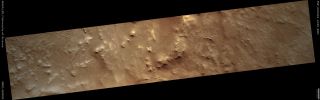
Psp_009442_2030_red.jpgAntoniadi Crater (possible True Colors; credits: Lunar Explorer Italia)78 visiteMars Local Time: 15:22 (early afternoon)
Coord. (centered): 22,9° North Lat. and 53,5° East Long.
Spacecraft altitude: 282,0 Km (such as about 176,2 miles)
Original image scale range: 56,4 cm/pixel (with 1 x 1 binning) so objects ~1,69 mt across are resolved
Map projected scale: 50 cm/pixel
Map projection: EQUIRECTANGULAR
Emission Angle: 0,3°
Phase Angle: 46,1°
Solar Incidence Angle: 46° (meaning that the Sun is about 44° above the Local Horizon)
Solar Longitude: 106,5° (Northern Summer)
Credits: NASA/JPL/University of Arizona
Additional process. and coloring: Lunar Explorer ItaliaMareKromium
(4 voti)
|
|
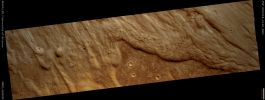
Psp_009418_2230_red.jpgFeatures of Arandas Crater (possible True Colors; credits: Lunar Explorer Italia)70 visiteMars Local Time: 15:17 (early afternoon)
Coord. (centered): 42,9° North Lat. and 345,9° East Long.
Spacecraft altitude: 301,0 Km (such as about 188,1 miles)
Original image scale range: 30,1 cm/pixel (with 1 x 1 binning) so objects ~60,2 cm across are resolved
Map projected scale: 25 cm/pixel
Map projection: EQUIRECTANGULAR
Emission Angle: 0,5°
Phase Angle: 44,1°
Solar Incidence Angle: 44° (meaning that the Sun is about 46° above the Local Horizon)
Solar Longitude: 105,7° (Northern Summer)
Credits: NASA/JPL/University of Arizona
Additional process. and coloring: Lunar Explorer ItaliaMareKromium
(4 voti)
|
|
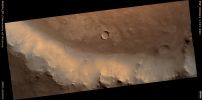
Psp_009422_1555_red.jpgSouthern Crater (possible True Colors; credits: Lunar Explorer Italia)62 visiteMars Local Time: 15:30 (middle afternoon)
Coord. (centered): 24,5° South Lat. and 245,1° East Long.
Spacecraft altitude: 252,9 Km (such as about 158,0 miles)
Original image scale range: 25,3 cm/pixel (with 1 x 1 binning) so objects ~50,6 cm across are resolved
Map projected scale: 25 cm/pixel
Map projection: EQUIRECTANGULAR
Emission Angle: 4,8°
Phase Angle: 73,9°
Solar Incidence Angle: 70° (meaning that the Sun is about 20° above the Local Horizon)
Solar Longitude: 105,8° (Northern Summer)
Credits: NASA/JPL/University of Arizona
Additional process. and coloring: Lunar Explorer ItaliaMareKromium
(4 voti)
|
|
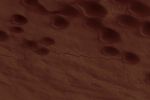
PSP_010169_2650_RED_abrowse-03.jpgDunes and other Surface Features in Chasma Boreale (edm n. 2 - natural colors; credits: Lunexit)63 visiteLe dune che vedete in questo dettaglio extramagnificato del panorama relativo alla Regione di Chasma Boreale SEMBRANO essere collegate da una frattura longitudinale, semi-irregolare ed a bordi frastagliati. Questa "frattura", se sovrasaturiamo l'immagine ed operiamo una ulteriore magnificazione, mostra delle leggere differenze di colore e di albedo e, alla fine, pare assomigliare davvero molto ad un canale di drenaggio (una sorta di fiumiciattolo, per dirla semplicemente).
Rilievi similari li abbiamo già incontrati su Titano e, se per i drainage channels della Luna Nebbiosa non paiono esserci più dubbi sul fatto che un qualche tipo di liquido scorra nel loro letto, per quanto attiene Marte ancora tutto tace.
In realtà, il fatto che questa specie di "frattura" superficiale possa essere un piccolo canale (che si inserisce in un ampio reticolo di canali - osservate il ctx frame per capire il contesto di riferimento) e che all'interno di esso scorra qualcosa, è pura speculazione; ma che la "frattura" (rectius: il network di fratture) sia oltremodo recente, è un fatto (basta osservare il dettaglio magnificato con una minima attenzione per capirlo).
La NASA, nel commentare questo frame, non si sofferma su queste "curiose" fratture del suolo e non ci offre alcuna idea/spiegazione delle stesse.
Peccato.MareKromium
(4 voti)
|
|
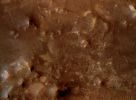
PSP_010206_1975_RED_abrowse-01.jpgAncient Bedrock and Megabreccia in Nili Fossae region (edm - possible True Colors; credits: Lunexit)82 visiteThis edm shows a rock type known as Megabreccia, composed of numerous differently colored blocks, each up to 40 meters (130 feet) across, arranged in a seemingly disorganized array.
Megabreccia forms when an energetic event, such as formation of an impact crater, breaks up pre-existing rocks and jumbles their fragments. Megabreccia is found in some of the most ancient rocks exposed on the Martian Surface.MareKromium
(4 voti)
|
|
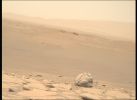
SOL0805-Mars_Perseverance_ZR0_0805_0738401772_785EBY_N0391170ZCAM08826_0340LMJ.jpgSol 805 - Dusty Landscape (Original Colors - Credits - NASA/JPL)106 visiteThis image was acquired on May 26, 2023 (Sol 805) at the Local Mean Solar Time of 11:55:32.MareKromium
(3 voti)
|
|
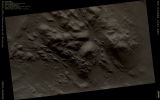
PSP_010888_2030_RED_abrowse.jpgMojave Crater's Floor and Central Uplift (Natural Colors; credits: Dr Paolo C. Fienga - Lunexit Team)70 visiteThis observation shows a portion of the Central Uplift structure in Mojave Crater.
Central Uplifts are a typical feature of large Impact Craters on Earth, Moon and Mars; craters larger than 6 or 7 Km in diameter on Mars typically form this mountain-like peak in the central portion of the crater interior.
This Peak consists of rocks originating from several kilometers beneath the pre-impact surface.
Mojave has a very prominent Central Uplift as it has a diameter of about 60 Km (apprx. 37 miles). In this image, boulders as large as about 15 meters (50 feet) across have been eroded from the massive uplifted rock and have rolled downslope. Fine-grained debris has also collected in the topographic lows, and has been shaped by the wind into Dunes and Ripples.
Notably absent from this image are the striking Drainage Channels and Alluvial Fans that are abundant on the wall-terraces and ejecta of Mojave Crater (see PSP_001415_1875). These features were likely formed by Surface Runoff of liquid water, which may have been released from the Subsurface during the impact event that formed Mojave.
Previously, it had been suggested that a brief, torrential downpour over Mojave Crater delivered the water. However, Mars Orbiter Camera's (MOC) images of Mojave's Central Uplift have previously shown no evidence for Surface Runoff, and the higher resolution of this HiRISE image confirms that this part of the Crater appears untouched by liquid water.
So the question remains: by what means was the water, in the form of Runoff, supplied to Mojave? This question, in addition to several others regarding this phenomenon, are currently being investigated by the HiRISE team and their collaborators.MareKromium
(3 voti)
|
|
PSP_010200_1805_RED_abrowse-01.jpgFresh Crater Cluster (EDM - Natural Colors; credits: Dr Paolo C. Fienga - Lunexit Team)76 visiteMany of the newest craters are part of a crater cluster, like this one. This cluster is about 350 meters (almost a quarter mile) across at its longest, and the largest crater in the image is 5 meters (16 feet) in diameter.
These clusters likely result from breaking up of the impactor before it strikes the surface. How widely dispersed the craters are depends on the strength and density of the impactor. Scientists can study these clusters to learn more about the object that created them.MareKromium
(3 voti)
|
|
| 13505 immagini su 1126 pagina(e) |
 |
|
|
|
|
1120 | |
|
|
|
|





