| Piú votate - MARS |
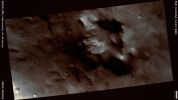
PSP_010454_1635_RED_abrowse.jpgCentral Uplift within an Unnamed Impact Crater (Natural Colors; credits: Lunar Explorer Italia)84 visiteMars Local Time: 15:45 (middle afternoon)
Coord. (centered): 16,1° South Lat. and 150,2° East Long.
Spacecraft altitude: 261,3 Km (such as about 163,3 miles)
Original image scale range: 26,1 cm/pixel (with 1 x 1 binning) so objects ~ 78 cm across are resolved
Map projected scale: 25 cm/pixel
Map projection: EQUIRECTANGULAR
Emission Angle: 8,4°
Phase Angle: 56,6°
Solar Incidence Angle: 63° (meaning that the Sun is about 27° above the Local Horizon)
Solar Longitude: 144,0° (Northern Summer)
Credits: NASA/JPL/University of Arizona
Additional process. and coloring: Lunar Explorer ItaliaMareKromium 
(5 voti)
|
|
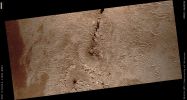
PSP_010414_1900_RED_abrowse.jpgVolcanic Vent near Athabasca Valles (Natural Colors; credits: Lunar Explorer Italia)69 visiteMars Local Time: 15:32 (middle afternoon)
Coord. (centered): 9,6° North Lat. and 157,3° East Long.
Spacecraft altitude: 286,1 Km (such as about 178,8 miles)
Original image scale range: 28,6 cm/pixel (with 1 x 1 binning) so objects ~ 86 cm across are resolved
Map projected scale: 25 cm/pixel
Map projection: EQUIRECTANGULAR
Emission Angle: 15,8°
Phase Angle: 67,1°
Solar Incidence Angle: 52° (meaning that the Sun is about 38° above the Local Horizon)
Solar Longitude: 142,4° (Northern Summer)
Credits: NASA/JPL/University of Arizona
Additional process. and coloring: Lunar Explorer ItaliaMareKromium
(5 voti)
|
|
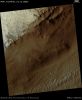
PSP_010430_2115_RED_abrowse.jpgOlivine Deposits (Natural Colors; credits: Lunar Explorer Italia)77 visiteMars Local Time: 15:35 (middle afternoon)
Coord. (centered): 30,8° North Lat. and 79,7° East Long.
Spacecraft altitude: 289,8 Km (such as about 181,1 miles)
Original image scale range: 29,0 cm/pixel (with 1 x 1 binning) so objects ~ 87 cm across are resolved
Map projected scale: 25 cm/pixel
Map projection: EQUIRECTANGULAR
Emission Angle: 7,4°
Phase Angle: 44,2°
Solar Incidence Angle: 52° (meaning that the Sun is about 38° above the Local Horizon)
Solar Longitude: 143,1° (Northern Summer)
Credits: NASA/JPL/University of Arizona
Additional process. and coloring: Lunar Explorer ItaliaMareKromium
(5 voti)
|
|

PSP_010429_1660_RED_abrowse.jpgUnnamed Southern Crater (Natural Colors; credits: Lunar Explorer Italia)75 visiteMars Local Time: 15:48 (middle afternoon)
Coord. (centered): 13,8° South Lat. and 113,5° East Long.
Spacecraft altitude: 276,4 Km (such as about 172,7 miles)
Original image scale range: 27,6 cm/pixel (with 1 x 1 binning) so objects ~ 83 cm across are resolved
Map projected scale: 25 cm/pixel
Map projection: EQUIRECTANGULAR
Emission Angle: 20,7°
Phase Angle: 46,6°
Solar Incidence Angle: 63° (meaning that the Sun is about 27° above the Local Horizon)
Solar Longitude: 143,0° (Northern Summer)
Credits: NASA/JPL/University of Arizona
Additional process. and coloring: Lunar Explorer ItaliaMareKromium
(5 voti)
|
|
PSP_010432_2380_RED_abrowse.jpgCentral Peak of an Unnamed Crater of Vastitas Borealis (Natural Colors; credits: Lunar Explorer Italia)67 visiteMars Local Time: 15:22 (early afternoon)
Coord. (centered): 57,9° North Lat. and 19,8° East Long.
Spacecraft altitude: 310,5 Km (such as about 194,0 miles)
Original image scale range: 31,1 cm/pixel (with 1 x 1 binning) so objects ~ 963 cm across are resolved
Map projected scale: 25 cm/pixel
Map projection: EQUIRECTANGULAR
Emission Angle: 0,7°
Phase Angle: 56,7°
Solar Incidence Angle: 57° (meaning that the Sun is about 33° above the Local Horizon)
Solar Longitude: 143,1° (Northern Summer)
Credits: NASA/JPL/University of Arizona
Additional process. and coloring: Lunar Explorer ItaliaMareKromium
(5 voti)
|
|
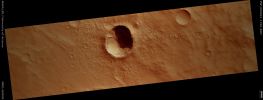
Psp_009622_1590_red.jpgMedium-size Impact Crater (possible True Colors; credits: Lunar Explorer Italia)86 visiteMars Local Time: 15:31 (middle afternoon)
Coord. (centered): 20,9° South Lat. and 184,4° East Long.
Spacecraft altitude: 257,3 Km (such as about 160,8 miles)
Original image scale range: 51,5 cm/pixel (with 1 x 1 binning) so objects ~1,54 mt across are resolved
Map projected scale: 50 cm/pixel
Map projection: EQUIRECTANGULAR
Emission Angle: 3,5°
Phase Angle: 70,5°
Solar Incidence Angle: 68° (meaning that the Sun is about 22° above the Local Horizon)
Solar Longitude: 112,9° (Northern Summer)
Credits: NASA/JPL/University of Arizona
Additional process. and coloring: Lunar Explorer ItaliaMareKromium
(5 voti)
|
|
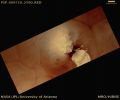
PSP_009710_2590_RED.jpgRelatively Fresh Ice-Patch near the North Polar Layered Deposits (possible True Colors; credits: Lunar Explorer Italia)66 visiteMars Local Time: 14:57 (early afternoon)
Coord. (centered): 78,7° North Lat. and 285,2° East Long.
Spacecraft altitude: 323,6 Km (such as about 202,2 miles)
Original image scale range: 32,4 cm/pixel (with 1 x 1 binning) so objects ~97 cm across are resolved
Map projected scale: 25 cm/pixel
Map projection: EQUIRECTANGULAR
Emission Angle: 11,8°
Phase Angle: 50,0°
Solar Incidence Angle: 60° (meaning that the Sun is about 30° above the Local Horizon)
Solar Longitude: 116,1° (Northern Summer)
Credits: NASA/JPL/University of Arizona
Additional process. and coloring: Lunar Explorer ItaliaMareKromium
(5 voti)
|
|
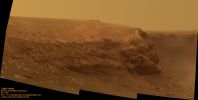
OPP-SOL1329-1193591285_32257-4_Sol1329B_P2379_L257atc-1.jpgCape Verde, according to NASA - Sol 132962 visiteCaption NASA:"A promontory nicknamed "Cape Verde" can be seen jutting out from the walls of Victoria Crater in this approximate true-color picture taken by the PanCam on NASA's MER Opportunity. The Rover took this picture on Martian Day, or Sol, 1329 (Oct. 20, 2007), more than a month after it began descending down the crater walls - and just 9 Soles shy of its second Martian birthday on Sol 1338 (Oct. 29, 2007).
Opportunity landed on the Red Planet on Jan. 25, 2004. That's nearly 4 years ago on Earth, but only 2 on Mars, because Mars takes longer to travel around the Sun than Earth. One Martian year equals 687 Earth days.
The overall soft quality of the image, and the "haze" seen in the lower right portion, are the result of scattered light from dust on the front sapphire window of the Rover's camera.
This view was taken using 3 PanCam filters, admitting light with wavelengths centered at 750 (near infrared), 530 (green) and 430 nanometers (violet)".MareKromium
(5 voti)
|
|
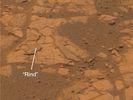
OPP-SOL552-B_P2580_1_True_RAD_ann-B570R1.jpgLemon Rind - Sol 55266 visiteCaption NASA originale:"After months spent crossing a sea of rippled sands, Opportunity reached an outcrop in August 2005 and began investigating exposures of sedimentary rocks, intriguing rind-like features that appear to cap the rocks, and cobbles that dot the martian surface locally. Opportunity spent several Martian Days analyzing a feature called Lemon Rind, a thin surface layer covering portions of outcrop rocks poking through the sand north of Erebus Crater. In images from the PanCam, Lemon Rind appears slightly different in color than surrounding rocks. It also appears to be slightly more resistant to wind erosion than the outcrop's interior. This is an approximately true-color composite produced from frames taken during Opportunity's 552nd Sol (Aug. 13, 2005)".
(5 voti)
|
|

SOL1492.jpgBright Panorama - Sol 1492 (Credits: Dr Marco Faccin and Elisabetta Bonora)144 visiteHey, NASA Guys: look at this! Can you do any better?!?MareKromium
(10 voti)
|
|
OPP-SOL1395-1.jpgLook at those grains of dust... - Sol 1395 (false colors; credits: Dr M. Faccin)64 visiteUna brillante intuizione (molto probabilmente corretta) del Dr Faccin sulla struttura fisica delle Camere di cui i MER sono dotati. Ma lasciamo che sia lui stesso a spiegare quello che ha scoperto:"...la NASA fa vedere che si ci sono nubi di polvere (intorno ai Rover) ma, osservando bene, si può notare che ci sono anche dei grani di questa polvere sugli obbiettivi.
Ora notate: alcune di queste macchie scure sono esagonali, una forma data dal diaframma. Scoperto questo, noi sappiamo che i CCD dei MER sono muniti di diaframma meccanico, al pari di una semplice camera digitale da 50 Euro.
Quanto detto si riferisce alla NavCam - che presumo sia analoga alla PanCam - la quale si distingue dalle Rear e FrontHazCam poichè esse, credo, sono ad obbiettivo fisso - simili alle webcam, tanto per intenderci...".
Allora: la NASA usa sempre "supertecnologie" da milioni di Dollari, oppure - magari qualche volta... - "tira a risparmiare"? E soprattutto: ma siamo così sicuri che ci vogliano "suprtecnologie" per "sopravvivere alle "estreme" (ma dove?!?) condizioni di Marte?
Siamo sempre più dell'idea che qualcosa non torni: complimenti e congratulazioni al Dr Faccin ed ora, se volete, la parola a Voi!...MareKromium
(8 voti)
|
|

ESP_014188_1320_RED_abrowse.jpgUSGS Dune Database Entry Number 0894-475 (Natural Colors; credits: Lunexit)82 visitenessun commentoMareKromium
(14 voti)
|
|
| 13505 immagini su 1126 pagina(e) |
 |
|
|
|
|
1118 | |
|
|
|
|





