| Piú votate - MARS |
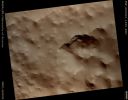
Psp_009435_1850_red.jpgLayered Outcrop and associated Boulder Tracks, North of Pavonis Mons (possible True Colors; credits: Lunar Explorer Italia)75 visiteMars Local Time: 15:25 (early afternoon)
Coord. (centered): 5,1° North Lat. and 246,7° East Long.
Spacecraft altitude: 266,0 Km (such as about 166,3 miles)
Original image scale range: 26,6 cm/pixel (with 1 x 1 binning) so objects ~80 cm across are resolved
Map projected scale: 25 cm/pixel
Map projection: EQUIRECTANGULAR
Emission Angle: 2,2°
Phase Angle: 54,6°
Solar Incidence Angle: 53° (meaning that the Sun is about 37° above the Local Horizon)
Solar Longitude: 106,3° (Northern Summer)
Credits: NASA/JPL/University of Arizona
Additional process. and coloring: Lunar Explorer ItaliaMareKromium 
(4 voti)
|
|
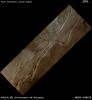
Psp_009406_2600_red.jpgExposed Rupes Tenuis of the Southern Margin of Hyperborea Lingula66 visiteMars Local Time: 14:42 (early afternoon)
Coord. (centered): 79,9° North Lat. and 302,1° East Long.
Spacecraft altitude: 320,6 Km (such as about 200,3 miles)
Original image scale range: 32,1 cm/pixel (with 1 x 1 binning) so objects ~64,1 cm across are resolved
Map projected scale: 25 cm/pixel
Map projection: EQUIRECTANGULAR
Emission Angle: 8,0°
Phase Angle: 51,8°
Solar Incidence Angle: 58° (meaning that the Sun is about 32° above the Local Horizon)
Solar Longitude: 105,3° (Northern Summer)
Credits: NASA/JPL/University of Arizona
Additional process. and coloring: Lunar Explorer ItaliaMareKromium
(4 voti)
|
|
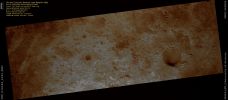
PSP_010183_2035_RED_abrowse-00.jpgColourful old Bedrock near Mawrth Vallis (possible True Colors; credits: Lunexit)76 visiteThis image covers part of a proposed Rover Landing Site in the Mawrth Vallis Region of Mars.
Polygonal fracture patterns (similar to a tiled floor) are visible on the surfaces of some of these rocks, and yellow/brown ridges protruding from the Surface may be composed of hard minerals or cemented sediments formed when water flowed through fractures in the ancient Bedrock. Dark gray-bluish dunes or ripples of wind-blown sand are also visible on the Surface here.
Elsewhere in the image, exposures of the light-toned rocks in the steep walls of impact craters reveal that these rocks are finely layered, similar to sedimentary rocks on Earth. The orbiting Infrared Spectrometers OMEGA and CRISM have demonstrated that these layered rocks contain Clay (---> argilla/minerali argillosi) minerals, which can only form in the presence of water.
The different colors of the rocks typically reflect differences in composition, suggesting that multiple styles or episodes of water activity may be recorded in the rock record here.
These characteristics have made Mawrth Vallis a prime candidate Landing Site for future Mars Rover Missions, including NASA’s Mars Science Laboratory due to launch in 2009.MareKromium
(4 voti)
|
|
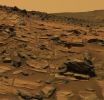
SOL748-Home Plate-PIA02690-3.jpgHome Plate: almost true colors and HR (3) - Sol 748 to 75160 visitenessun commento
(4 voti)
|
|
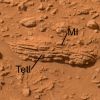
SOL298-Tetl_Rock-01-RA-01-Tetl-A298R1.jpg"Tetl Rock" - Sol 298 (Aalmost True Colors; credits: NASA/JPL-Caltech)102 visiteImmagine ravvicinata e spettacolarmente dettagliata della roccia stratiforme conosciuta come Tetl. Non ci sembra di rilevare alcun tipo di anomalia in questa immagine; l'unica cosa che ci sembra poco credibile, nonostante la NASA abbia rubricato questo frame come eseguito in "almost true colors", è proprio nel particolare colore di fondo assunto dalla superficie Marziana.
L'arancione è molto luminoso e l'immagine, nonostante il livello di particolari visibili risulti alquanto elevato, sembra - in qualche modo - leggermente "velata". Non vi è traccia di "berries".
(18 voti)
|
|

Linear_Ridges-PCF-LXTT-1.jpgLinear Ridges (Enhanced Natural Colors; credits for the additional process. and color.: Dr Paolo C. Fienga - Lunexit Team)65 visitenessun commentoMareKromium
(9 voti)
|
|
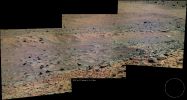
SOL1377-1-EB-LXTT.jpgVisual Survey - Sol 1377 (an Image-Mosaic in False Colors by Elisabetta Bonora - Lunexit Team)86 visitenessun commentoMareKromium
(5 voti)
|
|
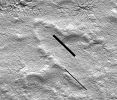
ESP_014282_0930_RED_abrowse-03.jpgSpiders (EDM n.2 - credits: Dr G. Barca)74 visite...Si, a questo punto è certo: si trattava di un image-artifact. Senza dubbi. Grandi complimenti al nostro sempre puntualissimo Dr Barca per la pazienza avuta!MareKromium
(5 voti)
|
|
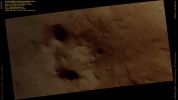
PSP_010454_1635_RED_abrowse~0.jpgCentral Uplift of Unnamed Impact Crater (Natural Colors; credits: Lunar Explorer Italia)84 visitenessun commentoMareKromium
(5 voti)
|
|
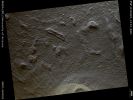
PSP_010426_2155_RED_abrowse.jpgErebus Montes (Natural Colors; credits: Lunar Explorer Italia)77 visiteMars Local Time: 15:31 (middle afternoon)
Coord. (centered): 35,3° North Lat. and 187,4° East Long.
Spacecraft altitude: 295,3 Km (such as about 184,6 miles)
Original image scale range: 59,1 cm/pixel (with 1 x 1 binning) so objects ~1,77 mt across are resolved
Map projected scale: 50 cm/pixel
Map projection: EQUIRECTANGULAR
Emission Angle: 1,6°
Phase Angle: 52,8°
Solar Incidence Angle: 51° (meaning that the Sun is about 39° above the Local Horizon)
Solar Longitude: 142,9° (Northern Summer)
Credits: NASA/JPL/University of Arizona
Additional process. and coloring: Lunar Explorer ItaliaMareKromium
(5 voti)
|
|
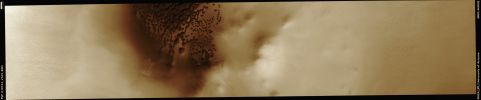
PSP_010512_2505_RED_abrowse.jpgImpact Crater with possible Summer Ice in Vastitas Borealis (Natural Colors; credits: Lunar Explorer Italia)99 visiteMars Local Time: 15:13 (early afternoon)
Coord. (centered): 70,0° North Lat. and 352,1° East Long.
Spacecraft altitude: 317,9 Km (such as about 198,7 miles)
Original image scale range: 63,6 cm/pixel (with 1 x 1 binning) so objects ~ 1,61 mt across are resolved
Map projected scale: 50 cm/pixel
Map projection: EQUIRECTANGULAR
Emission Angle: 2,0°
Phase Angle: 62,1°
Solar Incidence Angle: 64° (meaning that the Sun is about 26° above the Local Horizon)
Solar Longitude: 146,3° (Northern Summer)
Credits: NASA/JPL/University of Arizona
Additional process. and coloring: Lunar Explorer ItaliaMareKromium
(5 voti)
|
|
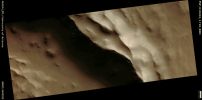
PSP_010416_1710_RED_abrowse.jpgTerra Tyrrhena (Natural Colors; credits: Lunar Explorer Italia)69 visiteMars Local Time: 15:43 (middle afternoon)
Coord. (centered): 9,1° South Lat. and 106,9° East Long.
Spacecraft altitude: 263,2 Km (such as about 164,5 miles)
Original image scale range: 52,7 cm/pixel (with 1 x 1 binning) so objects ~ 1,58 mt across are resolved
Map projected scale: 50 cm/pixel
Map projection: EQUIRECTANGULAR
Emission Angle: 8,1°
Phase Angle: 53,5°
Solar Incidence Angle: 60° (meaning that the Sun is about 30° above the Local Horizon)
Solar Longitude: 142,5° (Northern Summer)
Credits: NASA/JPL/University of Arizona
Additional process. and coloring: Lunar Explorer ItaliaMareKromium
(5 voti)
|
|
| 13505 immagini su 1126 pagina(e) |
 |
|
|
|
|
1117 | |
|
|
|
|





