| Piú votate - MARS |
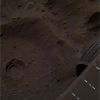
SOL2123-EB-LXTT-1.jpgDusty Solar Panels and "The Mark" - Sol 2123 (Absolute Natural Colors; credits for the additional process. and color.: Elisabetta Bonora - Lunexit Team)98 visitenessun commentoMareKromium 
(7 voti)
|
|

SOL2123-EB-LXTT-2.jpgDusty Solar Panels - Sol 2123 (Absolute Natural Colors; credits for the additional process. and color.: Elisabetta Bonora - Lunexit Team)111 visitenessun commentoMareKromium
(7 voti)
|
|
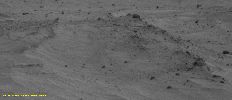
SOL2125-EB-LXTT-movie.gifSpark or Image-Artifact? - Sol 2125 (a GIF-Movie by Elisabetta Bonora - Lunexit Team)108 visitenessun commentoMareKromium
(7 voti)
|
|

SOL2179-MF-LXTT.jpgThe Soft and Colourful Sands near Spirit Winter-Haven - Sol 2179 (Image-Mosaic - Enhanced Natural Colors; credits for the additional process. and color.: Dr Marco Faccin - Lunexit Team)65 visitenessun commentoMareKromium
(7 voti)
|
|
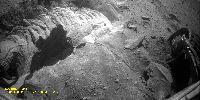
SOL2156-EB.gifMartian Sandtrap Workout! (GIF-Movie; credits: Elisabetta Bonora)66 visitenessun commentoMareKromium
(7 voti)
|
|
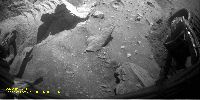
SOL2150-2154-EB.gifThe "Magic (and yet still buried!) Wheel" goes up and down... - Sol 2150-2154 (GIF-Movie; credits: Elisabetta Bonora)67 visitenessun commentoMareKromium
(7 voti)
|
|
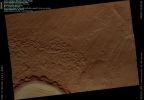
PSP_010100_2165_RED_abrowse.jpgEjecta Blanket (Natural Colors; credits: Lunar Explorer Italia)65 visiteThis image of a crater in the Utopian Region can be described as what happens when heat produced from an impact comes into contact with Mars’ icy Surface.
Since the Surface Temperature of Mars is well below the freezing point of water, Mars’ soil is a mixture of soil and permafrost. When this impact occurred, a great deal of energy in the form of heat was released onto the Surface, creating a melted feature in the bright icy soil. This melting and then refreezing of the ice (as the impact cooled) caused what is known as a "Periglacial Formation". This is depicted towards the middle of the image where the Ejecta Blanket lays.
This is likely a geologically newer surface since the only impacts disrupting the image are a few small craters that are mostly towards the bottom left-hand side of the full image.
The fact the Ejecta Blanket is still intact and not fully collapsed supports the idea that is it a newer surface feature as it has not been affected by erosional processes.MareKromium
(4 voti)
|
|
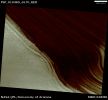
PSP_010489_2670_RED_abrowse.jpgTrough on the North Polar Layered Deposits (Natural Colors; credits: Lunar Explorer Italia)85 visiteMars Local Time: 11:00 (late morning)
Coord. (centered): 87,0° North Lat. and 195,5° East Long.
Spacecraft altitude: 316,1 Km (such as about 197,6 miles)
Original image scale range: 31,6 cm/pixel (with 1 x 1 binning) so objects ~ 95 cm across are resolved
Map projected scale: 25 cm/pixel
Map projection: EQUIRECTANGULAR
Emission Angle: 0,7°
Phase Angle: 73,7°
Solar Incidence Angle: 73° (meaning that the Sun is about 17° above the Local Horizon)
Solar Longitude: 145,4° (Northern Summer)
Credits: NASA/JPL/University of Arizona
Additional process. and coloring: Lunar Explorer ItaliaMareKromium
(4 voti)
|
|

PSP_010494_1790_RED_abrowse.jpgMound in Aeolis (Natural Colors; credits: Lunar Explorer Italia)84 visiteMars Local Time: 15:40 (middle afternoon)
Coord. (centered): 1,1° South Lat. and 135,7° East Long.
Spacecraft altitude: 268,1 Km (such as about 167,6 miles)
Original image scale range: 53,6 cm/pixel (with 1 x 1 binning) so objects ~ 1,61 mt across are resolved
Map projected scale: 50 cm/pixel
Map projection: EQUIRECTANGULAR
Emission Angle: 0,0°
Phase Angle: 56,6°
Solar Incidence Angle: 57° (meaning that the Sun is about 33° above the Local Horizon)
Solar Longitude: 145,6° (Northern Summer)
Credits: NASA/JPL/University of Arizona
Additional process. and coloring: Lunar Explorer ItaliaMareKromium
(4 voti)
|
|
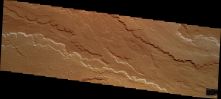
Volcanic_features-LavaFlows-Daedalia_Planum-PCF-LXTT.jpgLava Flows in Daedalia Planum (False Colors; credits: Lunar Explorer Italia)62 visiteCaption NASA:"This image shows a small portion of the extensive Lava Flows from Arsia Mons that make up Daedalia Planum".
Source: NASA/2001 Mars Odyssey Orbiter
Coord.: 21,1° South Lat. and 240,8° East Long.
MareKromium
(4 voti)
|
|
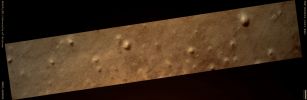
Psp_009659_2425_red.jpgTerrain in Vastitas Borealis (possible True Colors; credits: Lunar Explorer Italia)77 visiteMars Local Time: 15:08 (early afternoon)
Coord. (centered): 62,4° North Lat. and 241,9° East Long.
Spacecraft altitude: 309,5 Km (such as about 193,4 miles)
Original image scale range: 61,9 cm/pixel (with 1 x 1 binning) so objects ~1,86 mt across are resolved
Map projected scale: 50 cm/pixel
Map projection: EQUIRECTANGULAR
Emission Angle: 0,3°
Phase Angle: 50,8°
Solar Incidence Angle: 51° (meaning that the Sun is about 39° above the Local Horizon)
Solar Longitude: 114,3° (Northern Summer)
Credits: NASA/JPL/University of Arizona
Additional process. and coloring: Lunar Explorer ItaliaMareKromium
(4 voti)
|
|

SOL1413-2.jpgInteresting Outcrop - Sol 1413 (possible True Colors; credits: Dr G. Barca & Lunexit)61 visitenessun commentoMareKromium
(4 voti)
|
|
| 13505 immagini su 1126 pagina(e) |
 |
|
|
|
|
1116 | |
|
|
|
|





