| Piú votate - 1-Ceres and 4-Vesta |

062-Vesta-071811-PCF-LXTT.jpgFeatures of 4-Vesta (Natural Colors; credits for the additional process. and color.: Dr Paolo C. Fienga - Lunar Explorer Italia)135 visiteCaption NASA:"NASA's Dawn Spacecraft obtained this image with its framing camera on July 18, 2011. It was taken from a distance of about 6500 miles (approx. 10.500 Km) away from the Protoplanet 4-Vesta. The smallest detail visible is about 1,2 miles across (approx. 2 Km).MareKromium
(4 voti)
|
|

018-Vesta-6-PIA13428.jpgSome of the "Faces" of 4-Vesta, from Hubble Space Telescope97 visiteNASA's Hubble Space Telescope snapped these images of the Asteroid 4-Vesta in preparation for the Dawn Spacecraft's visit in 2011. Each of the 4 Hubble images captures views of Vesta during its 5,34-hour rotation period. Hubble's sharp "eye" can see features as small as about 40 Km (24,84 miles) across in these images. Vesta was 211 MKM (approx. 131 MMs) from Earth when Hubble made the observations.
The images show the difference in brightness and color on the Asteroid's Surface. These characteristics hint at the large-scale features that the Dawn Spacecraft will see when it visits the potato-shaped asteroid.
Astronomers used the images, taken with Hubble's Wide Field Camera 3, to better determine 4-Vesta's Spin Axis. Based on the HST observations, astronomers calculated a slightly different, and more precise, Rotation Axis for Vesta. The new calculation will change the pattern of sunlight expected to illuminate the Asteroid when Dawn arrives.
Determining a more accurate Spin Axis for 4-Vesta will also help scientists refine the Dawn Spacecraft's orbit around the Asteroid. Dawn will orbit the rocky object for a year, beginning in July 2011. The Spacecraft will then travel to the "Dwarf Planet" 1-Ceres, arriving in 2015.
Hubble has kept its "eye" on 4-Vesta for more than 15 years, beginning in 1994. Hubble images of 4-Vesta in 1997 helped astronomers discover the Asteroid's very large Impact crater. Astronomers combined views of 4-Vesta in Near-UltraViolet and blue light to construct these images and the images were taken on Feb. 25, 2010.MareKromium
(4 voti)
|
|

001-Ceres-alone.jpg1-Ceres from Hubble Space Telescope62 visiteNASA's Hubble Space Telescope took these images of the asteroid 1 Ceres over a 2-hour and 20-minute span, the time it takes the Texas-sized object to complete one quarter of a rotation. One day on Ceres lasts 9 hours.
Hubble snapped 267 images of Ceres as it watched the asteroid make more than one rotation. By observing the asteroid during a full rotation, astronomers confirmed that Ceres has a nearly round body like Earth's. Ceres' shape suggests that its interior is layered like those of terrestrial planets such as Earth. Ceres may have a rocky inner core, an icy mantle, and a thim, dusty, outer crust.
The "Bright Spot" that we see is a mistery: it is (obviously) brighter than its surroundings, but it is still very dark (very low albedo) reflecting only a small portion of Sunlight.
(4 voti)
|
|

020-1-Ceres-PIA22641.jpgUnusually-looking Surface Feature on 1-Ceres109 visiteCaption NASA Originale:"This image was obtained by NASA's Dawn Spacecraft on July 17, 2018 from an altitude of about 25 miles (such as approx. 40,23 Km).
The center of this picture is located at about 31,0° South Latitude and 248,9° East Longitude".MareKromium
(3 voti)
|
|
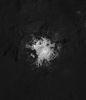
021-1-Ceres-Cerealia_Facula-Occator_Crater-PIA21924.jpgCerealia Facula111 visiteCaption NASA Originale"This mosaic of Cerealia Facula is based on images obtained by NASA's Dawn Spacecraft in its second extended mission, from an altitude as low as about 21 miles (such as approx. 33,79 Km). The contrast in resolution obtained by the two phases is visible here, reflected by a few gaps in the high-resolution coverage. This image is superposed to a similar scene acquired in the low-altitude mapping orbit of the mission from an altitude of about 240 miles (i.e. approx. 386,24 km).
The increased resolution afforded by the low altitude is revealing intimate details about the relationships between bright and dark materials across the Facula (---> Bright Spot), which will help resolve the mystery of its origin.
Cerealia Facula is located at about 19,7° North Latitude and 239,6° East Longitude".MareKromium
(3 voti)
|
|

054-Vesta-571329-PCF-LXTT.jpgApproaching 4-Vesta (Natural Colors; credits for the additional process. and color.: Dr Paolo C. Fienga - Lunar Explorer Italia)133 visiteCaption NASA:"NASA's Dawn Spacecraft obtained this image with its framing camera on July 17, 2011. It was taken from a distance of about 9500 miles (approx. 15.000 Km) away from the Protoplanet 4-Vesta. Each pixel in the image corresponds to roughly 0,88 miles (about 1,4 Km)".MareKromium
(3 voti)
|
|

056-Vesta-3D-PIA14314.jpgThe South Pole of 4-Vesta in 3D107 visiteCaption NASA:"This anaglyph image of the South Polar Region of the Asteroid 4-Vesta was put together from two clear filter images, taken on July, 9th, 2011 by the framing camera instrument aboard NASA's Dawn Spacecraft. Each pixel in this image corresponds to roughly 2,2 miles (about 3,5 Km)".MareKromium
(3 voti)
|
|
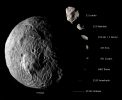
060-Vesta_and_Friends-PIA14316.jpg4-Vesta and "Friends"...88 visiteCaption NASA:"This composite image shows the comparative sizes of 8 (eight) Asteroids. Up until now, Lutetia, with a diameter of about 81 miles (approx. 130 Km), was the largest Asteroid visited by a Spacecraft.
Vesta, which is also considered a protoplanet because it's a large body that almost became a planet, dwarfs all other small bodies in this image, with its diameter sizing up at approximately 330 miles (about 530 Km)".
MareKromium
(3 voti)
|
|
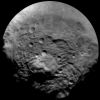
055-Vesta-PIA14315.jpgThe South Pole of 4-Vesta111 visiteCaption NASA:"This image, taken by the framing camera instrument aboard NASA's Dawn Spacecraft, shows the South Polar Region of 4-Vesta, which has a diameter of about 330 miles (approx. 530 Km). The image was taken through the clear filter on July, 9th, 2011, as part of a rotation characterization sequence, and it has a scale of about 2,2 miles (approx. 3,5 Km) per pixel.
To enhance details, the resolution was enlarged to .6 miles (roughly 1 Km) per pixel.
This Region is characterized by rough topography, a large Mountain, Impact Craters, Grooves and steep Scarps. The original image was map-projected, centered at 55°
South Latitude and 210° East Longitude".MareKromium
(3 voti)
|
|

049-Vesta-PIA14124.jpg4-Vesta in Spectrometer View (Visible Light and IR)76 visiteCaption NASA:"On June 8, 2011, the Visible and InfraRed Mapping Spectrometer aboard NASA's Dawn Spacecraft captured the instrument's first images of 4-Vesta that are larger than a few pixels, from a distance of about 218.000 miles (approx. 351.000 Km). The images were taken for calibration purposes.
Images obtained in the Visible part of the light Spectrum, at about 0,55 microns in wavelength, appear on the left. Images obtained in the InfraRed Spectrum, at around 3 microns in wavelength, appear on the right. The spatial resolution of these images is about 60 miles (approx. 90 Km) per pixel.
The Visible and InfraRed mapping spectrometer will be able to provide images of 4-Vesta in 432 wavelengths, which will help scientists determine the basic composition of the Asteroid".MareKromium
(3 voti)
|
|

051-569825main_dawn-image-070111-43_946-710.jpgApproaching 4-Vesta79 visitenessun commentoMareKromium
(3 voti)
|
|

052-569814main_dawn-image-062411-43_946-710.jpgApproaching 4-Vesta72 visitenessun commentoMareKromium
(3 voti)
|
|
| 55 immagini su 5 pagina(e) |
 |
|
4 |
|





