| Piú votate - 1-Ceres and 4-Vesta |

019-Vesta-5-PIA13427.jpg4-Vesta from Hubble Space Telescope104 visiteThe Asteroid 4-Vesta is somewhat like our Moon, with ancient Lava Beds (the dark patches) and powdery Debris (or Regolith), such as the pulverized remains of impacts (the orange-colored areas). A flattened area on one end of 4-Vesta is a giant Impact Crater formed by a collision that perhaps occurred billions of years ago.
The crater is approx. 460 Km (285,66 miles) across, which makes it close to 4-Vesta's roughly 530-Km (329,13-mile) diameter. The asteroid is about the size of Arizona.
4-Vesta is one of the largest of a reservoir of about 100.000 Asteroids, the leftover material from the formation of our Solar System.
Astronomers combined images of Vesta in Near-UltraViolet and blue light to make this picture movie. The Hubble observations were made on Feb. 25 and Feb. 28, 2010.MareKromium
(5 voti)
|
|

007-Ceres-PIA10235.jpg1-Ceres (natural colors, from HST - credits: NASA/ESA et al.)58 visiteCaption NASA:"This is a NASA Hubble Space Telescope color image of 1-Ceres, the largest object in the Asteroid Belt.
Astronomers enhanced the sharpness in these Advanced Camera for Surveys images to bring out features on Ceres' surface, including brighter and darker regions that could be asteroid impact features.
The observations were made in Visible and UV Light between December 2003 and January 2004.
The colors represent the differences between relatively red and blue regions. These differences may simply be due to variation on the surface among different types of material.
Ceres' round shape suggests that its interior is layered like those of terrestrial planets such as Earth. Ceres may have a rocky inner core, an icy mantle, and a thin, dusty outer crust inferred from its density and rotation rate of 9 hours. Ceres is approximately 590 miles (about 950 Km) across and was first discovered in 1801".MareKromium
(5 voti)
|
|

099-DawnTrajectory.jpgThe "Dawn" Mission to 4-Vesta and 1-Ceres57 visiteGerman mathematician Karl F. Gauss calculated from Piazzi's few observations that 1-Ceres circled around the Sun once every 4,6 years or about 4 years, 220 days. The asteroid has a very primitive surface, say scientists on NASA's Dawn mission, which will launch in 2007 and examine 1-Ceres in 2015. The asteroid, like a young planet, contains water-bearing minerals, and possibly a very weak atmosphere and frost. Infrared observations show that the surface is warm.
NASA's HST observed that 1-Ceres' surface has a large spot, which could be a crater formed when another asteroid struck Ceres.
A second explanation may be that the spot is a brighter substance in the asteroid's soil. In July 2001, an object larger than 1-Ceres was found in the vast Kuiper Belt of asteroids, stretching from 30 to 100 AU (2,8 to 9,3 BMs away from the Sun.) This brightest and therefore biggest non-planet space rock, 2001 KX76, could be as big as 1300 Km across.
Per maggiori informazioni sulla Missione "Dawn", visitate il Sito:
http://dawn.jpl.nasa.gov/mission/index.asp
(5 voti)
|
|

016-1-Ceres-Occator-Black_Shadow-01.jpgDark "Spot" inside Occator Crater (CTX Frame)119 visiteMareKromium
(4 voti)
|
|

017-1-Ceres-Occator-Black_Shadow-02.jpgDark "Spot" inside Occator Crater (EDM)136 visiteMareKromium
(4 voti)
|
|

018-1-Ceres-PIA22764.jpgOccator Crater on the Limb...126 visitenessun commentoMareKromium
(4 voti)
|
|

090-Craters-Cornelia_Crater-PIA16489-PCF-LXTT-IPF.jpgCornelia Crater (Absolute Natural Colors; credits for the additional process. and color.: Dr Paolo C. Fienga/Lunar Explorer Italia/Italian Planetary Foundation)110 visiteThis frame shows us a consistent number of examples of long, narrow and sinuous Gullies that scientists on NASA's Dawn Mission have found on the Giant Asteroid 4-Vesta. The Impact Crater shown here is called Cornelia and the Gullies inside it - called "Type-B" Gullies - are different substantially from the straighter, wider, shorter Gullies that Planetary Scientists have found on different Celestial Bodies (like the ones located on the Rims of many Martian Impact Craters, for instance) and which are designated as "Type-A" Gullies (and the reason of such a distinction is found in the circumstance that these two Gully-types have different formation mechanisms). This picture was obtained by the NASA - Dawn Spacecraft Framing Camera on January 11, 2012; North is up.
This frame (which is an Original NASA - Dawn Spacecraft b/w image published on the NASA - Planetary Photojournal with the ID n. PIA 16489) has been additionally processed and then colorized, according to an informed speculation carried out by Dr Paolo C. Fienga (LXTT-IPF), in Absolute Natural Colors (such as the colors that a human eye would actually perceive if someone were onboard the NASA - Dawn Spacecraft and then looked outside, towards the Surface of the Giant Asteroid 4-Vesta), by using an original technique created - and, in time, dramatically improved - by the Lunar Explorer Italia Team. Different colors, as well as different shades of the same color, mean, among others, the existence of different Elements present on the Surface of 4-Vesta, each having a different Albedo (---> Reflectivity) and Chemical Composition.MareKromium
(4 voti)
|
|

089-Craters-Licinia_Crater-PIA16050-PCF-LXTT-IPF.jpgLicinia Crater (Absolute Natural Colors; credits for the additional process. and color.: Dr Paolo C. Fienga/Lunar Explorer Italia/Italian Planetary Foundation)70 visiteThis NASA - Dawn Spacecraft Framing Camera (FC) image of 4-Vesta shows Licinia Crater, which is the large Impact Crater positioned in the center of the picture. Licinia Crater has a fresh, sharp Rim that is scalloped in shape; all around the Inner Walls of Licinia Crater there are many Streaks of Dark and Bright Dusty Material cascading towards the Crater's center. There are also many hummocky Slumps of Material around the Crater's Walls and Base. A large Mound of Material (most likely made of small Rocks and Dust) is well visible in the Crater's center, and the Mound itself is surrounded by more smooth and dark unidentified Material. The possibility that such (as of yet, we repeat, unidentified) smooth Material visible on 4-Vesta's Surface might be the so-called "Impact Melt" is currently under investigation. Licinia Crater is one of the freshest Impact Craters that can be seen in this image.
This area visible here is located in the "Floronia Quadrangle" of 4-Vesta, in the Northern Hemisphere of the Giant Asteroid. The NASA - Dawn Spacecraft obtained this image with its Framing Camera (FC) on October 11, 2011. The image was taken through the Camera's Clear Filter and the distance of the Spacecraft from the Surface of 4-Vesta was, at the time that the picture was taken, of approx. 700 Km (such as a little less than 435 miles); the image has a resolution of about 63 meters (207 feet) per pixel. This picture of Licinia Crater was acquired during the HAMO (---> High-Altitude Mapping Orbit) phase of the mission.
This frame (which is an Original NASA - Dawn Spacecraft b/w image published on the NASA - Planetary Photojournal with the ID n. PIA 16050) has been additionally processed and then colorized, according to an informed speculation carried out by Dr Paolo C. Fienga (LXTT-IPF), in Absolute Natural Colors (such as the colors that a human eye would actually perceive if someone were onboard the NASA - Dawn Spacecraft and then looked outside, towards the Giant Asteroid 4-Vesta), by using an original technique created - and, in time, dramatically improved - by the Lunar Explorer Italia Team. Different colors, as well as different shades of the same color, mean, among others, the existence of different Elements present on the Surface of 4-Vesta, each having a different Albedo (---> Reflectivity) and Chemical Composition.MareKromium
(4 voti)
|
|
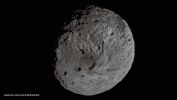
068-Vesta-South_Pole_Dawn_3840.jpgFeatures of 4-Vesta: South Pole and South Polar Regions (Absolute Natural Colors; credits for the additional process. and color.: Dr Paolo C. Fienga - Lunexit Team)230 visitenessun commentoMareKromium
(4 voti)
|
|
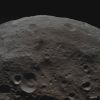
067-Vesta-PIA14694-1.jpgFeatures of 4-Vesta: Dark Material on Hilltops (Absolute Natural Colors; credits for the additional process. and color.: Dr Paolo C. Fienga - Lunexit Team) 131 visiteCaption NASA:"NASA's Dawn Spacecraft obtained this image with its framing camera on Aug. 18, 2011. This image was taken through the framing camera's clear filter aboard the Spacecraft. The image has a resolution of about 260 mts per pixel".
MareKromium
(4 voti)
|
|
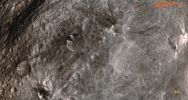
066-Vesta-PIA14324-PCF-LXTT.jpgBizarre-looking Surface Feature of 4-Vesta (Natural Colors; credits for the additional process. and color.: Dr Paolo C. Fienga - Lunar Explorer Italia) 177 visitenessun commentoMareKromium
(4 voti)
|
|

008-Ceres-Dumas_300-PCF-LXTT.jpg1-Ceres from Keck Observatory107 visitenessun commentoMareKromium
(4 voti)
|
|
| 55 immagini su 5 pagina(e) |
 |
3 | |
|





