| Piú votate - Mars Reconnaissance Orbiter (MRO) |

PSP_005409_1530_RED_abrowse-01.jpgUnnamed Southern Crater with Central Peak (EDM - Enhanced Natural Colors; credits for the additional process. and color.: Dr Paolo C. Fienga - Lunexit Team)104 visitenessun commentoMareKromium
(3 voti)
|
|

PSP_006133_1410_RED_abrowse-PCF-LXTT.jpgComplex "Folded Terrain" in Hellas Planitia (Absolute Natural Colors; credits for the additional process. and color.: Dr Paolo C. Fienga - Lunexit Team)111 visitenessun commentoMareKromium
(3 voti)
|
|

PSP_001552_1410_RED_abrowse-02.jpgFrost Covered Gullies in Terra Sirenum (CTX Frame + EDM - Absolute Natural Colors; credits: Dr Paolo C. Fienga - Lunexit Team) 88 visitePSP_001552_1410 shows Gullies in a Unnamed Crater located in Terra Sirenum (Southern Hemisphere of Mars).
This image was acquired during the Winter, which explains the abundant frost (the bright material) seen throughout the image. The frost is likely water frost, as opposed to CO2, because temperatures at this latitude probably do not get cold enough for Carbon Dioxide to condense.
The formation mechanism of Gullies is much debated. Several theories support erosion by liquid water, while others favor dry debris flows or Carbon Dioxide. A major unknown is, if the Gullies are formed by liquid water, does the water originate from the Surface or Subsurface?
Also interesting about this scene is the fact that the Gullies occur at multiple elevations along the same Crater Wall. This is uncommon on Mars. Gullies, whether or not they are found in conjunction with an obvious horizontal layer, usually form at the same elevation on a given slope. It is unknown what caused these Gullies to form at multiple elevations. Their locations are suggestive of a distributed water source, which also favors a Surface, rather than a confined Subsurface origin of water, such as an Aquifer.
Acquisition Date: November, 25th, 2006
Mars Local Time (M.L.T.): 15:40 (Middle Afternoon)
Latitude (centered): 38,9° South
Longitude (East): 195,9 °
Range to Target Site (or Spacecraft Altitude as to the pictured area): 250,5 Km (such as approx. 156,6 miles)
Original Image Scale Range: 50,1 cm/pixel (with 2 x 2 binning) so objects ~150 cm across are resolved
Map Projected Scale: 50 cm/pixel and North is up
Map projection: EQUIRECTANGULAR
Emission Angle: 2,4°
Phase Angle: 76,9°
Solar Incidence Angle: 75° (with the Sun about 15° above the Local Horizon)
Solar Longitude: 140,6° (Northern Summer)MareKromium
(3 voti)
|
|

PSP_004988_1085_RED_abrowse-00.jpgSouth Presso-Polar Pit Gullies (CTX Frame - Absolute Natural Colors; credits for the additional process. and color.: Dr Paolo C. Fienga - Lunexit Team)89 visiteThis observation shows partial views of two high latitude Pits. These Polar Pits contain Gullies, small-scale Slope Features that are proposed to require some amount of liquid water to form.
Several of the Gullies have multiple Channels and Debris-Aprons from numerous Flows that occurred throughout time. Many of the Gullies are seen to originate at a Boulder-Layer at the Pit Edges. This layer is deteriorating and releasing Boulders that can be seen rolling down the Pit Walls. The bright material near the Pit Edges is probably Seasonal Frost. MareKromium
(3 voti)
|
|

PSP_004988_1085_RED_abrowse-01.jpgSouth Presso-Polar Pit Gullies (EDM - Absolute Natural Colors; credits for the additional process. and color.: Dr Paolo C. Fienga - Lunexit Team)87 visiteWhat is particularly interesting about these Gullies is that some might be forming (see this EDM, approx. 800 meters across, of the South-facing Gullies in the bottom Pit). The Gullies on this Wall have incised Alcoves, but only a few have well-developed Channels.
This could be a Region of current Gully formation. Aiding this hypothesis is the fact that there are a couple of depressions between the visible Gullies, suggestive of a developing Gully where water and/or material removed from under the Surface caused the overlying ground to collapse. It is also possible that water originating on the Surface is carving out these depressions, although it is difficult to melt water ice at the temperatures found in this particular location.MareKromium
(3 voti)
|
|
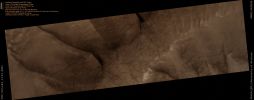
PSP_005383_1255_RED_abrowse-00.jpgDunefield with DD Tracks inside Russel Crater (Absolute Natural Colors; credits for the additional process. and color.: Dr Paolo C. Fienga - Lunexit Team)70 visiteDust Devils make dark, diffuse scribble markings on the Surface by kicking up Dust and are especially active in the Summertime over Dark Surfaces, such as those with many deposits of sand-sized material.
The Surface warms up in the Sunlight, creating the right conditions to form Dust Devils. Mars also has larger dust storms that can deposit a thin layer of Dust and eliminate the Dust Devil Tracks. MareKromium
(3 voti)
|
|
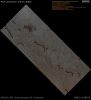
PSP_005095_0935_RED_abrowse.jpgSouth Polar Residual Cap (Absolute Natural Colors; credits for the additional process. and color.: Dr Paolo C. Fienga - Lunexit Team)76 visitenessun commentoMareKromium
(3 voti)
|
|
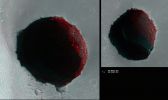
PSP_003317_1975_and_ESP_003317_1975-EB-LXTT-02.jpgThe "OO Pits" - Rimless Collapse Pits in Tharsis (High-Def-3D; credits for the additional process.: Elisabetta Bonora - Lunexit Team)132 visitenessun commentoMareKromium
(3 voti)
|
|
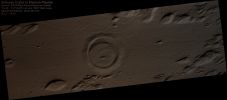
PSP_003398_1910_RED_browse-PCF-LXTT.jpgUnnamed Crater in Elysium Planitia (Absolute Natural Colors; credits for the additional process. and color.: Dr Paolo C. Fienga - Lunexit Team)105 visitenessun commentoMareKromium
(3 voti)
|
|
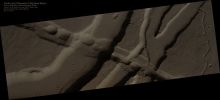
PSP_003426_2035_RED_abrowse-PCF-LXTT.jpgFaults and Channels in Elysium Mons (Absolute Natural Colors; credits for the additional process. and color.: Dr Paolo C. Fienga - Lunexit Team)111 visitenessun commentoMareKromium
(3 voti)
|
|
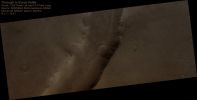
PSP_003273_1675_RED_browse-PCF-LXTT.jpgThrough in Evros Vallis (Absolute Natural Colors; credits for the additional process. and color.: Dr Paolo C. Fienga - Lunexit Team)106 visitenessun commentoMareKromium
(3 voti)
|
|
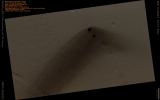
PSP_003317_1975_and_ESP_003317_1975-EB-LXTT-00.jpgThe "OO Pits" - Rimless Collapse Pits in Tharsis (CTX Frame - Absolute Natural Colors; credits for the additional process.: Dr Paolo C. Fienga - Lunexit Team)123 visitenessun commentoMareKromium
(3 voti)
|
|
| 2235 immagini su 187 pagina(e) |
 |
|
|
|
|
98 | |
|
|
|
|





