| Piú votate - Mars Reconnaissance Orbiter (MRO) |
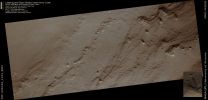
PSP_006569_1915_RED_abrowse-00-PCF-LXTT.jpgFeatures of Henry Crater (Absolute Natural Colors; credits for the additional process. and color.: Dr Paolo C. Fienga - Lunexit Team)88 visiteNamed after a 19th Century French Astronomer, Henry Crater is an about 165 Km (approx. 103 mile) diameter Impact Crater, located in Arabia Terra, on a portion of the Martian Highlands extending into the Northern Hemisphere. This observation shows multiple Layers on the Edge of a Mound on the Floor of the Crater, which is distinct from others in the immediate vicinity.
The Layers represent the eroded remains of Sedimentary Rocks that formed from Sediments deposited within the Crater sometime after its formation. The origin of the Sediments on the Crater Floor in not known but may be windblown Dust and Sand.
The Layers exhibit differences in degrees of hardness and resistance to erosion with resistant Layers forming Cliffs and more easily eroded Layers forming Ledges.
Inset: Several Dark Streaks are visible on the Slopes. Slope Streak formation is among the few known processes currently active on Mars. Streaks are believed to form by downslope movement of Dust in an almost fluid-like manner (analogous to a terrestrial Snow Avalanche) either exposing darker underlying material or creating a darker surface by increasing its roughness. MareKromium
(3 voti)
|
|
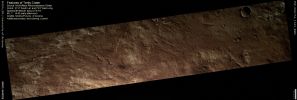
PSP_006752_1525_RED_abrowse-PCF-LXTT2.jpgFeatures of Terby Crater (Absolute Natural Colors; credits for the additional process. and color.: Dr Paolo C. Fienga - Lunexit Team)87 visitenessun commentoMareKromium
(3 voti)
|
|
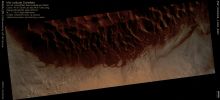
PSP_006648_1300_RED_abrowse-00-PCF-LXTT.jpgSouthern Dunefield (Absolute Natural Colors; credits: Dr Paolo C. Fienga - Lunexit Team)74 visiteSeen here is the Eastern Edge of a Dunefield located in a large, degraded crater in the Southern Hemisphere.
Similar to other Dunes on Mars, these Dunes are dark-toned and contain Gullies. Gullies are features found on Slopes and Dunes in the Mid-Latitudes of both Hemispheres. Both Slope and Dune Gullies were initially suggested to be a result of liquid water from the Surface or Subsurface. Slope and Dune Gullies usually have different morphologies: Dune Gullies are more linear and have Levees bordering their Channels. They typically have no distinguishable, or very small, Alcove and Debris Aprons.
Slope gullies, on the other hand, often have deeply incised Alcoves and Channels that exhibit fluvial characteristics such as Streamlined Islands.
What is highly unusual about this Dunefield is that one of its Gullies has the morphology of a "Slope Gully! (approx. 3 Km across)! This Dune Gully has a very incised Alcove, what appears to be Streamlined Islands on the Channel Floor, and a large, and "feathery" Debris Apron.MareKromium
(3 voti)
|
|
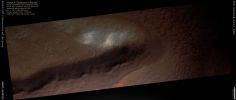
PSP_006648_2255_RED_abrowse-PCF-LXTT.jpgScarps in Deuteronilus Mensae (Absolute Natural Colors; credits for the additional process. and color.: Dr Paolo C. Fienga - Lunexit Team:)81 visiteThis image shows Scarps (such as "Steep Slopes") in Deuteronilus Mensae, a Region of distinctive Terrain in the Northern Hemisphere of Mars. Polygonal fractures, possibly formed by thermal cycles in ice-rich ground, are visible throughout the scene.
The high-standing topography at the top of the Scarps have several muted circles: these are Remnant Impact Craters that have degraded throughout time and their degradation process might have been enhanced by the presence of ground ice.
The two Scarps have different morphologies: the lower (East-facing) side has a Debris Apron with a wave-like texture at its base.
This is suggestive of material that has moved down the Scarp and gradually flowed away from it. Such a process would be expected if the material were ice-rich. There is no counterpart of this feature at the base of the upper (such as the West-facing) side.MareKromium
(3 voti)
|
|
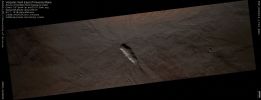
PSP_006653_1795_RED_abrowse-PCF-LXTT.jpgVolcanic Vent, East of Pavonis Mons (Absolute Natural Colors; credits for the additional process. and color.: Dr Paolo C. Fienga - Lunexit) 86 visiteThis image shows an Equatorial Volcanic Vent. A Volcanic Vent is an opening in the Crust of a Planet that emits Lava (such as "molten rock") and Volcanic Gases. The rough texture of the Plains surrounding the Vent is indicative of Lava.
There is a large number of snake-like features emanating from the Vent. The parallel lines that outline the features are "Levees", which mark the edges of Channels that carried molten Lava. As Lava flows, it moves slowest at its edges and bottom because the Lava sticks to the non-flowing rocks; as a consequence of this event, the lava slows down, cools off and, in the end, it hardens.
Levees, on their side, form when the sides of the Lava Flow harden but the center of it keeps moving. As the eruption episode ends, and the Lava drains, the center is left lower than the sides producing these high-standing structures.MareKromium
(3 voti)
|
|
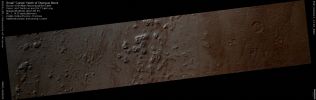
PSP_006667_2150_RED_abrowse-00-PCF-LXTT.jpgSmall "Cones", North of Olympus Mons (Absolute Natural Colors; credits for the additional process. and color.: Dr Paolo C. Fienga - Lunexit) 85 visiteOlympus Mons is the largest Volcano in the Solar System and is thought to have been active in the relatively recent past (which on Mars means many millions of years ago). While this towering giant gets a lot of the attention, it is surrounded by a vast field of other Volcanic Features. This HiRISE image takes a close look at one set of intriguing landforms: small Cones.
Cones similar to these are found atop the freshest Lava Flows on Mars in Athabasca Valles. In that location, HiRISE found proof that they formed by steam exploding through the Lava Flow. The steam was produced by boiling water (or ice) in the ground underneath the Lava Flow. Could the same thing have happened here?
Unfortunately, HiRISE finds that this area north of Olympus Mons is covered in a thick layer of Dust. While the wonderful resolution of HiRISE reveals details of the Ripples in the Dust, it cannot show us what is underneath the Dust. Therefore we cannot prove that these Cones formed the same was as the Athabasca Valles ones.
They could be small Volcanic Vents, but it is unlikely that so many small eruptions would have taken place so close together.
However, since we cannot show that the ground under the Dust is actually Lava, we cannot rule out non-volcanic processes. Still, the similarity in the shapes and sizes of these Cones to the ones in Athabasca Valles leaves open the possibility that Water and Lava interacted explosively here.MareKromium
(3 voti)
|
|

PSP_005387_1935_RED_abrowse-00-PCF-LXTT.jpg"Sinuous" Collapse Pits on Ascraeus Mons (Absolute Natural Colors; credits for the additional process. and color.: Dr Paolo C. Fienga - Lunexit Team)77 visitenessun commentoMareKromium
(3 voti)
|
|
PSP_005109_1770_RED_browse-PCF-LXTT.jpgPeri-Equatorial Canyon and Winstreak (Absolute Natural Colors; credits for the additional process. and color.: Dr Paolo C. Fienga - Lunexit Team) 98 visitenessun commentoMareKromium
(3 voti)
|
|

PSP_003921_1690_RED_browse-PCF-LXTT.jpgProposed MSL Landing Site in Eos Chasma (Natural Colors; credits for the additional process. and color.: Dr Paolo C. Fienga - Lunexit Team) 142 visitenessun commentoMareKromium
(3 voti)
|
|

ESP_020319_1470_RED_abrowse-PCF-LXTT.jpgIce-rich Lobate Debris-Aprons in Terra Promethei (Absolute Natural Colors; credits for the additional process. and color.: Dr Paolo C. Fienga - Lunexit Team)168 visiteThis image shows a portion of a Lobate "Debris-Apron! along the bottom of a Hill in the Promethei Terra Region of Mars. This Region contains many such Mesas surrounded by Lobate Debris-Aprons that are thought to be ice-rich.
These Aprons have been interpreted as a variety of possible features including Rock Glaciers, ice-rich Mass Movements, or Debris-covered Glacial Flows. Recent radar data have shown them to be composed of nearly 100% pure ice.
Parallel Grooves and Ridges indicate the direction of flow.
Both the Debris-Apron and the Plains beyond it are blanketed with an ice-rich Mantle that is common throughout the Martian Mid-Latitudes. The Mantle Deposits are pitted and grooved perhaps due to the sublimation of ice. This Mantle is thought to have been deposited as snow around 10 million years ago during a period of high obliquity, when the Planet's Axis was more tilted and environmental conditions could have been more conducive to snowfall in these Regions.
Several small Impact Craters are visible on the Plains that appear to have been filled with Mantling Deposits that have subsequently been partially removed. These Craters give us clues to the erosional history of the Deposit.MareKromium
(3 voti)
|
|

ESP_020323_2050_RED_abrowse-PCF-LXTT.jpgFan-shaped Deposit (Absolute Natural Colors; credits for the additional process. and color.: Dr Paolo C. Fienga - Lunexit Team:)118 visiteThis HiRISE image shows a Fan-shaped Deposit at the distal end of a Valley. The Fan is approximately 3,5x3,7 Km in size. While other similar Fans on Mars display stair-step terracing along their edges, this particular Fan does not show any Terraces. There is a Valley, instead, that appears to be the source of material that now composes much of the Fan.
Martian Fans are thought to be either Alluvial or Deltaic in origin.
On Earth, Alluvial Fans form when material upslope is eroded and transported by water down a confined Valley until reaching a flatter, broader surface downslope where the material is deposited to produce a Fan-shaped Surface Feature .
Deltaic Fans, on the other hand, form when rivers transport sediment downstream until an unconfined and flatter surface is reached under water, at which time the sediment is deposited in a Fan-shape.
Whether the Martian Fan formed by Alluvial or Deltaic processes in unknown, but both processes require a fluid (most likely water) that carved the Valley and transported the sediment downstream.MareKromium
(3 voti)
|
|

PSP_005409_1530_RED_abrowse-00.jpgUnnamed Southern Crater with Central Peak (CTX Frame - Enhanced Natural Colors; credits for the additional process. and color.: Dr Paolo C. Fienga - Lunexit Team)117 visitenessun commentoMareKromium
(3 voti)
|
|
| 2235 immagini su 187 pagina(e) |
 |
|
|
|
|
97 | |
|
|
|
|





