| Piú votate - Mars Reconnaissance Orbiter (MRO) |

ESP_020822_2220_RED_abrowse.jpgFlow-like Features inside Moreux Crater (Absolute Natural Colors; credits for the additional process. and color.: Dr Paolo C. Fienga - Lunexit Team)196 visitenessun commentoMareKromium
(3 voti)
|
|

ESP_020955_1785_RED_abrowse-PCF-LXTT.jpgRidges inside Schiaparelli Crater (Natural Colors; credits for the additional process. and color.: Dr Paolo C. Fienga - Lunexit Team)469 visitenessun commentoMareKromium
(3 voti)
|
|

ESP_020956_1955_RED_abrowse-PCF-LXTT.jpgYardangs inside Trouvelot Crater (Natural Colors; credits for the additional process. and color.: Dr Paolo C. Fienga - Lunexit Team)595 visitenessun commentoMareKromium
(3 voti)
|
|

ESP_020954_0935_RED_abrowse-PCF-LXTT.jpgSouth Polar "Spiders" (Absolute Natural Colors; credits: Dr Paolo C. Fienga - Lunexit Team)435 visitenessun commentoMareKromium
(3 voti)
|
|

ESP_020924_1455_RED_abrowse.jpgTriple (Simultaneous) Impact (Absolute Natural Colors; credits for the additional process. and color.: Dr Paolo C. Fienga - Lunexit Team)590 visitenessun commentoMareKromium
(3 voti)
|
|

ESP_020793_1935_RED_abrowse-PCF-LXTT.jpgElliptical Impact Crater or Crater Chain? (Natural Colors; credits for the additional process. and color.: Dr Paolo C. Fienga - Lunexit Team)318 visiteCaption NASA:"This image shows what appears to be a highly Elliptical Crater, which would be unusual. Closer examination reveals that it is probably two overlapping Craters that formed concurrently, plus several smaller Craters aligned with the Long Axis of the elliptical depression.
This type of "Crater Chain" can form from a highly oblique impact, in which the Impactor (Bolide) trajectory is almost parallel to the Surface".MareKromium
(3 voti)
|
|
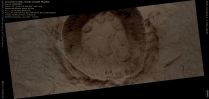
ESP_014412_1780_RED_abrowse.jpgUnnamed Crater with Deep Gullies (Absolute Natural Colors; credits for the additional process. and color.: Dr Paolo C. Fienga - Lunexit Team)253 visitenessun commentoMareKromium
(3 voti)
|
|
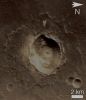
Craters-Unnamed_Crater-Arabia_Terra-1.jpgMartian "Love" (EDM - Absolute Natural Colors; credits for the additional process. and color.: Dr Paolo C. Fienga - Lunexit Team)95 visiteis picture of a "heart-shaped" feature in Arabia Terra on Mars was taken on May 23, 2010, by the Context Camera (CTX) on NASA's Mars Reconnaissance Orbiter. A small Impact Crater near the tip of the heart is responsible for the formation of the bright, heart-shaped feature. When the impact occurred, darker material on the Surface was blown away while brighter material beneath it was revealed.
Some of this brighter material appears to have flowed further downslope to form the heart, as the small impact occurred on the Ejecta Blanket of a much larger Impact Crater.
The heart-shaped feature is about 1 Km (0,6 mile) long and is centered at 21,9° North Lat. and 12,7° West Long.
These pictures are subframes of the full CTX image B21_017910_2002_XI_20N012W, taken just at the start of Northern Summer on Mars. North is to the right, and illumination is from the upper right.MareKromium
(3 voti)
|
|

Craters-Unnamed_Crater-Arabia_Terra-2.jpgMartian "Love" (EDM - Absolute Natural Colors; credits for the additional process. and color.: Dr Paolo C. Fienga - Lunexit Team)101 visiteThis picture of a "heart-shaped" feature in Arabia Terra on Mars was taken on May 23, 2010, by the Context Camera (CTX) on NASA's Mars Reconnaissance Orbiter. A small Impact Crater near the tip of the heart is responsible for the formation of the bright, heart-shaped feature. When the impact occurred, darker material on the Surface was blown away while brighter material beneath it was revealed.
Some of this brighter material appears to have flowed further downslope to form the heart, as the small impact occurred on the Ejecta Blanket of a much larger Impact Crater.
The heart-shaped feature is about 1 Km (0,6 mile) long and is centered at 21,9° North Lat. and 12,7° West Long.
These pictures are subframes of the full CTX image B21_017910_2002_XI_20N012W, taken just at the start of northern summer on Mars. North is to the right, and illumination is from the upper right.MareKromium
(3 voti)
|
|

ESP_020842_2030_RED_abrowse-00-PCF-LXTT.jpgFresh Primary Crater on a Secondary Craters' Cluster (Absolute Natural Colors; credits for the additional process. and color.: Dr Paolo C. Fienga - Lunexit Team:)86 visitenessun commentoMareKromium
(3 voti)
|
|
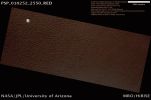
PSP_010252_2550_RED-PCF-LXTT.jpgSmall Snow-filled Depression in Vastitas Borealis (Absolute Natural Colors; credits for the additional process. and color.: Dr Paolo C. Fienga - Lunexit Team)67 visitenessun commentoMareKromium
(3 voti)
|
|

PSP_005658_1760_RED_abrowse-00-PCF-LXTT.jpgWinslow Crater (CTX Frame - Absolute Natural Colors; credits for the additional process. and color.: Dr Paolo C. Fienga - Lunexit Team)72 visitenessun commentoMareKromium
(3 voti)
|
|
| 2235 immagini su 187 pagina(e) |
 |
|
|
|
|
95 | |
|
|
|
|





