| Piú votate - Mars Reconnaissance Orbiter (MRO) |

PSP_003239_1870_RED_browse-01-PCF-LXTT.jpgSlope Streaks on Collapse Pits (EDM - Absolute Natural Colors; credits: Dr Paolo C. Fienga - Lunexit Team)372 visitenessun commentoMareKromium
(3 voti)
|
|
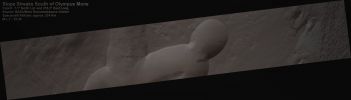
PSP_003239_1870_RED_browse-00-PCF-LXTT.jpgSlope Streaks on Collapse Pits (CTX Frame - Absolute Natural Colors; credits: Dr Paolo C. Fienga - Lunexit Team)363 visitenessun commentoMareKromium
(3 voti)
|
|
Psp_001700_2505_red-01.jpgLauth Crater and the Frozen "Pseudo-Lake" of Vastitas Borealis (CTX Frame - Absolute Natural Colors; credits for the additional process. and color.: Dr Paolo C. Fienga - Lunexit Team)296 visiteThis EDM shows the Dunes and Frost boundary up-close. The Frost is largely absent over the Dunes and is more stable over the Ground that does not have Dune-shaped Landforms.MareKromium
(3 voti)
|
|

ESP_021569_1650-PCF-LXTT.jpgOver the Columbia Hills (Absolute Natural Colors; credits: Dr Paolo C. Fienga - Lunexit Team)310 visiteAcquisition date: 04 March 2011
Mars Local Time (M.L.T.): 15:11 (Early Afternoon)
Latitude (centered): 14,6° South
Longitude (East): 175,6°
Spacecraft Altitude: approx. 264 Km (163,944 miles)
Original Image Scale Range: 26,4 cm/pixel (with 1 x 1 binning) so objects ~79 cm across are resolved
Map Projected Scale: 25 cm/pixel and North is up
Map Projection: EQUIRECTANGULAR
Emission Angle: 2,9°
Sun-Surface-Spacecraft Angle (i.e.: Phase Angle): 48,7°
Solar Incidence Angle (S.I.A.): 46°, with the Sun about 44° above the Local Horizon
Solar Longitude: 247,7° - Northern AutumnMareKromium
(3 voti)
|
|
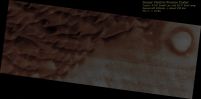
Psp_002455_1320_red-PCF-LXTT.jpgDunes in Proctor Crater (Absolute Natural Colors; credits for the additional process. and color.: Dr Paolo C. Fienga - Lunexit Team)118 visiteThis image shows the edge of a Dark Dunefield on the Floor of Proctor Crater, an approx. 150 Km diameter Impact Crater located in the Southern Highlands of Mars.
Many smaller and brighter "Bed-Forms", most likely small dunes or Granule Ripples, cover the substrate between the larger Dark Dunes as well as most of the Floor of Proctor Crater. In many locations, large (Erratic) Boulders are seen on the same surfaces as the bright Bed-Forms.
The Dark Dunes stratigraphically overlie the small bright Bed-Forms, indicating that the Dark Dunes formed more recently. However in several areas, the Dark Dunes appear to influence the orientation of the small Bright Dunes, possibly by wind flowing around the larger ones, suggesting that both Dark and Bright Bed-Forms are coeval.MareKromium
(3 voti)
|
|
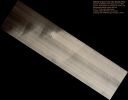
PSP_004980_1035_RED_browse-00~0.jpgUnnamed "Ghost" Crater near the South Pole (CTX Frame - Absolute Natural Colors; credits for the additional process. and color.: Dr Paolo C. Fienga - Lunexit) 156 visiteThis HiRISE image shows a Circular Structure near the South Pole of Mars. This feature is probably a heavily modified Impact Crater. It is currently expressed as a group of concentric circular features with little vertical expression.
This feature was probably once an Impact Crater many tens of meters deep. (Small impact craters are typically about 1/5th as deep as they are wide).
The original topography has been smoothed by some combination of burial and viscous relaxation. Most burial processes will preferentially fill in low areas like craters; the infilling material may then compact, producing arcuate structures. MareKromium
(3 voti)
|
|
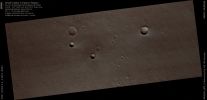
PSP_008213_1965_red-abrowse-PCF-LXTT.jpgSmall Craters in Elysium Planitia (Absolute Natural Colors; credits for the additional process. and color.: Dr Paolo C. Fienga - Lunexit Team)143 visitenessun commentoMareKromium
(3 voti)
|
|

ESP_020888_0935_RED_abrowse.jpgSouth Polar Fans (Absolute Natural Colors; credits for the additional process. and color.: Dr Paolo C. Fienga - Lunexit Team)281 visitenessun commentoMareKromium
(3 voti)
|
|

ESP_020875_0980_RED_abrowse-PCF-LXTT.jpgSouth Polar "Pseudo-Trees" (Absolute Natural Colors; credits for the additional process. and color.: Dr Paolo C. Fienga - Lunexit Team)319 visitenessun commentoMareKromium
(3 voti)
|
|

ESP_021536_1780_00-PCF-LXTT.jpgSanta Maria Crater and "Oppy" (Absolute Natural Colors; credits: Dr Paolo C. Fienga - Lunexit Team)253 visitenessun commentoMareKromium
(3 voti)
|
|

ESP_019727_1930_RED_abrowse-01-PCF-LXTT.jpgSigns of possible "Mass Wasting" (EDM - Natural Colors; credits for the additional process. and color.: Dr Paolo C. Fienga - Lunexit Team)186 visitenessun commentoMareKromium
(3 voti)
|
|

ESP_015900_1465_RED_abrowse-02-PCF-LXTT.jpgUnnamed Southern Crater with Gullies, Rolling Boulders and Dunes (EDM n. 2 - Absolute Natural Colors; credits for the additional process. and color.: Dr Paolo C. Fienga - Lunexit Team)367 visiteCaption NASA:"This image shows a nice example of different types of Dunes in close proximity to each other: North is at roughly 03:00 in this EDM.
On either side of the Mound - which is located on the Southern End of the Crater Floor - there are different types of Dunes. On the Southern side of the mound (left side of the EDM), there are "Star Dunes" (named for the Star-like Intersections of their Crests). These types of Dunes are usually formed when the wind blows in multiple directions.
On the Northern side of the Mound (the right when looking at the EDM), there are simpler Dune shapes, forming roughly straight, parallel lines. Notice that the same side of each Dune is steeper. These are called Linear Dunes, and are formed by wind blowing mainly parallel to the direction of their Crests, probably with some variation to one side or the other that causes the asymmetrical Slopes. The Linear Dunes transition to the Star Dunes near the Mound.
Since the main factor controlling which type of Dunes are formed is the (Dominant) Winds' Direction, there must have been different Wind Directions in this area (for instance, it is very likely that significant whirlpools were caused by the wind blowing around the Mound or also when they interacted with the nearby Crater Wall).MareKromium
(3 voti)
|
|
| 2235 immagini su 187 pagina(e) |
 |
|
|
|
|
94 | |
|
|
|
|





