| Piú votate - Mars Reconnaissance Orbiter (MRO) |
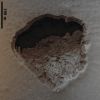
PSP_005414_1735_RED_abrowse-PCF-LXTT-01.jpgPit Chain on Arsia Mons - "Annie" (EDM - Absolute Natural Colors; credits for the additional process. and color.: Dr Paolo C. Fienga - Lunexit Team)196 visiteCaption NASA:"This small Pit located in the middle of the Chain was discovered by a team of scientists from the U.S. Geological Survey and Arizona State University using data from the THEMIS camera onboard the Mars Odyssey Spacecraft during a search for possible Cave Entrances. They informally named this pit "Annie".
A section of the HiRISE image over "Annie" has been specially processed to enhance the contrast in the shadowed areas. This shows that the Pit is is largely filled with wind blown materials. Shadow measurements indicate that the Floor is about 112 meters (367 feet) below the Rim".MareKromium
(3 voti)
|
|
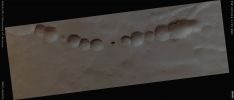
PSP_005414_1735_RED_abrowse-PCF-LXTT-00.jpgPit Chain on Arsia Mons (CTX Frame - Absolute Natural Colors; credits for the additional process. and color.: Dr Paolo C. Fienga - Lunexit Team)154 visiteCaption NASA:"The Chain of Collapse Pits visible in this image formed by collapse as the giant Shield Volcano, Arsia Mons, was pulled apart. While Magma intruding into the Volcano might have pushed the rocks aside, it is also possible that the collapse is caused by the volcano falling apart underneath its own weight.
Acquisition date: September, 22nd, 2007
M.L.T.: 14:14 (Early Afternoon)
Latitude (centered): 6,5° South
Longitude (East): 240,0°
Spacecraft Altitude: 252,4 Km
Original Image Scale Range: 25,3 cm/pixel (with 1 x 1 binning) so objects ~76 cm across are resolved
Map Projected Scale: 25 cm/pixel and North is up
Map Projection: EQUIRECTANGULAR
Emission Angle: 3,9°
Sun-Mars-Spacecraft (Phase) Angle: 38,1°
S.I.A.: 34°, with the Sun about 56° above the Local Horizon
Solar Longitude: 318,2° (Northern Winter)MareKromium
(3 voti)
|
|
ESP_023076_1890_RED_abrowse-PCF-LXTT.jpgDunefield on the Floor of Nili Patera (Absolute Natural Colors; credits for the additional process. and color.: Dr Paolo C. Fienga - Lunexit Team)237 visitenessun commentoMareKromium
(3 voti)
|
|
ESP_023080_0945_RED_abrowse-PCF-LXTT.jpgSouth Polar "Swiss-Cheese Surface Features" (Natural Colors; credits for the additional process. and color.: Dr Paolo C. Fienga - Lunar Explorer Italia)193 visitenessun commentoMareKromium
(3 voti)
|
|

PSP_008301_2480_RED_abrowse-PCF-LXTT-01.jpgPolygons in Vastitas Borealis (EDM - Absolute Natural Colors; credits for the additional process. and color: Dr Paolo C. Fienga - Lunexit Team)135 visitenessun commentoMareKromium
(3 voti)
|
|

ESP_023234_1460_RED_abrowse-PCF-LXTT-01.jpgThe "Colourful" Floor of Hellas Planitia (EDM - Absolute Natural Colors; credits for the additional process. and color.: Dr Paolo C. Fienga - Lunar Explorer Italia)197 visitenessun commentoMareKromium
(3 voti)
|
|

ESP_022472_1285_RED_abrowse-PCF-LXTT.jpgUnnamed Southern Crater with "Blooming" Gully (Absolute Natural Colors; credits for the additional process. and color.: Dr Paolo C. Fienga - Lunexit Team)216 visiteCaption NASA:"This observation shows Mid-Latitude-Type Gullies as well as dark and light materials. Brown/orange Dunes in this Unnamed Crater can also be seen (East of the Gully Aprons). One of the more stunning features is the Gully formation right outside the center swath of the full image.
At HiRISE resolution, we can examine whether there has been activity in the Gullies that post-dates the placement of windblown materials, like Boulders down the Slopes. We can also gather information to help determine the processes responsible for Gully formation".
Acquisition Date: May, 13th, 2011
Mars Local Time (M.L.T.): 14:33 (Early Afternoon)
Latitude (centered): 51,3° South
Longitude (East): 6,8°
Range to Target Site (Spacecraft Altitude): 254,7 Km (159,2 miles)
Original Image Scale Range: 51 cm/pixel (with 2 x 2 binning) so objects of ~1 meter and 53 cm across are resolved
Map Projected Scale: 50 cm/pixel and North is up
Map Projection: EQUIRECTANGULAR
Emission Angle: 8,4°
Sun-Mars-MRO (or "Phase") Angle: 47,8°
Solar Incidence Angle: 41° (with the Sun about 49° above the Local Horizon)MareKromium
(3 voti)
|
|
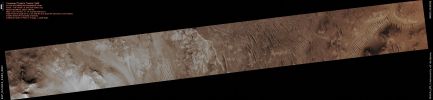
ESP_023024_1685_RED_abrowse-PCF-LXTT-00.jpgUplifted Rocks in Crater Center (CTX Frame - Absolute Natural Colors; credits for the additional process. and color.: Dr Paolo C. Fienga - Lunexit Team)180 visiteCaption NASA:"Impacts forming Craters excavate holes deep into the ground, exposing rocks from far below the present Surface. At the center of large Craters, rocks from still further below can be uplifted, rebounding upwards during the last stages of Crater formation. This image shows the Central Peak of a large Impact Crater located in the Southern Highlands of Mars".MareKromium
(3 voti)
|
|

ESP_023024_1685_RED_abrowse-PCF-LXTT-01.jpgUplifted Rocks in Crater Center (EDM - Absolute Natural Colors; credits for the additional process. and color.: Dr Paolo C. Fienga - Lunexit Team)179 visiteCaption NASA:"This EDM reveals varied colors, suggesting that a range of rock types are present. Studies of these rocks from far below the Surface help us to understand ancient Mars as well as the processes that have altered the rocks after they formed and were buried".MareKromium
(3 voti)
|
|

Craters-Gale_Crater-PIA14307-PCF-LXTT.jpgCemented Fractures in the Mountain inside Gale Crater (Absolute Natural Colors; credits for the additional process. and color.: Dr Paolo C. Fienga - Lunexit Team)137 visiteOne type of feature of scientific interest on the mountain inside Gale Crater is exposure of Cemented Fractures, evidence that groundwater once reached to at least that height of the Mountain.
This image of that part of the mountain, taken by the High Resolution Imaging Science Experiment camera on NASA's Mars Reconnaissance Orbiter, shows symmetry in how material on one side of each fracture is balanced by material on the other side. This pattern indicates that mineral-saturated groundwater once filled the fractures. The water deposited minerals on both sides of the opening, eventually filling the gap.MareKromium
(3 voti)
|
|
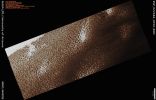
ESP_022684_0950_RED_abrowse-PCF-LXTT.jpgSouth Polar Monitoring (Absolute Natural Colors; credits for the additional process. and color.: Dr Paolo C. Fienga - Lunexit Team)118 visitenessun commentoMareKromium
(3 voti)
|
|
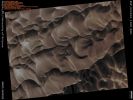
ESP_022616_1300_RED_abrowse.jpgDunefield on the Floor of Matara Crater (Absolute Natural Colors; credits for the additional process. and color.: Dr Paolo C. Fienga - Lunexit Team)126 visitenessun commentoMareKromium
(3 voti)
|
|
| 2235 immagini su 187 pagina(e) |
 |
|
|
|
|
90 | |
|
|
|
|





