| Piú votate - Mars Reconnaissance Orbiter (MRO) |

PSP_005456_1650_RED_abrowse-01.jpgHome Plate from Orbit (EDM; Natural Colors - elab. Lunexit)62 visiteIl MER Spirit è indicato da una Freccia Rossa (Red Arrow), ad approx. ore 05:30 di Home Plate (la struttura più chiara, posta sul lato Dx del frame ed in posizione mediana).MareKromium
(7 voti)
|
|
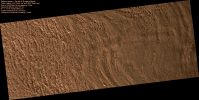
PSP_003639_1345_RED_browse-00.jpgDebris Apron South of Euripus Mons (context image - possible natural colors; elab. Lunexit)54 visiteEuripus Mons is located to the east of Hellas impact basin in the southern mid-latitudes of Mars.
The overall wavy, curved surface pattern of this debris apron suggests that material flowed out from the isolated flat-top ridge. This mass movement of debris probably involved ice flow (possibly forming rock glaciers) and potentially liquid water.MareKromium
(7 voti)
|
|

PSP_005155_1030_RED_browse.jpgExposure of South Polar Layered Deposits54 visiteA complex geologic history is on display in this image of the South Polar Layered Deposits. These layered deposits are a mixture of dust and water-ice. Each layer is thought to record information about the state of the Martian climate at the time of its deposition.
The original stack of layered ice has eroded to produce a scarp that exposes the internal layers. Smooth material was then deposited to cover this scarp before being in turn eroded. Deposition on top of an eroded surface like this produces what geologists call an "unconformity in the stratigraphic record". Remnants of this smooth material can be seen on the left of the image and draping the layered scarp near the image center.
Although it looks, at first glance, like this material has flowed down the scarp, that is unlikely to have happened. The extremely cold temperatures at the Martian Poles mean that ice in general does not flow like we see it do here on Earth. There are also no indications of some of the geomorphologic features that flowing ice typically acquires (such as crevasses, compressional ridges or moraines).
MareKromium
(7 voti)
|
|

TRA_000827_1875_RED_browse-2.jpgCerberus' River (Extremely Saturated Natural Colors; credits for the additional process. and color.: Dr Gianluigi Barca - Lunexit Team)59 visitenessun commentoMareKromium
(7 voti)
|
|

Psp_001503_2180_red-01.jpgTricks of the Light, Tricks of the Surface... (extra-detail mgnf - 2)60 visitenessun commento
(7 voti)
|
|

Psp_001697_1390_red.jpgUnnamed (and yet beautiful) Crater with Gullies in Terra Sirenum57 visiteThis image shows part of an unnamed crater, itself located inside the much larger Newton Crater, in Terra Sirenum. This unnamed crater is approx. 7 Km in diameter (over 4 miles) and some 700 mt (about 760 yards) deep.
Numerous gully systems are visible on the East- and South-facing walls of the crater; their characteristics are astonishingly diverse, though.
These troughs are extremely rectilinear, lack tributaries and do not seem to have terminal fan deposits: they terminate rather abruptly, some of them in a spatula-like shape. Their characteristics contrast sharply with those of gully systems elsewhere in this same crater, which are sinuous, have numerous tributaries and show distinct fan deposits.
HiRISE is unveiling the large diversity exhibited by Martian Gully Systems, thanks to its HR, stereo and color capabilities. These diverse types of gullies observed may have been produced by different mechanisms. Current leading hypotheses explaining the origin of gullies include erosion from seepage or eruption of water from a subsurface aquifer, melting of ground ice, or surface snow; and dry landslides. MareKromium
(7 voti)
|
|

Psp_001700_2505_red-01.jpgThe "Frozen Lake" of Vastitas Borealis...is not a Lake, according to NASA (EDM - Enhanced Natural Colors; credits for the additional process. and color.: Dr Paolo C. Fienga - Lunexit Team)56 visiteThis EDM shows the Dunes and Frost boundary up-close. The Frost is largely absent over the Dunes and is more stable over the ground that does not have dune-shaped landforms.
(7 voti)
|
|

Psp_001497_2480_red-01.jpgThe Northern Lakes: Lake "Ginny" (EDM - False Colors)54 visiteEd una volta operato un extra-detail mgnf a noi pare che non ci possano essere più dubbi di sorta: sul fondo di questo Cratere c'è un deposito di ghiaccio (l'albedo del ghiaccio d'acqua non tradisce!) e quindi, come già fatto in passato, possiamo parlare tranquillamente di Frozen Lake.
E poi, dato che NASA ed ESA non vedono (e se hanno visto, non hanno detto nulla), noi, in qualità di "scopritori" di questo Terzo Lago Marziano, abbiamo deciso di battezzarlo con il nome di "Lake Ginny".
Attenzione: noi lo sappiamo che la IAU non approverà mai queste nostre decisioni nè avallerà mai queste nostre scoperte (almeno non finchè saremo vivi...).
Tuttavia, se in un futuro (lontano) ci verrà resa un pò di giustizia, forse qualcuno dei nomi che abbiamo dato ad alcuni rilievi Lunari e Marziani che, tutto sommato ed a ragion veduta, riteniamo legittimamente di aver individuato per primi, potrebbe anche essere confermato. E nel dubbio, operando con entusiasmo e con il cuore pieno di speranza...Noi "battezziamo"!MareKromium
(7 voti)
|
|

Chasma_Boreale-PSP_001374_2650_RED.jpgChasma Boreale (False Colors)111 visitenessun commentoMareKromium
(7 voti)
|
|

Coprates_Labes_Canyon-Tra_000849_1675_red~1.jpgUnusual Landforms or...Something more?!?161 visiteUn ottimo lavoro di osservazione ed estrapolazione realizzato dal nostro caro Amico e Socio Lorenzo Leone ci riporta ad una (ormai) annosa e vexata questione: alcuni rilievi di Marte, nella loro "stranezza", restano rilievi naturali o si tratta di remnants di strutture artificiali?
Voi, cari Amici, la nostra posizione la conoscete; ma per questa volta - e diremmo con buona ragione - ci piace citare Lorenzo:"...Prendendo in esame una delle ultime immagini pubblicate, Coprates Labes, mi sono voluto divertire analizzandola nel tentativo di catturare le forme più strane (e sicuramente più fantasiose), ma di sicuro interesse.
Le immagini parlano da sole: abbiamo 2 possibili piramidi ed un "fortino".
Un gioco di luci ombre, aiutato da oggetti particolari, ma fantasticare e analizzare non nuoce certamente.
Ed è certo che Marte, almeno per me, riesce sempre a stupire...".
E noi condividiamo al 100%!MareKromium
(7 voti)
|
|

Chasma_Boreale-Psp_001412_2650_red-01.jpgChasma Boreale: the Martian "Pentagon" and other unusual surface features (2)134 visiteMareKromium
(7 voti)
|
|
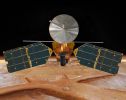
00-MRO-front-view_br~0.jpgHere is the "Mars Reconnaisance Orbiter"108 visiteThis artist's concept of the Mars Reconnaissance Orbiter features the spacecraft's main bus facing down, toward the red planet. The large silver circular feature above the spacecraft bus is the high-gain antenna, the spacecraft's main means of communicating with both Earth and other spacecraft. The long, thin pole behind the bus is the SHARAD antenna. Seeking liquid or frozen water, SHARAD will probe the subsurface using radar waves at a 15-25 MHz frequency band, "seeing" in the first few hundreds of feet (up to 1 kilometer) of Mars' crust. The large instrument (covered in black thermal blanketing) in the center is the HiRISE camera. This powerful camera will provide the highest-resolution images from orbit to date.
The other easily visible instruments are: the Electra telecommunications package which is the gold-colored instrument directly left of the HiRISE camera. It will act as a communications relay and navigation aid for Mars spacecraft. To the right of the HiRISE camera is the Context Imager (CTX).
(7 voti)
|
|
| 2235 immagini su 187 pagina(e) |
 |
|
|
|
|
9 | |
|
|
|
|





