| |

| Piú votate - Mars Reconnaissance Orbiter (MRO) |

PSP_008927_2010_RED-00.jpgPossible MSL Landing Site in Nili Fossae Trough (natural colors; credits: Lunexit)56 visiteNili Fossae Trough is a linear trough about 25 Km wide, formed in response to the creation of the Isidis Basin.
Nili Fossae has diverse deposits, some containing Phyllosilicates (Clay Deposits which typically form in the presence of water), and others with the minerals Olivine and Pyroxene.
This image is part of a series covering the 25 km Landing Ellipse; they are used to determine the safest possible Landing Site for the Mars Science Laboratory Rover. In this frame, relatively smooth rock exposures is visible, as well as sand ripples and some small knobs. There are few large rocks in the area, while the surface seems to be mostly flat, fractured rock.
This landscape is located in the South-Eastern part of the Landing Ellipse.MareKromium
(7 voti)
|
|

PIA10139-FansField~0.jpgFans Field (MULTISPECTRUM; credits: Lunexit)57 visiteAt the very beginning of Spring in the Southern Hemisphere on Mars the ground is covered with a seasonal layer of CO2 ice.
In this image there are 2 lanes of undisturbed ice bordered by 2 lanes peppered with Fans of dark dust.
When we zoom in to the image, we see that the Fans are seen to be pointed in the same direction, dust carried along by the prevailing wind. The Fans seem to emanate from spider-like features.
Image Data: the image is centered at -86,4° Latitude and 99,1° East Long.
The range to the target site was 276,1 Km (about 172,6 miles). At this distance the image scale is 55,2 cm/pixel (with 2x2 binning) so objects ~166 cm across are resolved.
The image was taken at 16:27 MLT (middle afternoon), with the Sun just 2° above the Local Horizon. MareKromium
(7 voti)
|
|

PIA10140-DarkFans~0.jpgBright Streaks and Dark Fans (MULTISPECTRUM; credits: Lunexit)55 visiteIn a Region of the South Pole known informally as "Ithaca", numerous Fans of dark frost form every Spring. HiRISE collected a time lapse series of these images, starting at Ls = 185 and culminating at Ls = 294. "Ls" is the way we measure time on Mars: at Ls = 180 the Sun passes the Equator on its way South; at Ls = 270 it reaches its maximum subsolar latitude and Summer begins.
We believe that the bright streaks are fine frost condensed from the gas exiting the vent. The conditions must be just right for the bright frost to condense. MareKromium
(7 voti)
|
|
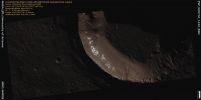
PSP_008792_1410_RED_abrowse.jpgLight-Toned Layers in Crater Wall (MULTISPECTRUM; credits: Lunexit)56 visiteThis approximately 8 Kilometer-diameter Impact Crater is interesting because of the light-toned band visible in the upper slopes of the Inner Crater Wall.
Because the light-toned materials are confined to a distinct elevation within the Crater, it is possible that it represents a well-defined Layer exposed in the Crater Walls.MareKromium
(7 voti)
|
|

PSP_008778_1685_RED_abrowse.jpgMistery Mounds (MULTISPECTRUM; credits: Lunexit)55 visiteThis image was targeted because a previous MGS-MOC image (R1100035) showed an distinctive field of Mounds on the floor of an ancient, large, filled-in Unnamed Crater.
The origin of the Mounds was unclear, so we hoped that a HiRISE image with higher resolution and color would solve the mystery. The HiRISE image shows much more detail on the Mounds and other rough textures, indicating that this is an eroded bedrock surface, perhaps exposed by removal of an overlying layer of fine-grained materials by the wind.
But how did the rocks form, and why did they erode onto Mounds? It could have been lava or impact ejecta or fluvial sediments, perhaps altered and indurated by groundwater.
The Mounds could be due to how it was deposited — like hummocky Impact Ejecta — or how it was indurated. In other words, we haven't solved the mystery!...
Yet we may get new clues from future images of similar terrains in places where the origin is more interpretable, or from other datasets such as the mineral content determined by CRISM.MareKromium
(7 voti)
|
|

PSP_006769_1595_RED_abrowse.jpgSouthern Highlands Panorama (Enhanced Natural Colors; credits: Lunexit)55 visiteThis image shows a portion of the Southern Highlands cut by Arda Valles, an ancient Valley Network.
The Valley Network is degraded as seen by the lack of obvious walls and a V-shaped bottom. The valley networks are thought to have formed by running liquid water on the surface of Mars billions of years ago, with a few being active more recently.
Arda Valles has many dunes within it and craters on top of it, which show that is has been around for long enough for craters to form. The surface that Arda Valles cuts is more cratered than the valley surface because wind has moved material into the valley throughout time such that the surface in the valley gets covered and past craters might be buried there.MareKromium
(7 voti)
|
|

PSP_007805_2505_RED_abrowse-01.jpgThe "Frozen Lake" of Vastitas Borealis, alias Louth Crater (extra-detail mgnf - MULTISPECTRUM; credits: Lunexit)65 visiteThis extra-detail mgnf shows a comparison of these dunes acquired in late Northern Summer (see PSP_001700_2505, top) with the newer image. It is hard to believe this is the same piece of ground because the brightness patterns are so different due to the large temperature changes throughout the year.
Nota Lunexit: dunque il famoso "Lago di Ghiaccio" - situato all'interno di un cratere senza nome il quale venne individuato nella Regione Nordica di Vastitas Borealis dalla Sonda ESA "Mars Express" - non è un lago, ed il cratere "senza nome" è, in realtà, il Cratere "Louth". Ora, se ci consentite una piccolissima ironia (naturalmente corredata da elementi fattuali), vorremmo dire che il modo in cui ESA e NASA si comportano, alle volte, è davvero "bizzarro" (tanto per usare un eufemismo...).
Andate a leggerVi (o a "rileggerVi", se volete) quello che l'ESA scrisse riguardo questo Cratere. Noi, tanto per semplificare, Vi riportiamo il tutto qui di seguito e Voi, se non vi fidate (un Vostro sacrosanto Diritto) e volete verificare di persona, andate qui: http://www.esa.int/SPECIALS/Mars_Express/SEMGKA808BE_1.html
Caption ESA:"The HRSC on ESA's Mars Express obtained this perspective view on 2 February 2005 during orbit 1343 with a ground resolution of approximately 15 metres per pixel. It shows an unnamed impact crater located on Vastitas Borealis, a broad plain that covers much of Mars's far Northern Latitudes, at approximately 70,5° North and 103° East.
The crater is 35 Km wide and has a maximum depth of approximately 2 Km beneath the crater rim. The circular patch of bright material located at the centre of the crater is residual water ice.
The colours are very close to natural, but the vertical relief is exaggerated three times. The view is looking East.
Credits: ESA/DLR/FU Berlin (G. Neukum)".
Allora: dato e premesso che si sta parlando SENZA OMBRA DI DUBBIO del medesimo rilievo, vorremmo un pò capire come mai il "cratere senza nome" è diventato "Louth Crater".
E da quando?
E' intervenuta la IAU per battezzarlo?
O si tratta di un nome convenzionale adottato dalla NASA ma non ufficiale? Mistero.
L'ESA aveva battezzato questo rilievo come "Lago Ghiacciato" ed ora si scopre che l'unica cosa ghiacciata (rectius: ricoperta di semplice brina gelata) è il "mound" (dosso) che caratterizza solo un versante del cratere. Il "residual water ice" di cui parlava il Dr Neukumm dell'ESA - osservando il "fondo" del cratere - è "sparito" e la NASA, infatti, non lo menziona neppure (anzi! Semmai la NASA avanza l'ipotesi/suggerisce che, oltre ad un minimo di ghiaccio d'acqua, il "grosso" della componente ghiacciata che si vede sul "dosso" imbiancato che giace posizionato sul fondo del cratere, sia semplicemente "frozen CO2").
Volete la nostra ipotesi? Ne abbiamo due, a dire il vero.
Prima Ipotesi: la "scoperta" dell'ESA non era una scoperta reale. Le immagini MRO hanno pesantemente ridimensionato il fenomeno del presunto Lago Ghiacciato (il quale si è rivelato essere un cratere con un pò di brina su alcune porzioni del suo fondo) ed i Signori della NASA, tanto per non dare espressamente degli incompetenti a coloro che formano lo STAFF Scientifico che cura le imprese della Sonda Mars Express (in generale) ed al Dr Neukumm (in particolare), "fanno finta di nulla" e commentano questo rilievo ignorando (diremmo "per cortesia professionale") la circostanza per cui esso era stato già ampiamente trattato e discusso dai loro Colleghi Europei in ben altri termini.
Morale: la NASA, ivi, per "salvare la faccia" ai Colleghi dell'ESA, commenta "asetticamente" ed ignora il passato.
Seconda Ipotesi: la scoperta del Lago Ghiacciato di Vastitas da parte dell'ESA è una scoperta "vera" a tutti gli effetti ed apre scenari i quali non piacciono all'establishment della NASA. L'ESA viene invitata a non pronunciarsi ulteriormente sulla questione del Lago (o DEI LAGHI!) di Vastitas Borealis e la NASA, piano piano, accantona il fenomeno e quindi lo "cancella" dall'Immaginario Collettivo con queste recenti immagini le quali, effettivamente, mostrano un cratere con, al suo interno, un dosso ricoperto di brina persistente e nulla di più.
Morale: la Scienza "Ufficiale" dice che su Marte NON CI SONO ACQUE SUPERFICIALI e quindi, anche davanti ad una o più evidenze del contrario, bisogna ribadire il "Dogma" per il quale su Marte NON ESISTONO ACQUE SUPERFICIALI, nè liquide, nè ghiacciate.
E' sin troppo semplice immaginare che qualcuno, leggendo l'ipotesi 2, ci bollerà come "Complottisti" e poi, leggendo l'Ipotesi 1, dedurrà che NASA ed ESA lavorano "in sintonia" e che l'una integra, completa e, se necessario, corregge il lavoro dell'altra.
Certo, piacerebbe anche a noi che fosse così.
Ma così non è. Basta leggere (e rileggere) gli articoli ORGINALI ESA e NASA su questo Lago/Non Lago di Ghiaccio/Non Ghiaccio per capire che il "flusso informativo" non è stato nè limpido, nè coerente. E comunque sia, ci piacerebbe sapere chi e quando ha battezzato il Cratere "Senza Nome" in Cratere "Louth".
Ed in conclusione, se questo è il modo - non diciamo di "fare Scienza" ma, se non altro - di fare "Divulgazione" adottato dalla NASA in questo momento storico...Beh, allora noi possiamo solo darVi un suggerimento: studiate ed interpretate tutto DA SOLI. Magari, di quando in quando ed orà più, ora meno, prenderete (come accade a noi) "Lucciole per Lanterne" ma, se non altro, non diventerete mai dei semplici "recettori passivi" del modo (distorto) di Divulgare il Sapere adottato dalla più grande e famosa Agenzia Spaziale del Mondo (che noi ammiriamo sempre tanto ma, stavolta, un pò meno del solito...).
Amen.
p.s.: abbiamo reperito un cospicuo quantitativo di abstracts sul "presunto ghiaccio" di Louth Crater (ATTENZIONE: nome ancora NON ufficiale!) e, anzichè schiarirci le idee, adesso le abbiamo ancora più confuse...
Ma ne verremo fuori, come ovvio, e quindi pubblicheremo un articolo su questo rilievo davvero MOLTO intrigante e, incidentalmente, spenderemo qualche parola sul "modo schizofrenico" di "Fare Scienza" adottato in questo momento storico.MareKromium
(7 voti)
|
|

PSP_005574_1720_RED_abrowse-01.jpgLayers and Slope-Streaks within Valleys along the Highland-Lowland Boundary (extra-detail mgnf - MULTISPECTRUM; credits: Lunexit)56 visiteSlope Streak formation is among the few known processes currently active on Mars. Since the Slope Streaks in this image appear to superpose (lie on top of) the surfaces between individual dunes, the Streaks most likely formed more recently and are younger than the dunes.
Many hypotheses have been proposed for the formation of Slope Streaks including dry avalanching, geochemical weathering, liquid stains or flows, and moisture wickering.
Recent observations from HiRISE images have revealed that the dark interior of Slope Streaks is lower in elevation than the surroundings, suggesting that material must have been removed in the formation of the streak.MareKromium
(7 voti)
|
|

PSP_006528_1120_RED_abrowse-01.jpgSources of Basaltic Sand (extra-detail mgnf n. 1; MULTISPECTRUM - credits: Lunexit)63 visiteThis image was targeted at a point in Mitchell Crater in the Southern Highlands of Mars where sands abruptly appear and spread North.
The sands seem to derive from the edge of an eroding mesa (shown here with an arrow; 8,66 Km, or about 5,4 miles across).
A close-up view of the terrain nearby (see the extra-detail mgnf n. 2) suggests that boulders and sand have been excavated by erosion from beneath brighter, polygonally fractured ground (1,45 Km, or about 0,9 mi across). MareKromium
(7 voti)
|
|

PSP_006528_1120_RED_abrowse-02.jpgSources of Basaltic Sand (extra-detail mgnf n. 2; MULTISPECTRUM - credits: Lunexit)54 visiteThis rocky layer may originally have been a lava flow; Martian lava flows are predominantly composed of basalt, which would account for the dark color of the sand.
The polygonal pattern of the bright upper layer may be due to repeated freezing and thawing of the soil that buries the lava flow. The tracks of Dust-Devils are clearly visible on the smooth, sandy surface but largely vanish when they cross into the polygonally fractured terrain.MareKromium
(7 voti)
|
|

PSP_005418_1075_RED_abrowse-01.jpgDistorted Layers in the SPLD (extra-detail mgnf - MULTISPECTRUM; credits: Lunexit)54 visiteThis enhanced image (1,2 Km or 0.7 miles across) shows a section of the South Polar Layered Deposits, which are an accumulation of layers consisting mostly of water ice and dust. Perhaps their closest analog on Earth would be the Ice Caps of Greenland and Antarctica.
This image is particularly interesting because the layers are not flat-lying but rather appear "wavy" (---> ondeggianti).
This appearance could partly be an “illusion” due to erosion after the flat-lying layers were deposited. In that case, the wavy appearance is due to the fact that the layer edges are wavy, going into and out of the plane of the outcrop exposing the layers.
Alternatively, this waviness could be due to deformation of the layers folding caused by flow of the ice.
Here, the flow probably occurred long ago since current temperatures are too low to allow the ice to flow at a significant rate.MareKromium
(7 voti)
|
|

Phobos_Deimos-PIA10117.jpgCRISM Views Phobos and Deimos56 visiteThese 2 images taken by the Compact Reconnaissance Imaging Spectrometer for Mars (CRISM) show Mars' 2 small moons, Phobos and Deimos, as seen from the MRO's low orbit around Mars. Both images were taken while the spacecraft was over Mars' night side, with the spacecraft turned off its normal nadir-viewing geometry to glimpse the moons. The image of Phobos, shown at the top, was taken at 01:19 UTC on October 23, 2007 (19:19 EDT on Oct. 22), and shows features as small as 400 mt (1320 feet) across. The image of Deimos, shown at the bottom, was taken at 20:16 UTC (00:16 EDT) on June 7, 2007, and shows features as small as 1,3 Km (0,8 miles) across.
Both CRISM images were taken in 544 colors covering 0.36-3.92 micrometers and are displayed at twice the size in the original data for viewing purposes.
Phobos and Deimos are about 21 and 12 Km (13,0 and 7,5 miles) in diameter and orbit Mars with periods of 7 hours, 39,2 minutes and 1 day, 6 hours, 17,9 minutes respectively. Because Phobos orbits Mars in a shorter time than Mars' 24 hour, 37.4-minute rotational period, to an observer on Mars' surface it would appear to rise in the West and set in the East. From Mars' surface, Phobos appears about one-third the diameter of the Moon from Earth, whereas Deimos appears as a bright star. The moons were discovered in 1877 by the astronomer Asaph Hall, and as satellites of a planet named for the Roman God of War, they were named for Greek mythological figures that personify fear and terror.
The first spacecraft measurements of Phobos and Deimos, from the Mariner 9 and Viking Orbiter spacecraft, showed that both moons have dark surfaces reflecting only 5 to 7% of the sunlight that falls on them. The first reconstruction of the moons' spectrum of reflected sunlight was a difficult compilation from 3 different instruments, and appeared to show a flat, grayish spectrum resembling carbonaceous chondrite meteorites. Carbonaceous chondrites are primitive carbon-containing materials thought to originate in the outer part of the Asteroid Belt. This led to a commonly held view among planetary scientists that Mars' moons are primitive asteroids captured into Martian orbit early in the Planet's history. More recent measurements have shown that the moons are in fact relatively red in their color, and resemble even more primitive D-type asteroids in the outer Solar System.
Those ultra-primitive bodies are also thought to contain carbon as well as water ice, but to have experienced even less geochemical processing than many carbonaceous chondrites.
The version of the CRISM images shown here were constructed by displaying 0.90, 0.70, and 0.50 micrometer wavelengths in the red, green, and blue image planes. This is a broader range of colors than is visible to the human eye, but it accentuates color differences. Both moons are shown with colors scaled in the same way.
Deimos is red-colored like most of Phobos. However, Phobos' surface contains a second material, grayer-colored ejecta from a 9-Km (5,6-mile) diameter crater.
This crater, called Stickney, is located at the upper left limb of Phobos and the grayer-colored ejecta extends toward the lower right.
These CRISM measurements are the first spectral measurements to resolve the disk of Deimos, and the first of this part of Phobos to cover the full wavelength range needed to assess the presence of iron-, water-, and carbon-containing minerals.MareKromium
(7 voti)
|
|
| 2235 immagini su 187 pagina(e) |
|
|
|
|
|
8 | |
|
|
|
|
|
|





