| |

| Piú votate - Mars Reconnaissance Orbiter (MRO) |
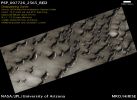
PSP_007726_2565_RED_abrowse-PCF-LXTT-IPF.jpgNorthern Dunes (Absolute Natural Colors; credits for the additional process. and color.: Dr Paolo C. Fienga/Lunar Explorer Italia/Italian Planetary Foundation)110 visiteThis NASA - Mars Reconnaissance Orbiter "HiRISE" image shows a portion of a Dunefield where many large "Barchan" (meaning "Crescent-shaped"), a few "Barchanoid" (meaning a "Non uniformly Crescent-shaped") and some smaller Dome-shaped Sand Dunes can be seen. The Dunefield that contains all these types of Sand Dunes is located in the Northern Regions of Mars and in a specific place where the first significant changes occurring to Sand Dunes was reported on the Red Planet (in the AD 2008). That study made by Dr Bourke (et al.) used a time series of NASA - Mars Global Surveyor (MGS), Mars Orbiter Camera (MOC) images taken over a period of 3 Martian Years (which are equivalent to 6 Earth Years) and showed that 2 (two) approx. 20 meter-wide Dome Dunes disappeared while a third one shrank by an estimated 15%.
Now, the HiRISE image here confirms that the first two Sand Dune studied by Dr Bourke no longer exist but, interestingly, it also suggests that the Sediment removal is still ongoing, since the third Dune has dramatically reduced its volume. On the other hand, it must be noticed and underlined that this "Dune-Changing Process" does not occur in a uniform and generalized way (at least in this specific location), since many of the other large Dunes present in the Dunefield do not show any (apparent/obvious) change; however, more time and some more precise measurements (fit to display evidence of the occurrence of an actual change of the larger Dunes, either in their shape, or their position) are needed in order to achieve a more substantiated conclusion.
In addition to that, we should also consider that it is even possible that the stability of all the other larger Dunes present in the Dunefield might be caused by the circumstance that the Sediment existing inside them is now (let us say "at present time"...) unavailable for removal, due to Induration (meaning that said Sediment became too hard to be blown away by just a simple, even though quite strong sometime, Aeolian Action, but in a future - maybe as a consequence of a dramatic variation in the Surface Temperature of this Region of Mars - its physical conditions could change again, and therefore make it fit to be remodeled, removed or, maybe, totally dispersed).
In the end, the change observed in the small Dome-shaped Dunes indicates, once and for all, that certainly not all Dunes on Mars are effectively and permanently stabilized and immobile, as it was erroneously believed for a long time.
Mars Local Time: 14:10 (Early Afternoon)
Coord. (centered): 76,182° North Lat. and 95,300° East Long.
Spacecraft altitude: 318,0 Km (such as about 198,8 miles)
Original image scale range: 63,6 cm/pixel (with 2 x 2 binning) so objects ~ 1 mt and 91 cm across are resolved
Map projected scale: 50 cm/pixel
Map projection: POLAR STEREOGRAPHIC
Emission Angle: 2,8°
Phase Angle: 62,5°
Solar Incidence Angle: 60° (meaning that the Sun was about 30° above the Local Horizon at the time the picture was taken)
Solar Longitude: 47,6° (Northern Spring- Southern Autumn)
Credits: NASA/JPL/University of Arizona
Additional process. and coloring: Lunar Explorer Italia
This picture (which is a NASA - Original Mars Reconnaissance Orbiter EDM color frame identified by the serial n. PSP_007726_2565) has been additionally processed and then colorized in Absolute Natural Colors (such as the colors that a human eye would actually perceive if someone were onboard the NASA - Mars Reconnaissance Orbiter and then looked down, towards the Surface of Mars), by using an original technique created - and, in time, dramatically improved - by the Lunar Explorer Italia Team.MareKromium
(3 voti)
|
|

Craters-Unnamed_Southern_Impact_Crater_with_colorful_Layers-ESP_028693_1535-CTX-EDM-PCF-LXTT-IPF-1.jpgUnnamed Southern Impact Crater with Colorful Layers (Absolute Natural Colors; credits for the additional process. and color.: Dr Paolo C. Fienga - Lunar Explorer Italia/Italian Planetary Foundation)108 visiteThis image, obtained by the NASA - Mars Reconnaissance Orbiter (HiRISE Camera), shows us a wide portion of a relatively recent (geologically speaking, of course...) Impact Crater, located in the Southern Hemisphere of the Red Planet, and which is about 7 Km wide. Partway down from (but still quite close to) the Crater Rim, there is a prominent bright Layer of Bedrock. The full-resolution color data shows three distinct Bedrock colors: a pale yellow, a light greenish-gray and a very dark blue (almost black, in Absolute Natural Colors). These Layers should reasonably correspond to different types of Rock that, in time, were deposited as nearly flat-lying sheets; nobody can be sure, but - perhaps - this "colorful" Layering is a combination of Lava Flows and Sediments. The relatively blue and dark blue colors visible in the HiRISE InfraRed Color Frame (not shown here and which, in the Absolute Natural Colors' EDM - inset -, appear as greenish-gray and extremely dark blue to almost black) might correspond to Minerals like Olivine and Pyroxene, which can easily be found, among others, in some specific types of Lava.
Mars Local Time: 15:39 (Middle Afternoon)
Coord. (centered): 26,092° South Lat. and 88,942° East Long.
Spacecraft altitude: 257,7 Km (such as about 161,0 miles)
Original image scale range: 51,6 cm/pixel (with 2 x 2 binning) so objects ~ 1 mt and 55 cm across are resolved
Map projected scale: 50 cm/pixel
Map projection: EQUIRECTANGULAR
Emission Angle: 5,0°
Phase Angle: 66,0°
Solar Incidence Angle: 61° (meaning that the Sun was about 29° above the Local Horizon at the time the picture was taken)
Solar Longitude: 168,7° (Northern Summer - Southern Winter)
Credits: NASA/JPL/University of Arizona
Additional process. and coloring: Lunar Explorer Italia
These two pictures (which are a NASA - Original Mars Reconnaissance Orbiter CTX b/w and EDM color frames, both identified by the serial n. ESP_028693_1535) have been additionally processed and then colorized (and re-colorized, respectively) in Absolute Natural Colors (such as the colors that a human eye would actually perceive if someone were onboard the NASA - Mars Reconnaissance Orbiter and then looked down, towards the Surface of Mars), by using an original technique created - and, in time, dramatically improved - by the Lunar Explorer Italia Team.MareKromium
(3 voti)
|
|

ESP_023094_1640_RED_NOMAP_browse-PCF-LXTT-IPF.jpgThe Wall of Coprates Chasma (Absolute Natural Colors; credits for the additional process. and color: Dr Paolo C. Fienga/Lunar Explorer Italia/Italian Planetary Foundation)158 visiteMars Local Time: 14:08 (Early Afternoon)
Coord. (centered): 15,599° South Lat. and 300,540° East Long.
Spacecraft altitude: 258,8 Km (such as about 161,7 miles)
Original image scale range: 51,8 cm/pixel (with 2 x 2 binning) so objects ~ 1 mt and 55 cm across are resolved
Map projected scale: 50 cm/pixel
Map projection: EQUIRECTANGULAR
Emission Angle: 6,9°
Sun - Mars - MRO (or "Phase") Angle: 37,9°
Solar Incidence Angle: 31° (meaning that the Sun is about 59° above the Local Horizon)
Solar Longitude: 320,3° (Northern Winter - Southern Summer)
Credits: NASA/JPL/University of Arizona
Additional process. and coloring: Lunar Explorer Italia/Italian Planetary FoundationMareKromium
(3 voti)
|
|

Craters-Gale_Crater-PIA16148-PCF-LXTT-IPF.jpgCuriosity Traverse Map through Sol 29 (Absolute Natural Colors; credits for the additional process. and color.: Dr Paolo C. Fienga/Lunar Explorer Italia/Italian Planetary Foundation)131 visiteCaption NASA:"This Map shows the route driven by NASA's Mars rover Curiosity through the 29th Martian Day, or Sol, of the Rover's Mission on Mars (such as September 4, 2012). The route starts where the Mars Science Laboratory Spacecraft placed the Rover, a Site subsequently named "Bradbury Landing". The line extending toward the right (---> Eastward) from Bradbury Landing is the Rover's Path. Numbering of the dots along the line indicate the Sol number of each drive. North is up. The scale bar is 200 meters (656 feet).
By Sol 29, Curiosity had driven at total of 358 feet (such as 109 meters). At the location reached by the Sol 29 drive, the Rover began several Soles of Arm Characterization Activities. The "Glenelg Area", which is farther East, is the mission's first Major Science Destination, selected as likely to offer a good target for Curiosity's first analysis of powder collected by drilling into a Rock".MareKromium
(3 voti)
|
|

Craters-Gale_Crater-ESP_028256_9022-EB-MF-LXTT-IPF.jpgFeatures of Gale Crater (Natural Colors; credits for the additional process. and color.: Elisabetta Bonora and Marco Faccin/Lunar Explorer Italia/Italian Planetary Foundation)113 visitenessun commentoMareKromium
(3 voti)
|
|

PSP_001700_2505-PCF-LXTT-IPF-01.jpgLouth Crater (CTX Frame - Absolute Natural Colors; credits for the additional process. and color.: Dr Paolo C. Fienga - Lunexit Team)99 visiteThis observation shows a persistent Frost Patch located on a Mound which is inside Louth Crater. The Frost Patch has remained largely stable at least since the Viking era (such as the late 1970s). The bright Frosty Region is bounded by a Dunefield on the North/East and the so-called "Size Classes" of several of the Features forming the Dunefield probably represent generations of Dunes that were created under a variety of Dominant Wind Conditions. The Frost is largely absent over the Dunes, but it is way more stable on the Ground that does not possess Dune-shaped Landforms.
Mars Local Time: 15:14 (Early Afternoon)
Coord. (centered): 70,377° North Lat. and 103,397° East Long.
Spacecraft altitude: 317,5 Km (such as about 198,4 miles)
Original image scale range: 63,5 cm/pixel (with 2 x 2 binning) so objects ~ 1 mt and 91 cm across are resolved
Map projected scale: 50 cm/pixel
Map projection: POLAR STEREOGRAPHIC
Emission Angle: 9,3°
Sun - Mars - MRO (or "Phase") Angle: 56,1°
Solar Incidence Angle: 64° (meaning that the Sun is about 26° above the Local Horizon)
Solar Longitude: 146,4° (Northern Summer - Southern Winter)
Credits: NASA/JPL/University of Arizona
Additional process. and coloring: Lunar Explorer ItaliaMareKromium
(3 voti)
|
|
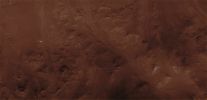
PSP_004277_1530_RED-PCF-LXTT-00.jpgFeatures of Holden Crater's Rim (CTX Frame "A" - Absolute Natural Colors; credits for the additional process. and color.: Dr Paolo C. Fienga - Lunexit Team)68 visiteHiRISE image PSP_004277_1530 covers a portion of the rim of Holden Crater, revealing breaches created when water over-topped the Rim and incised a series of Channels as it flowed down the Crater Wall.
The water responsible for the Channels was impounded outside of the rim of Holden in Uzboi Vallis (Holden Crater itself is approx. 150 Km in diameter).
Uzboi Vallis was interrupted when Holden Crater formed and the Rim formed an effective, temporary damn to flow farther to the North. Once the Uzboi Basin filled, water began flowing into Holden again, creating a series of low fan-shaped Deltas, alluvial deposits and a shallow, but relatively short-lived lake.
The Channels in this image were only active for a short time, as a Channel just to the East cut quickly into the Rim and became responsible for most of the drainage into the Crater.
The fact that most of the fan-shaped Deltas radiate from the Dominant Channel to the East rather than those in this image supports this scenario. MareKromium
(3 voti)
|
|

ESP_024398_1835_RED-PCF-LXTT-01.jpgFeatures of Aram Chaos (EDM - Absolute Natural Colors; credits for the additional process. and color.: Dr Paolo C. Fienga - Lunexit Team)107 visiteMars Local Time: 14:24 (early afternoon)
Coord. (centered): 3,6° North Lat. and 338,8° East Long.
Spacecraft altitude: 273,4 Km (such as about 170,9 miles)
Original image scale range: 54,7 cm/pixel (with 2 x 2 binning) so objects ~ 1 mt and 64 cm across are resolved
Map projected scale: 50 cm/pixel
Map projection: EQUIRECTANGULAR
Emission Angle: 1,3°
Sun - Mars - MRO (or "Phase") Angle: 37,3°
Solar Incidence Angle: 36° (meaning that the Sun is about 54° above the Local Horizon)
Solar Longitude: 13,2° (Northern Spring)
Credits: NASA/JPL/University of Arizona
Additional process. and coloring: Lunar Explorer ItaliaMareKromium
(3 voti)
|
|

ESP_024398_1835_RED-PCF-LXTT-00.jpgFeatures of Aram Chaos (CTX Frame - Absolute Natural Colors; credits for the additional process. and color.: Dr Paolo C. Fienga - Lunexit Team)107 visiteMars Local Time: 14:24 (early afternoon)
Coord. (centered): 3,6° North Lat. and 338,8° East Long.
Spacecraft altitude: 273,4 Km (such as about 170,9 miles)
Original image scale range: 54,7 cm/pixel (with 2 x 2 binning) so objects ~ 1 mt and 64 cm across are resolved
Map projected scale: 50 cm/pixel
Map projection: EQUIRECTANGULAR
Emission Angle: 1,3°
Sun - Mars - MRO (or "Phase") Angle: 37,3°
Solar Incidence Angle: 36° (meaning that the Sun is about 54° above the Local Horizon)
Solar Longitude: 13,2° (Northern Spring)
Credits: NASA/JPL/University of Arizona
Additional process. and coloring: Lunar Explorer ItaliaMareKromium
(3 voti)
|
|

PSP_005011_0885-PCF-LXTT-00.jpgThe "Terra Incognita" (CTX Frame "A" - Absolute Natural Colors; credits for the additional process. and color.: Dr Paolo C. Fienga - Lunexit Team)148 visiteMars Local Time: 21:11 (early evening hours)
Coord. (centered): 88,4° South Lat. and 191,1° East Long.
Spacecraft altitude: 256,6 Km (such as about 160,4 miles)
Original image scale range: 25,7 cm/pixel (with 1 x 1 binning) so objects ~ 77 cm across are resolved
Map projected scale: 25 cm/pixel
Map projection: POLAR STEREOGRAPHIC
Emission Angle: 17,3°
Sun - Mars - MRO (or "Phase") Angle: 80,2°
Solar Incidence Angle: 69° (meaning that the Sun is about 21° above the Local Horizon)
Solar Longitude: 299,8° (Northern Winter)
Credits: NASA/JPL/University of Arizona
Additional process. and coloring: Lunar Explorer ItaliaMareKromium
(3 voti)
|
|

PSP_005011_0885-PCF-LXTT-01.jpgThe "Terra Incognita" (CTX Frame "B" - Absolute Natural Colors; credits for the additional process. and color.: Dr Paolo C. Fienga - Lunexit Team)135 visiteMars Local Time: 21:11 (early evening hours)
Coord. (centered): 88,4° South Lat. and 191,1° East Long.
Spacecraft altitude: 256,6 Km (such as about 160,4 miles)
Original image scale range: 25,7 cm/pixel (with 1 x 1 binning) so objects ~ 77 cm across are resolved
Map projected scale: 25 cm/pixel
Map projection: POLAR STEREOGRAPHIC
Emission Angle: 17,3°
Sun - Mars - MRO (or "Phase") Angle: 80,2°
Solar Incidence Angle: 69° (meaning that the Sun is about 21° above the Local Horizon)
Solar Longitude: 299,8° (Northern Winter)
Credits: NASA/JPL/University of Arizona
Additional process. and coloring: Lunar Explorer ItaliaMareKromium
(3 voti)
|
|

ESP_024872_2175_RED-PCF-LXTT-01.jpgUnnamed Channel in Arabia Terra (EDM - Absolute Natural Colors; credits for the additional process. and color.: Dr Paolo C. Fienga - Lunexit Team)141 visiteMars Local Time: 14:20 (early afternoon)
Coord. (centered): 37,0° North Lat. and 350,6° East Long.
Spacecraft altitude: 318,3 Km (such as about 198,9 miles)
Original image scale range: 63,7 cm/pixel (with 2 x 2 binning) so objects ~ 1 mt and 91 cm across are resolved
Map projected scale: 50 cm/pixel
Map projection: EQUIRECTANGULAR
Emission Angle: 22,4°
Sun - Mars - MRO (or "Phase") Angle: 61,4°
Solar Incidence Angle: 40° (meaning that the Sun is about 50° above the Local Horizon)
Solar Longitude: 30,5° (Northern Spring)
Credits: NASA/JPL/University of Arizona
Additional process. and coloring: Lunar Explorer ItaliaMareKromium
(3 voti)
|
|
| 2235 immagini su 187 pagina(e) |
|
|
|
|
|
79 | |
|
|
|
|
|
|





