| Piú votate - Mars Reconnaissance Orbiter (MRO) |
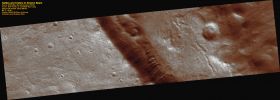
PSP_002620_1410_RED_browse-00.jpgGullies on the edge of Newton Basin (context image)58 visiteThis image shows a portion of two impact craters on the floor of Newton Basin where a smaller crater formed within a earlier larger one.
The larger crater's North rim can be seen diagonally (South-West/North-East) across the image and the smaller crater's north rim is near the right-side of the image.
Along the interior wall of the larger crater, several gullies have incised into the wall of the Crater. MareKromium
(4 voti)
|
|
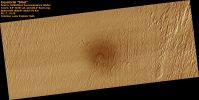
PSP_004030_1855_RED_browse.jpgBlast from the (Very Recent) Past58 visiteIn the center of this image is a very sharp-rimmed impact crater just 35 mt wide.
It lies in a bright, dust-covered region, but is surrounded by a slightly darker spot about 3 Km wide. The impact event created a blast of high winds that disturbed the dust and darkened the spot.
Since dust is constantly settling over the Region, the fact that we can still see the dark region means the impact event occurred of late, perhaps in recent decades. There are many dark streaks on topographic slopes over an even wider region surrounding the dark spot - these could be due to dust avalanches triggered by the impact, either from the air blast or from seismic shaking of the ground.
There are also rays of very small (approx. 1 mt in diameter) secondary craters extending radially outward from the 35-mt crater, created by the impact of rocks ejected from the main crater.
Thus a small impact crater has modified the surface over an area more then 10.000 times greater than that of the crater's interior.MareKromium
(4 voti)
|
|
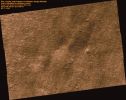
PSP_002202_2250_RED_browse-00.jpgPits, Cracks, and Polygons in Western Utopia Planitia (context image) - Elab. Lunexit57 visiteUtopia Planitia is part of the Great Northern Lowlands of Mars, where there may have been an ancient ocean.
The pits, cracks and polygons in Utopia have been interpreted as due to some combination of temperature variations in ice-rich ground, sublimation of ground ice, and collapse into subsurface voids.
This HiRISE image reveals many new details, including an abundance of boulders about 1 mt in diameter over the entire region (see the extr-detail mgnf).
The infrared color of HiRISE reveals two types of materials: the brighter and yellowish areas are probably dusty and the darker and bluer areas are probably coarser particles--sand and rocks.MareKromium
(4 voti)
|
|

PSP_003234_2210_red.jpgThe "Face" on Mars... (False Colors; credits: NASA/JPL)92 visiteImage PSP_003234_2210 was taken by the High Resolution Imaging Science Experiment (HiRISE) camera onboard the Mars Reconnaissance Orbiter spacecraft on 05-Apr-2007.
The complete image is centered at 40,7° latitude, 350,5° East Longitude. The range to the target site was 299,4 Km (187,1 miles). At this distance the image scale is 29,9 cm/pixel (with 1 x 1 binning) so objects ~90 cm across are resolved.
The image shown here has been map-projected to 25 cm/pixel and north is up.
The image was taken at a local Mars time of 03:28 PM and the scene is illuminated from the West with a solar incidence angle of 73°, thus the Sun was about 17° above the horizon.
At a Solar Longitude of 213,4°, the season on Mars is Northern Autumn.
(4 voti)
|
|

TRA_000825_2665_IRB.jpgNorth Polar Layered Deposits (full image & HR)59 visiteThis image of the north polar layered deposits was taken during the summer season (solar longitude of 113.6 degrees), when carbon dioxide frost had evaporated from the surface. The bright spots seen here are most likely patches of water frost, but the location of the frost patches does not appear to controlled by topography. Layers are visible at the bottom of the image, mostly due to difference in slope between them. The variations in slope are probably caused by differences in the physical properties of the layers. Thinner layers that have previously been observed in these deposits are visible, and may represent annual deposition of water ice and dust that is thought to form the polar layered deposits. These deposits are thought to record global climate variations on Mars, similar to ice ages on Earth. HiRISE images such as this should allow Mars' climate record to be inferred and compared with climate changes on Earth.
(4 voti)
|
|
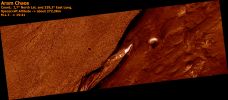
Psp_002839_1825_red.jpgAram Chaos' Sediments (False Colors)59 visiteAram Chaos appears to be a former impact crater. The terrain is disrupted, giving it a chaotic appearance (hence the name "chaos"). Scientists have postulated that a lake may have once existed inside the crater and sediments were laid down within the lake.
The mineral Hematite (rich in Iron) has been detected by orbiting spacecraft within Aram Chaos. Hematite has been identified in several other locations on Mars, including at the MER Landing Site in Meridiani Planum. The Hematite at both Meridiani and Aram Chaos most likely formed by precipitation in water.
This HiRISE image shows the light-toned sediments inside Aram Chaos that could have formed in a former lake. Unfortunately, dark debris now obscures much of this sediment, making it difficult to view and interpret the rocks. The light-toned layered deposit in the south (Dx) of the image is higher standing and has a pitted surface.
Circular structures with dark centers are likely to be impact craters that have been partly filled with dark debris, including sand. More irregular depressions appear to result from erosion of layered beds within the sediments. Wind could erode materials that are slightly weaker more quickly and produce the irregular topography seen along the surface of the deposit.
(4 voti)
|
|

Psp_002419_1675_red-02.jpgFrozen Waterfalls or just Layers and Dark Debris in Melas Chasma?58 visiteThis HiRISE sub-image shows layering in a light-toned deposit in Melas Chasma.
The layers are sedimentary in origin, but there are many processes that could have deposited them, such as volcanic airfall from explosive eruptions, dust-size particles settling out of the atmosphere due to cyclic changes and deposition in standing bodies of water.
By looking at the slopes in the layers and how the layers intersect each other, scientists can rule out various origins. A darker material can be seen covering much of the layered deposit. Some of this dark material is loose and can be seen accumulating as debris aprons at the base of steep slopes. Other dark material appears indurated and has been eroded by the wind to form etched edges with topographic expressions.
The lack of impact craters on the layered deposit indicates that it is a relatively young deposit, or the craters have been removed by the wind, or the deposit was quickly buried and is now being exhumed.MareKromium
(4 voti)
|
|

Craters-Holden_Crater-02.jpgThe beautiful "Holden Crater" (2)59 visitenessun commentoMareKromium
(4 voti)
|
|

Craters-Unnamed_Crater_with_Gullies.jpgGullies, from MRO59 visitenessun commentoMareKromium
(4 voti)
|
|

Juventae_Chasma_12m-02.jpgFeatures of Juventae Chasma (3)57 visitenessun commento
(4 voti)
|
|

TRA_000828_2495_IRB-1.jpgPolygonal Terrain (1)57 visiteA network of shallow surface troughs and fissures coalesce into polygonal patterns that are ubiquitous throughout this image. Polygonal patterned ground of this nature is quite common in permafrost regions of Earth, where seasonal thermal contraction of ice-cemented soil produces a honeycomb network of subsurface cracks. Cracks of this nature can also be produced by desiccation (mud cracks) or lava cooling (columnar joints), though typically on a smaller scale. The diameter of these martian polygons are dominantly 10-20 meters, analogous to terrestrial permafrost. The individual troughs are frequently only a couple of meters or less wide, and easily resolved at HiRISE resolution. Other characteristics, such as small ridges on either side of the troughs and the distribution of rocks in and around each polygon is also readily apparent. Small rocks and occasional larger boulders are also seen scattered throughout the image. Rocks protruding above the surface soil can be seen to cast shadows (solar illumination is from the lower left), which can aid in the determination of the rock's size and height. This image is located near an area under consideration as a landing site for the Mars Scout mission, Phoenix, planned for 2008. Examination of many factors including surface texture (roughness and morphology) and the size distribution of rocks will aid in final landing site selection.
(4 voti)
|
|

Craters-Becquerel_Crater_mound_6m-02.jpgBeautiful Becquerel Crater (3)61 visitenessun commento
(4 voti)
|
|
| 2235 immagini su 187 pagina(e) |
 |
|
|
|
|
76 | |
|
|
|
|





